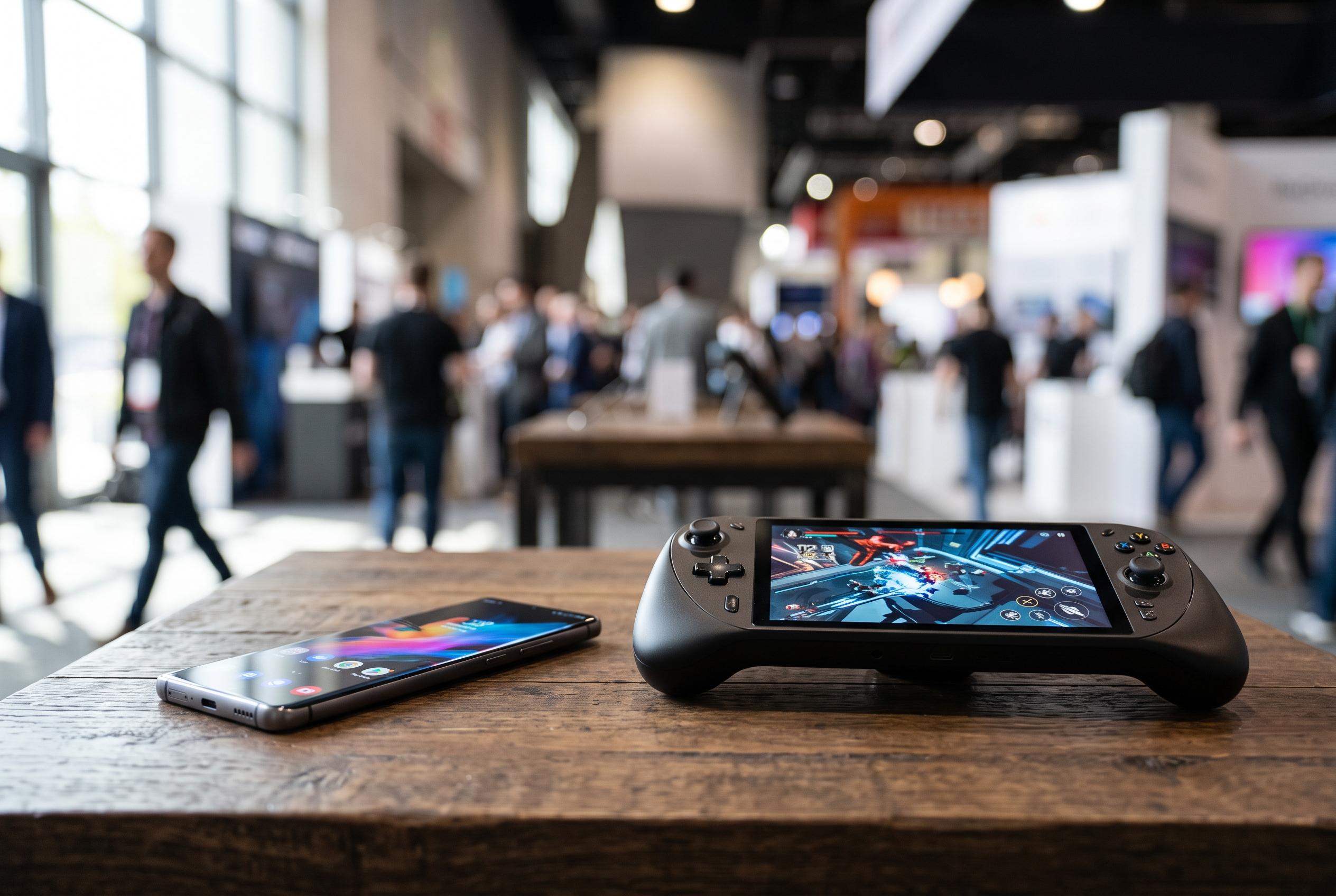

At this year’s IFA in Berlin, manufacturers showcased a series of hardware innovations aimed at reducing everyday frustrations, from bezel-less smartphones to hybrid gaming and working devices, signalling a focus on tangible user experience improvements over raw performance.
This year’s IFA in Berlin was most revealing not for a single blockbuster launch, but for a cluster of products trying to remove the small frustrations that still cling to mature device categories. Tecno tried to erase the last visible strip of black around a phone display, Acer showed a handheld games machine that opens into a miniature laptop, Lenovo used its side event to argue for more expressive PCs, and Ecovacs concentrated on making a robot vacuum clean itself almost as thoroughly as it cleans the floor.
Tecno’s so-called Bezelless concept was the clearest expression of that idea. Android Central reported that the company is claiming a true 0mm display border, meaning the visible black ring around the screen has effectively disappeared. Tecno said “eliminating the bezel required rethinking the smartphone from the inside out”, relying on advanced internal stacking, structural re-engineering and new screen-packing methods rather than merely pushing the glass closer to the edge.
Hands-on reporting from Android Authority suggests the result is more convincing in person than in press images. The outlet said the 6.7-inch, 144Hz handset felt surprisingly light and fairly thin despite carrying a 6,000mAh battery, and reported that the hardware is based on an existing Tecno device using a Dimensity 7300e chip. It also described a dual-layer cover glass design, with the display inserted from the rear so the inactive area can sit under the frame rather than forming a visible border. The Verge was more sceptical about the commercial future of the project, describing it as “strictly a concept phone” and linking it to earlier Tecno experiments shown at MWC this year that have yet to become retail products. The Verge’s hands-on also described a different decorative treatment from Android Authority’s unit, with a red rear notification LED and a butterfly motif that appears to rise from the back panel in the light.
Acer’s Project DualPlay Mini made a similar point in a different category. PC Gamer reported that Acer put the machine on stage in Berlin as a concept built to work “both as a gaming handheld and as a mobile productivity station”. The device uses a flip-and-swivel design that turns a compact handheld into a clamshell-style mini laptop with a keyboard. PC Gamer contrasted it with the Predator Atlas 7, the more conventional handheld in Acer’s line-up that is due for wider release later this year. That distinction matters: the stranger idea drew more attention precisely because it asks whether a portable gaming PC should also double as the emergency work machine already sitting in a bag.
Lenovo, by contrast, used IFA to show how this kind of experimentation can be folded into a broader mainstream strategy. IT Pro reported that the company once again ran its own Innovation World event alongside the exhibition, turning a Berlin hotel into a launch venue, briefing space and meeting point for partners including Intel, AMD and Nvidia. In that setting, the colourful IdeaPad Vibe appeared alongside products such as the ThinkCentre X Ultra desktop and the Yoga Tab Pro stylus. IT Pro argued that Lenovo was “brave enough to present ideas, not just standard annual refreshes”, which helps explain why the company has become increasingly willing to use IFA as a place to test how much personality buyers will accept in everyday computing hardware.
The most practical version of the trend came from floorcare. Vacuum Wars reported that Ecovacs unveiled the Deebot X12S OmniCyclone as a refinement of its earlier X12 platform, with the emphasis on reducing routine maintenance rather than simply adding headline features. Suction rises to 27,000Pa, rated at 53 air watts, while the OMNI Station uses a 40,000Pa high-pressure air pump to wash the OZMO Roller 3.0 mop and rinse debris from the tray after a cleaning cycle. The system is bagless, refills with hot water, dispenses cleaning solution automatically and dries internal components to limit residue and odour. The robot also lifts its mop roller by 15mm on carpet, uses TruePass adaptive climbing for thresholds and relies on AIVI 3D 4.0 obstacle avoidance. Vacuum Wars added that AGENT YIKO 3.0, Ecovacs’ voice system, is meant to remember whether a spoken instruction is a one-off request or a standing cleaning preference.
What ties these launches together is that they are not chiefly selling raw performance. They are trying to subtract friction. Tecno wants the display border to vanish. Acer wants to remove the need to choose between a handheld and a compact work device. Lenovo is trying to make mainstream laptops feel less anonymous at a trade fair where standard clamshells quickly blur together. Ecovacs is targeting the chores that remain even after paying for a premium self-cleaning robot. Some of those bets are much closer to market than others, but each one is a response to product categories that have become technically mature and commercially crowded.
That is why the strongest message from IFA 2026 was not that manufacturers have exhausted new ideas, but that they are once again willing to show the engineering behind them in public. A vanishing bezel, a folding handheld, a more distinctive laptop range and a dock that takes over more of a vacuum’s upkeep are modest advances when considered separately. Together, they suggest an industry looking past generic AI branding and back towards hardware decisions consumers can see, handle and judge for themselves.
Disclaimer: This content is intended for informational purposes only. Readers are advised to exercise their own judgement, conduct due diligence, or consult a qualified expert before acting on any information provided.