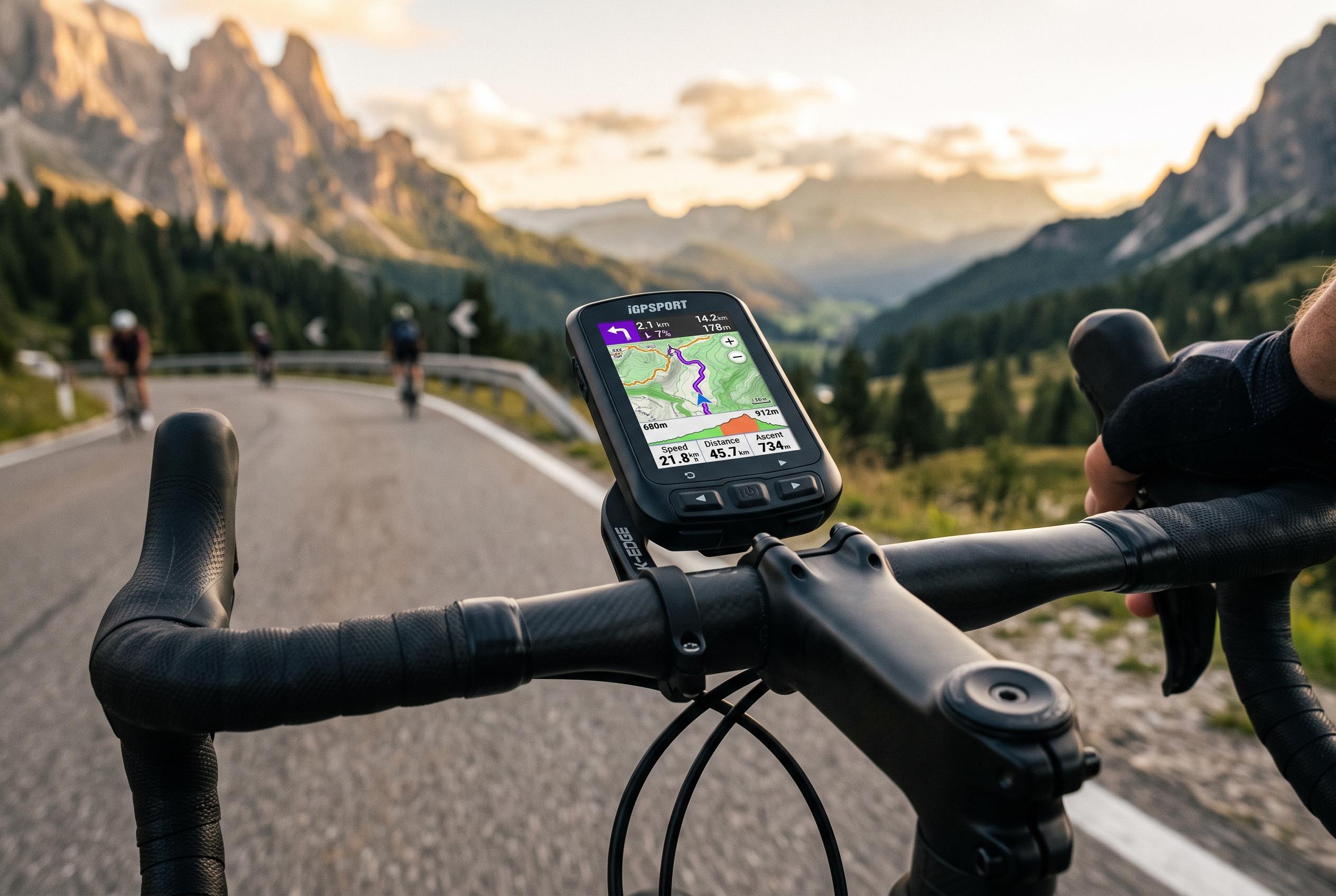

After over a year on the market, iGPSPORT’s BiNavi emerges as a serious contender to established GPS brands, thanks to its robust hardware, advanced navigation features, and compelling value proposition for serious cyclists.
More than a year after its early-2025 release, iGPSPORT’s BiNavi appears to have moved beyond being an intriguing outsider and into the ranks of genuinely credible navigation computers. Reviewers in Australia and Europe who lived with it for months rather than days have largely come to the same conclusion: the hardware is good enough to use seriously, and the compromises sit mostly in software polish rather than the core riding experience. Writing in Bicycling Australia after several months of testing, Harry Kooros said the unit had become his “go-to bike computer”. In a later Dutch review, Daan Walet approached it as a navigation-led device rather than a training lab instrument, while Kadenz Cycling’s Julien wrote in July 2026 that it had “changed the game for iGPSPORT”.
That matters because the BiNavi is not being judged against entry-level GPS units. It is iGPSPORT’s premium model, aimed squarely at riders considering products such as Garmin’s Edge 840 and 1040, Bryton’s Rider S510, Wahoo’s Roam and Bolt range, and Coros’s Dura. Weelz noted that the BiNavi’s 3.5-inch display is materially larger than several of those rivals, listing 2.8 inches for the Edge 840, 2.7 inches for the Bryton Rider S510 and 2.6 inches for the Coros Dura. Pedal Nova added that iGPSPORT itself is no overnight entrant: the company says it launched its first bike computer in 2012 and its first smart sports watch in 2023, while Chris Froome became a brand ambassador in 2024.
The hardware case is clearer than the software case. Smartzone lists a 320 x 480 transflective colour display, 32GB of storage, dual-band L1/L5 positioning, dimensions of 101 x 60 x 14.5mm and a weight of 103g. Those figures are matched by Pedal Nova, which also reports six physical buttons, USB-C charging, IPX7 waterproofing, a 1,250mAh battery and a quoted full charge time of 1.5 hours. Several reviewers dwell on the physical package rather than the specification sheet alone. Kooros says the box includes a detailed manual, mount, tether, rubber case and screen protector. Walet describes a thin unit with “a lot of screen and little casing”. Across the reviews, the build is consistently described as sturdy rather than flashy, which is probably the right emphasis for a device expected to live on a handlebar in bad weather.
Navigation is where the BiNavi makes its strongest case. Kooros deliberately missed turns on city streets and regional roads to test what iGPSPORT calls Off-Course Recalculation 2.0, and reported that the rerouting logic stood up well enough for real use. He also praised the timing of turn alerts and said the voice prompts were especially helpful when attention was on the road rather than the map. Weelz places the computer in front of both road and mountain-bike riders because of its detailed mapping and support for accessories such as radars and connected lights. Pedal Nova reaches a similar conclusion from a different angle, arguing that the unit makes most sense for gravel, adventure riding and commuting, where navigation clarity often matters more than squeezing every last training metric from a head unit.
The caveats are also fairly consistent. Bicycling Australia says routes and points of interest cannot be created or searched directly on the device, so a phone is still needed for some mid-ride changes. Smartzone’s reviewer is more openly sceptical about how much value riders will extract from advanced rerouting at all, saying the larger display, rather than live route correction, was the more convincing reason to step up from iGPSPORT’s cheaper BSC300. In that review, Jonas Andre says the BiNavi “fixes nearly all of the BSC300’s drawbacks”, but he questions whether that justifies paying two to three times more if a rider is happy following Komoot routes and correcting the odd mistake by eye. Kadenz Cycling also notes clunky processes and awkward English translations in places, even while judging the overall platform highly usable.
Where the device broadens its appeal is in connectivity. Weelz says the BiNavi supports heart-rate, cadence and power sensors, as well as Di2 and AXS drivetrains, radars and smart lights over ANT+ and Bluetooth. Julien at Kadenz reports no pairing issues with power meters, heart-rate monitors, cadence sensors or rear radar across different brands. Kooros adds that the BiNavi can control lighting modes directly from the head unit, display remaining light battery life, surface real-time weather through the companion app, mirror calls and messages, and handle music control from a phone. That set of functions does not amount to an ecosystem on Garmin’s scale, but it is enough to make the device plausible as the centre of a modern riding set-up rather than a one-purpose navigator.
Battery performance looks similarly strong, if not quite magic. The headline claim across the reviews is 35 or 35-plus hours, and Smartzone says the unit delivered “over 25 hours” in practice, which is the kind of number endurance riders will care about more than brochure maxima. Pedal Nova’s charging figure of 1.5 hours suggests the battery is not only large but reasonably quick to top up. Kadenz says regular use did not require charging after every outing, while Bicycling Australia treats the long runtime as one of the features that shifts the BiNavi from value curiosity to serious option. For riders using a bright map screen, multiple sensors and active navigation for long days, that is a more useful sign than a laboratory estimate.
The harder question is value, because the answer depends on what kind of rider is asking. Prices cited by reviewers range from around AUD$505 in Australia to roughly €240 in Germany, while Cobbles says the Dutch retail price was €220 in August 2026 and could fall to €176 with a discount code. Kadenz’s judgement is blunt: “For a computer that sells for under €250, it’s hard to do much better.” That does not make the BiNavi a universal recommendation. Riders heavily invested in Garmin Connect, or those who want the most mature on-device searching and rerouting, still have obvious reasons to spend more. But the accumulated evidence from the past 18 months suggests something more interesting than a simple budget substitute. The BiNavi looks like a navigation-first computer with premium-class hardware, broad accessory support and real staying power, sold at a price that forces better-known brands into an awkward comparison.
Disclaimer: This content is intended for informational purposes only. Readers are advised to exercise their own judgement, conduct due diligence, or consult a qualified expert before acting on any information provided.