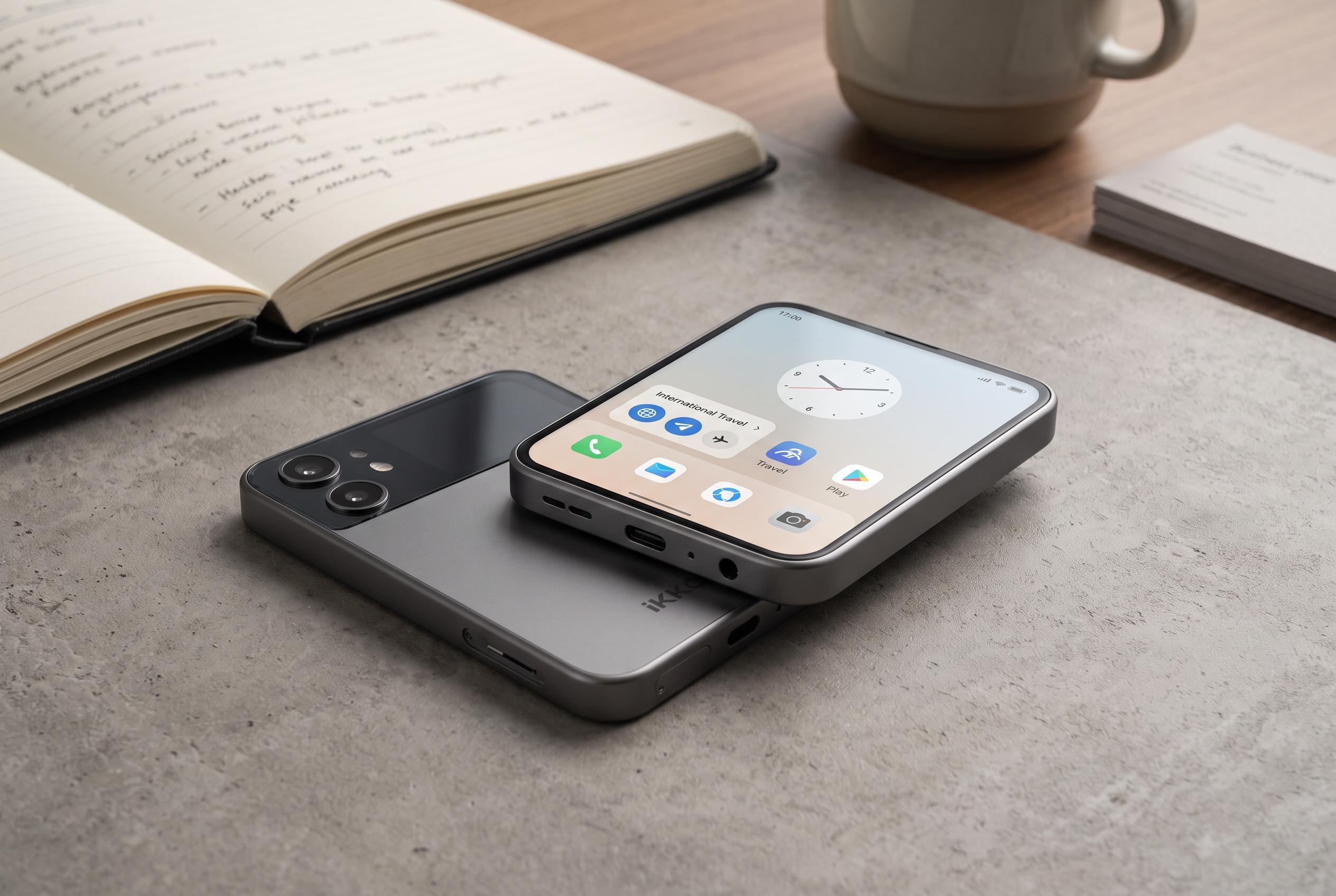

The iKKO MindOne Pro’s distinctive square-shaped design and ambitious international connectivity highlight a new direction for alternative smartphones, yet software limitations pose significant hurdles to practical use.
iKKO’s MindOne Pro is a reminder that unusual hardware can still stand out in a market crowded with near-identical slabs. The device’s near-square shape, compact footprint and careful assembly give it a distinctive presence, and that alone has helped it attract attention from users looking for something smaller and less distracting than a mainstream smartphone. Yet the same qualities that make it memorable also shape almost every compromise that follows.
The handset’s dimensions, roughly 86 x 72 mm according to Smartworld and Mobile Magazine HK, make it unusually easy to hold with one hand. Reviewers have praised the tight construction, refined materials and premium feel. TechRadar also noted that the device pairs a 4-inch-class display with a 50MP flip-up camera, which adds flexibility for selfies and group shots. But the extreme aspect ratio creates obvious practical limits. Text input becomes cramped, messaging threads are hard to follow once the keyboard appears and social feeds demand more scrolling than on a conventional phone.
Software is where the device appears most uneven. The Chinese domestic version described by 36Kr lacks Google services and relies on Tencent’s Appbao store, which the reviewer said could not be cleanly removed without causing problems. That review also described the system as a patchwork of components that felt only partly adapted to the device’s unusual screen. Smartworld similarly criticised the software experience, while 36Kr said the overall result felt like a “Frankenstein” build rather than a coherent platform.
The broader hardware and platform story is more ambitious than the day-to-day experience suggests. TechRadar reported that the MindOne Pro runs Android 15 alongside iKKO’s AI OS and is intended to offer free internet access in more than 60 regions. The same report said the phone was priced at $499 and initially positioned as a crowdfunded product that drew strong early interest. Wallpaper described the device as part of a wider group of alternative smartphones designed around digital wellbeing, privacy or utility rather than raw performance.
But the AI layer also appears to be one of the most contentious parts of the product. In the 36Kr review, the dedicated AI mode was described less as a separate operating system than as a launcher with a power-saving style interface, with access restricted to a small set of built-in apps. The reviewer said the AI tools were useful mainly for learning, transcription and translation, but less convincing for general-purpose assistance. That gap between concept and execution is likely to define the MindOne Pro’s appeal: inventive, compact and well made, but held back by software choices that limit how far the hardware can go.
Disclaimer: This content is intended for informational purposes only. Readers are advised to exercise their own judgement, conduct due diligence, or consult a qualified expert before acting on any information provided.