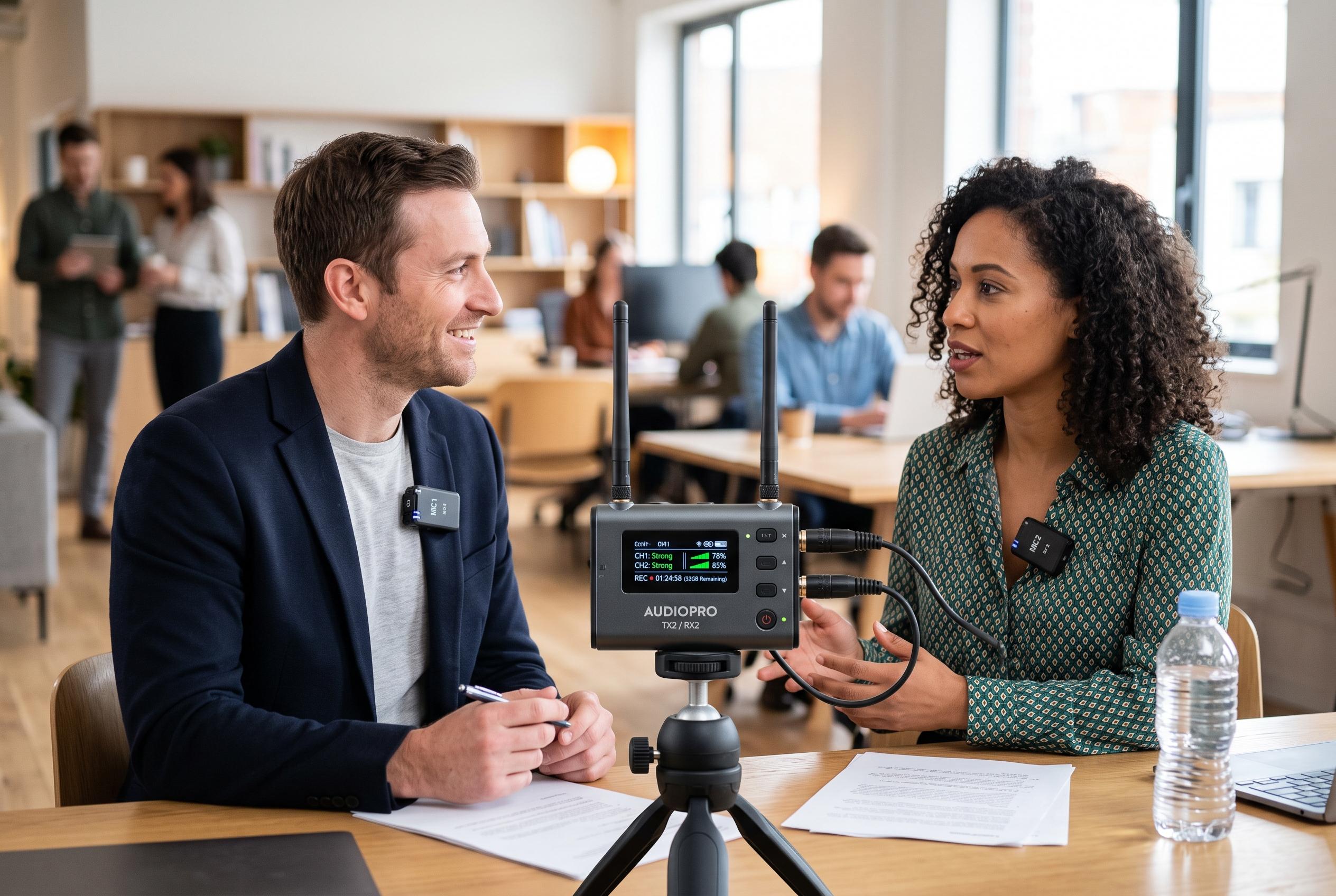

A new wave of dual-transmitter wireless microphone kits offers filmmakers and journalists greater control, reliability, and flexibility for two-person interviews, featuring advanced features like onboard storage and multi-channel support amid evolving field conditions.
Choosing a wireless mic for a two-person interview is less about convenience than control. The right system keeps both voices on the same timeline, reduces post-production work and avoids the drift that can appear when separate recorders are left to run independently. ShortFilmCentral’s August 2026 guide focuses on that problem, comparing eight dual-transmitter kits in controlled and field conditions across studio, street and rooftop settings.
Its top recommendation is the DJI Mic 2, which the guide describes as the most complete option for interview work. The appeal is practical: internal 32-bit float recording, long battery life, a 250m stated range and a receiver that can deliver mono, stereo or safety-track output. For crews that cannot afford to lose a take, that combination is difficult to ignore.
For lighter, lower-cost setups, the Hollyland Lark M2 and Lark A1 stand out. The Lark M2 is presented as the strongest value choice, with very small transmitters, 48kHz/24-bit audio and broad device support through multiple receiver types. The Lark A1 pushes cost even lower while still offering 48kHz/24-bit recording, strong battery life and simple plug-and-play use, making it attractive for creators who want a fast phone-based workflow.
The guide also gives serious attention to field-ready options. Shure’s MoveMic Two Kit is positioned as the premium choice for journalists working in changing weather, with IPX4 protection and app-based control. Saramonic’s Blink 500 ProX B2+ is highlighted for its cleaner noise performance and detailed sound, while COMICA’s BoomX-D2 is pitched at users who need long range and low latency in moving interview setups.
One of the more useful distinctions in the guide is between systems that merely transmit well and those that also protect against failure. NEEWER’s CM28 includes 4GB of onboard storage per transmitter, so each unit can keep a backup file even if the wireless link fails. That matters for documentary work, where a single dropout can destroy an unrecoverable interview. BOYA’s BY-V4U goes in a different direction, offering four channels rather than two, which makes it better suited to panels or multi-speaker recordings.
The broader technical advice is sound. The guide recommends 48kHz/24-bit audio as a baseline, with 32-bit float as a valuable safeguard when levels may be unpredictable. It also notes that signal-to-noise ratio, transmission range, battery endurance and receiver compatibility matter as much as headline features. For most interview work, a system with automatic frequency-hopping and a solid safety track is more useful than one with a long spec sheet but limited real-world resilience.
There is also a reminder that microphone technique still matters. The guide explains the 3-to-1 rule, which helps reduce bleed and phase problems when two lavaliers are used in the same space. That makes even a strong wireless system more reliable, especially in rooms with reflective surfaces or in outdoor interviews where speakers may move closer together than expected.
In practice, the best choice depends on the shoot. For all-round use, the DJI Mic 2 appears to be the safest pick. For value, the Hollyland Lark M2 and Lark A1 are the most compelling. For documentary crews, NEEWER’s onboard recording is a sensible insurance policy. For panels, BOYA’s four-channel design is distinctive. The common thread is clear: for two-person interviews, a dual-channel system is now the most efficient way to keep production simple and sound coherent.
Disclaimer: This content is intended for informational purposes only. Readers are advised to exercise their own judgement, conduct due diligence, or consult a qualified expert before acting on any information provided.