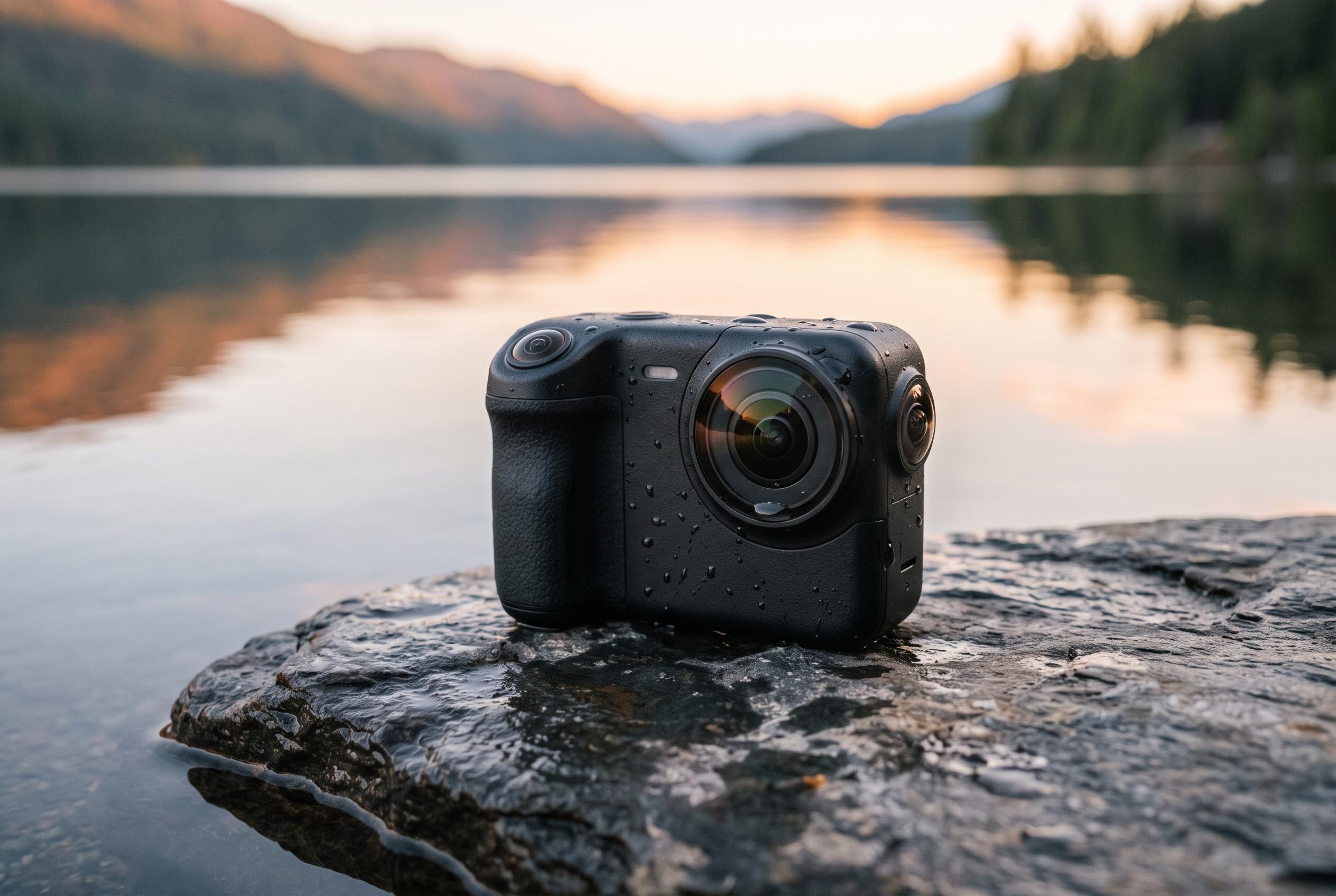

New comparisons reveal that while DJI’s Osmo 360 II offers better value and higher frame rates, the Insta360 X6 excels in image quality, waterproofing, and battery life, making it the preferred choice for most users.
DJI’s Osmo 360 II and Insta360’s X6 arrived within weeks of one another, but they are not chasing quite the same advantage. Both are positioned as premium 360-degree cameras for creators who want high-resolution capture, strong software support and enough durability for travel or action use. Yet the early evidence suggests they win in different areas, which makes the choice less about an outright champion than about priorities.
The most immediate difference is price. DJI’s camera undercuts Insta360’s on entry cost, with the Osmo 360 II Standard Combo priced at £509 in the UK, while the X6 starts at £619.99. DJI also offers an Adventure Combo that still lands below the equivalent higher-tier Insta360 bundle. That stronger value proposition is sharpened by DJI’s unusually generous built-in storage, which exceeds the X6’s internal capacity. The main caveat is availability: DJI is not launching the Osmo 360 II in the US for now, which leaves many buyers with only one realistic option.
On video quality, Insta360 still appears to have the narrower but decisive lead. TechRadar’s matched testing found that the X6 produces cleaner and more detailed footage in daylight, with less distortion and a more polished overall image. The Osmo 360 II does preserve more highlight detail in bright skies, and its native 8K/60fps capture is a notable technical advance, but the X6 remains the more convincing all-round camera in good light. At night, Insta360’s PureVideo mode again has the edge for image quality, although DJI’s SuperNight 2.0 reaches 60fps, which gives it an advantage for faster motion in low light.
Water resistance and robustness also favour the X6. Insta360 rates it to 20 metres without a case, compared with 10 metres for the Osmo 360 II. DJI is preparing a dive case that should extend underwater use further, while Insta360 already has a case that pushes the X6 to 60 metres. Both cameras now use user-replaceable lenses, which is important for a category in which exposed optics are a common weak point. DJI has also revised the lens coating and appears to have addressed one of the biggest complaints levelled at its first-generation model.
Battery life broadly tracks the same pattern. Insta360’s larger battery gives the X6 longer runtime, and TechRadar’s testing found that the claimed figures were largely credible. Heat management, however, remains a constraint for both cameras at their most demanding settings, with each eventually shutting down to cool during prolonged 8K recording. DJI’s stronger internal storage is useful here, especially for high-bitrate capture, but the X6 still looks better suited to longer shoots away from power.
Software support is less clear-cut. DJI Studio offers strong tracking and impressive slow-motion tools, while Insta360 Studio retains an advantage for professional workflows because it supports ProRes export. On mobile, Insta360 has traditionally been the more mature ecosystem, although TechRadar found its app stability could depend on the phone in use. Both companies now support direct 24-bit audio with their wireless microphone systems, so there is little to separate them on sound integration.
Taken together, the comparison leaves the X6 as the safer recommendation for most buyers, at least for now. It offers the better image quality, greater waterproofing and longer battery life, and it is available in markets where DJI’s new model is not. But the Osmo 360 II is not a mere also-ran. It is cheaper, shoots at a higher top frame rate in 8K and gives users more built-in storage, making it an appealing alternative for those who value specification-for-pound more than absolute image quality. TechRadar’s view is that the X6 remains the 360 camera to beat, but the margin is no longer as comfortable as it once was.
Disclaimer: This content is intended for informational purposes only. Readers are advised to exercise their own judgement, conduct due diligence, or consult a qualified expert before acting on any information provided.