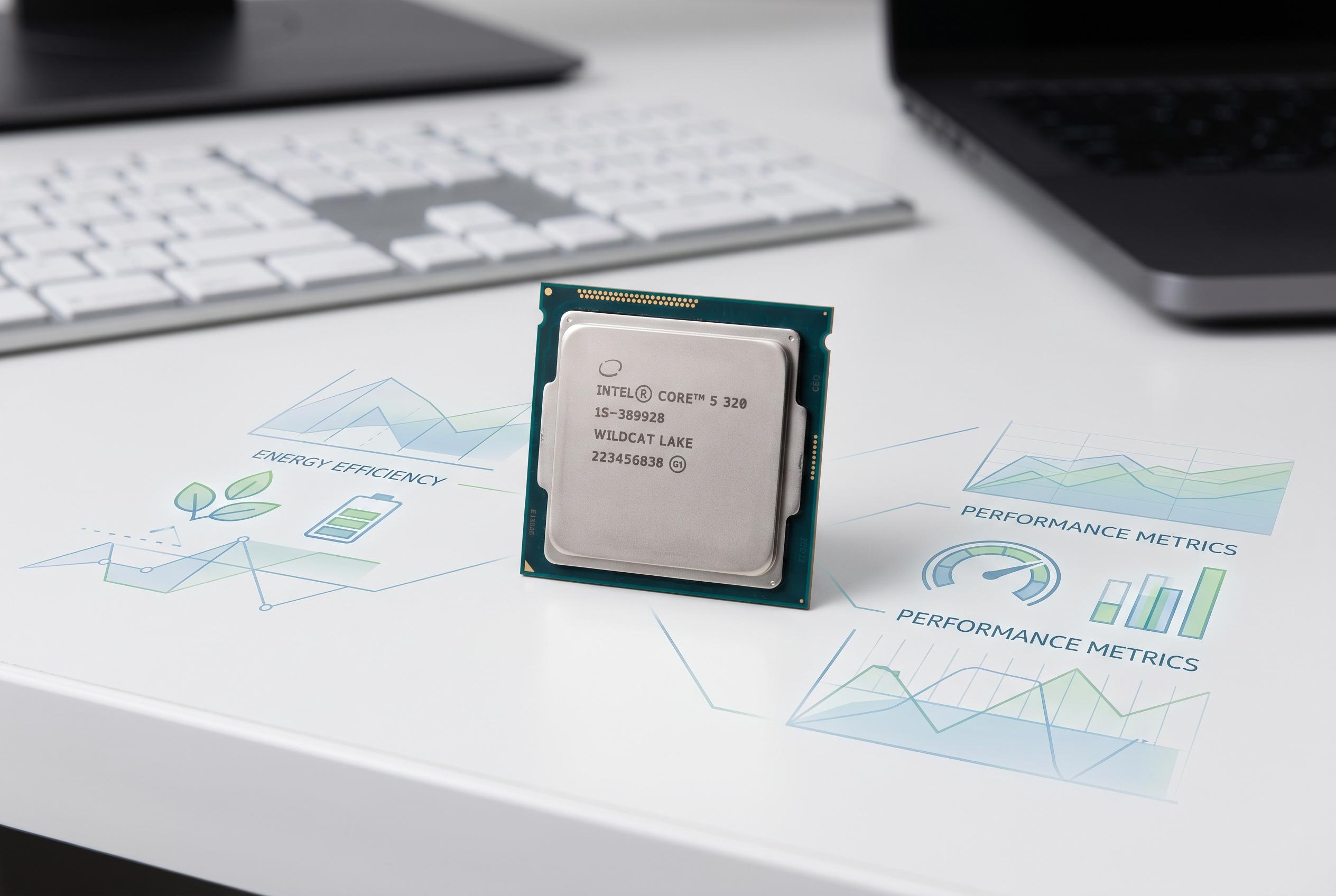

A new benchmark reveals Intel’s Core 5 320 ‘Wildcat Lake’ surpasses Apple’s A18 Pro in a specialised efficiency test, signalling a potential shift in portable computing performance, though broader metrics still favour Apple in responsiveness, graphics and AI.
A new benchmark from hardware reviewer Jeff Geerling suggests that Intel has done something long thought unlikely: a low-cost x86 chip has edged past Apple on one narrow measure of compute efficiency. In testing published on August 7, 2026, the Core 5 320 “Wildcat Lake” delivered a modest but genuine lead over the A18 Pro in a double-precision floating-point workload. Yet the wider comparison shows why the result should be read carefully. Intel’s chip improved one type of efficiency, while Apple still leads in graphics, on-device AI and single-core responsiveness, and the more practical question for most buyers is not which platform is most efficient in the abstract, but which is efficient for the work they actually do. Geerling’s numbers are backed by documented benchmark data, while Tom’s Guide’s review adds a more consumer-facing battery-life result.
The Geerling test used HPL, or High Performance Linpack, a benchmark widely associated with the Green500 list of the world’s most energy-efficient supercomputers. In that run, the Dell XPS 13 with Intel’s Core 5 320 produced 127.91 GFLOPS at 20.6 watts, or 6.21 GFLOPS per watt. The A18 Pro, tested in a MacBook Neo with 8GB of unified memory, reached 57.012 GFLOPS at 10.6 watts, or 5.38 GFLOPS per watt. That gives Intel a lead of about 15.4% in that specific workload. It is a meaningful result, but it is also a highly specialised one: HPL measures sustained FP64 throughput, not the mix of light browser work, document editing and media playback that defines ordinary laptop use.
The more relevant result for most consumers comes from Tom’s Guide’s full review, published on July 25, 2026. In its standard battery test, which involved continuous Wi-Fi web browsing at 150 nits, the Dell XPS 13 lasted 14 hours and 26 minutes, while the MacBook Neo ran for 13 hours and 26 minutes. That one-hour gap matters because it reflects the kind of light, mixed productivity load most people actually impose on a portable computer. According to the review, Intel’s Wildcat Lake design relies on Darkmont low-power efficiency cores to keep draw low during those lighter tasks.
Intel’s progress is tied closely to its 18A manufacturing process, which the company says is its most advanced node in commercial production in the United States. The process combines RibbonFET, Intel’s gate-all-around transistor design, with PowerVia, a backside power delivery scheme intended to reduce electrical loss and congestion on the front of the wafer. Intel says those changes can deliver up to 18% higher performance at the same power, or 38% lower power at the same performance, versus Intel 3. The company also says PowerVia reduces voltage droop and improves frequency headroom. That helps explain how a small, low-cost chip can show unusual efficiency in a budget laptop.
Apple still has clear advantages in the areas that matter most for creative and AI-heavy use. Tom’s Guide reported a Geekbench 6 single-core score of 3,535 for the A18 Pro platform, versus 2,684 for Intel’s chip, a lead of 38% for Apple on single-threaded responsiveness. In 3DMark Wildlife Extreme, Apple also led in graphics, scoring 3,661 compared with 2,455 for the XPS 13. On AI work, the gap is even larger: Intel’s NPU 5 offers 16 TOPS, while Apple’s Neural Engine is rated at 35 TOPS. That keeps Apple well ahead for photo enhancement, transcription and other on-device AI tasks, and it also means the Dell machine falls short of Microsoft’s Copilot+ threshold.
There are other trade-offs too. Tom’s Guide found much faster SSD performance in the XPS 13, with write speeds of 3,714 MB/s and read speeds of 5,026 MB/s, and the drive is upgradeable. The Dell machine is also lighter at 2.2 pounds, compared with 2.7 pounds for the MacBook Neo. PassMark’s daily-updated comparison data, meanwhile, shows the Core 5 320 ahead of the A18 Pro by roughly 20% in multi-threaded CPU testing, although the two are closer in single-threaded results. Taken together, the evidence suggests Intel has finally produced an x86 chip that can win on efficiency in at least one credible benchmark and one everyday battery test. But Apple still holds the stronger position where raw responsiveness, graphics and AI throughput are concerned.
Disclaimer: This content is intended for informational purposes only. Readers are advised to exercise their own judgement, conduct due diligence, or consult a qualified expert before acting on any information provided.