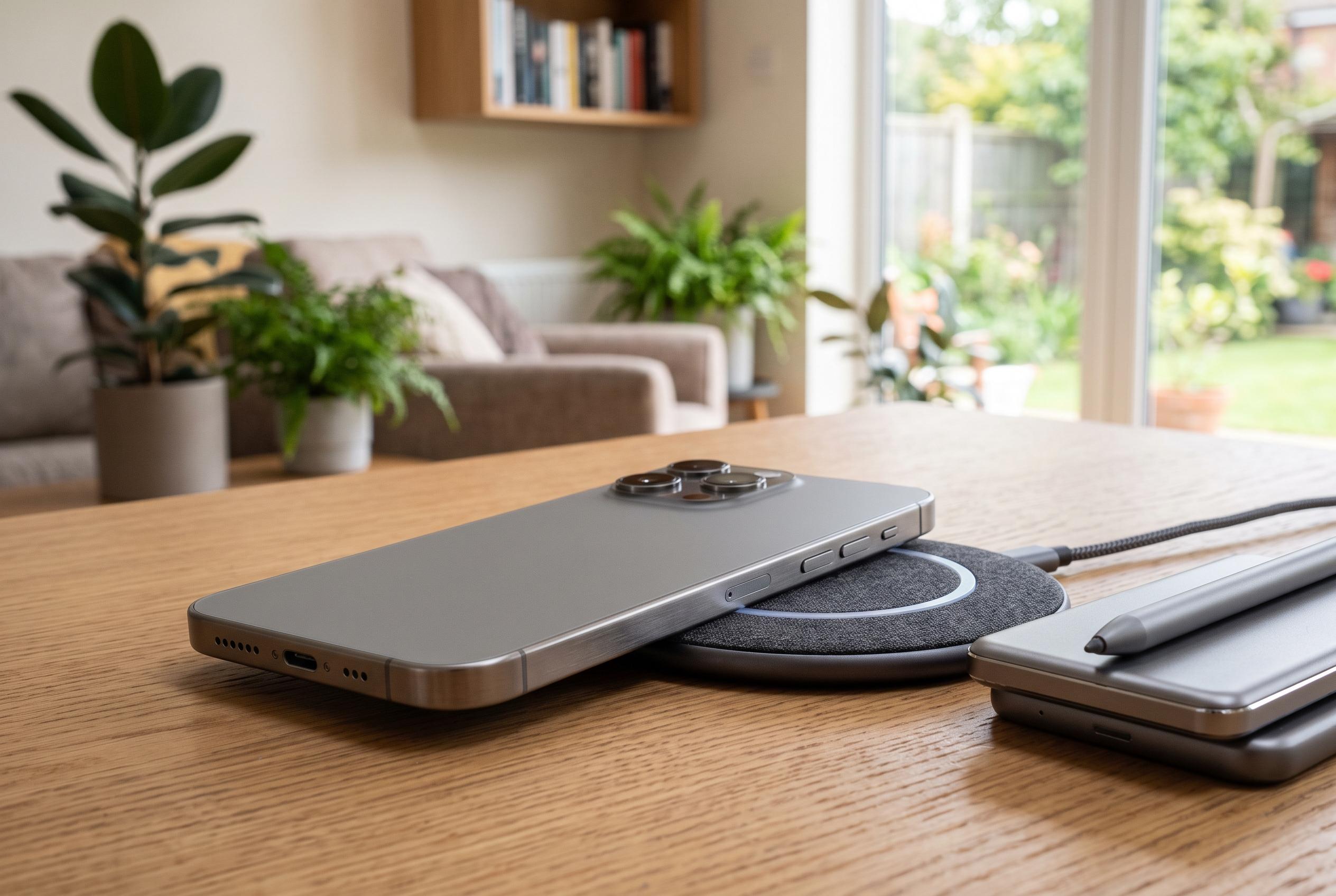

Apple’s latest Pro iPhone delivers its biggest gains beneath the familiar exterior, pairing a 2-nanometre A20 Pro chip and improved cooling with a variable-aperture camera and longer battery life.
Apple’s iPhone 18 Pro is a study in refinement rather than reinvention. In Apple’s September launch, it sat somewhat in the shadow of the first foldable iPhone, yet it is the model that best captures the company’s priorities this year: more power, better efficiency, a reworked camera system and a thinner slice of the interface at the top of the screen. According to Apple’s own announcement, the Pro model is the first iPhone built around the A20 Pro, the company’s first 2-nanometre smartphone chip, and it also brings a variable-aperture main camera, a larger vapour chamber and improved battery life.
The industrial design, however, remains familiar. Apple has largely kept the same outline as the previous Pro generation, while changing the finish and colour choices. The new model comes in Burgundy, Glacier, Silver and Black, and the rear glass is now uniform rather than split into contrasting tones. MacRumors notes that the standard iPhone 18 is not expected until spring 2027, which leaves the 18 Pro as Apple’s only immediate non-foldable flagship option at the top end of the range.
The biggest internal change is the A20 Pro. Apple describes it as a 6-core CPU design with a 7-core GPU and dual 16-core Neural Engine blocks, while Tom’s Hardware says the chip marks Apple’s first 2-nanometre smartphone processor and brings meaningful gains in both speed and efficiency. In practical terms, that means the phone can handle demanding editing, gaming and on-device AI tasks with very little strain. Apple also pairs the chip with revised thermal engineering, including a larger vapour chamber, which is intended to keep sustained performance high for longer.
That thermal work is more than a technical footnote. The iPhone 18 Pro is designed to hold its performance better under load, and that matters in real-world use. According to Apple, the new cooling architecture supports longer battery life, with the Pro model rated for up to 36 hours of video playback. Tom’s Guide, reviewing the handset, also highlighted its exceptional endurance and record-setting speed, though it noted the usual premium pricing uplift for the Pro line. Battery teardown data reported by Tom’s Guide suggests the North American model uses a 4,288mAh cell, a modest increase on the previous generation.
The screen changes are more restrained, but still relevant. Apple has reduced the size of the Dynamic Island by moving Face ID hardware further under the display, which gives the front of the phone a slightly cleaner appearance without compromising biometric security. The result is subtle rather than dramatic, yet it is one of the few visible changes that immediately distinguishes the handset from its predecessor. MacRumors says the smaller Dynamic Island is among the key updates Apple is using to justify the redesign.
Photography is where Apple is trying to add more meaningful flexibility. The variable-aperture main camera lets the phone change how much light reaches the sensor, which can improve portrait separation, reduce glare in difficult lighting and offer greater depth-of-field control when needed. Apple says the system is designed to make the camera more adaptable to different scenes, while Tom’s Guide describes the new setup as one of the most versatile camera systems in the current market. The broader point, though, is that Apple is still relying on software and camera processing to compensate for hardware that now looks conservative next to some of the strongest Android rivals.
Pricing is where the appeal becomes harder to defend. MacRumors lists a starting price of $1,199 in the United States for the iPhone 18 Pro, while the Pro Max starts at $1,299. In the article’s European pricing, the entry point is far higher, and Apple has also pushed the standard iPhone 18 back to 2027, removing any cheaper immediate alternative from the current line-up. That makes the Pro model feel less like an upgrade path and more like a premium gatekeeper for buyers already committed to Apple’s ecosystem.
In that context, the iPhone 18 Pro looks less like a breakthrough product than a concentrated version of Apple’s best work. It is extremely fast, unusually efficient, strong on battery life and carefully tuned for video and sustained workloads. Yet it also exposes how incremental Apple’s design language has become, and how much of its appeal now rests on polish rather than surprise. For users coming from older iPhones, the leap is substantial. For anyone already on last year’s Pro model, the case for changing is much weaker.
Disclaimer: This content is intended for informational purposes only. Readers are advised to exercise their own judgement, conduct due diligence, or consult a qualified expert before acting on any information provided.