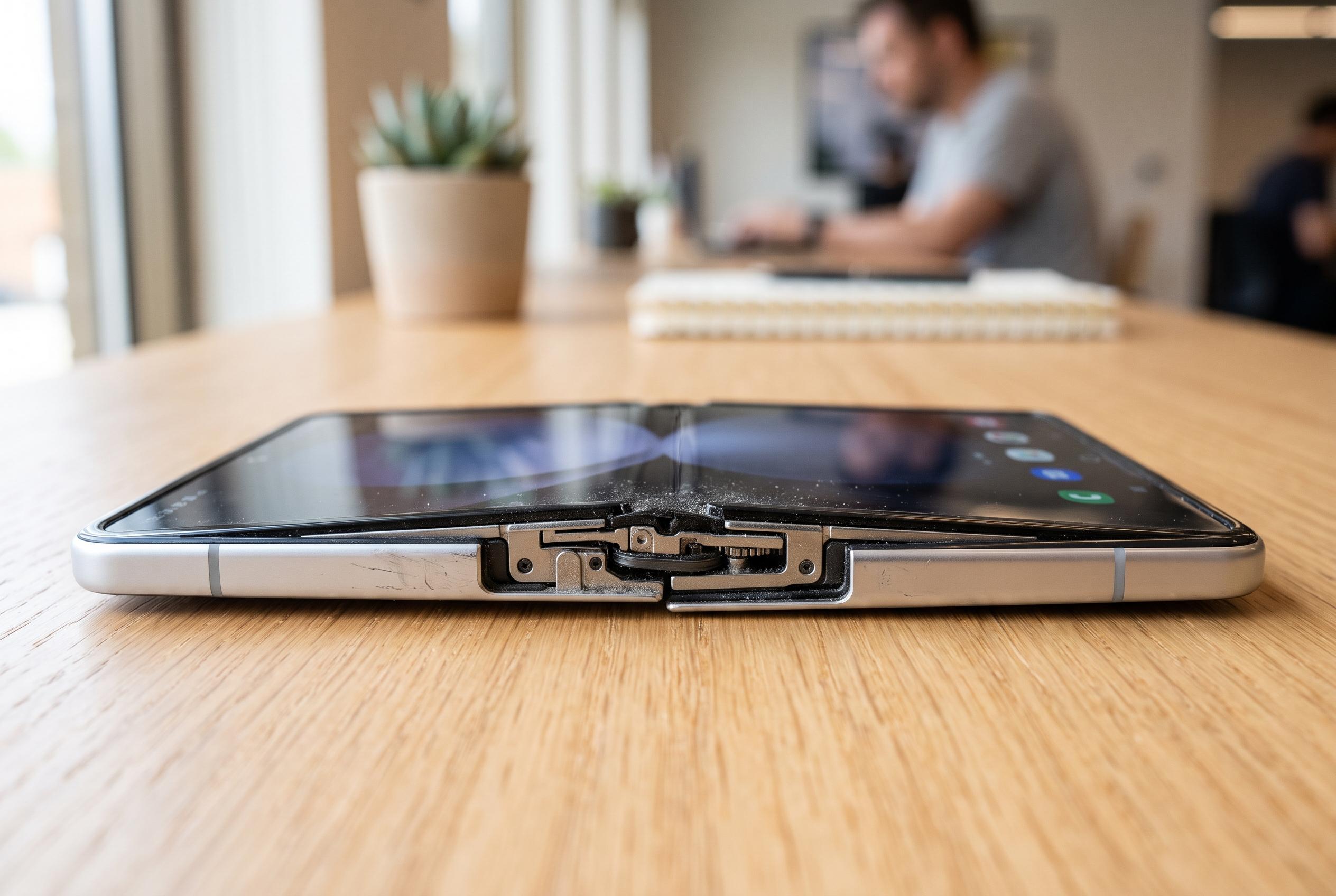

Early durability tests have highlighted possible weaknesses around Apple’s first foldable iPhone, with stress at the hinge and dust intrusion emerging as leading concerns.
Apple’s first foldable iPhone is already under scrutiny after a series of early durability checks pointed to possible weaknesses around the inner display and hinge. Tests by JerryRigEverything and iFixit did not establish a single confirmed cause, but both pointed towards the same broad risk: stress concentrated around the folding mechanism, with dust and debris adding another possible failure mode.
In JerryRigEverything’s test, the phone’s flexible inner panel proved far more vulnerable than its outer screen. The external display, protected by Ceramic Shield 2, resisted scratches until level seven on the Mohs scale, but the inner screen marked at level two and showed deeper damage at level three. Although Apple’s matte nano-texture finish made the damage less obvious when the display was lit, the scratches remained permanent. The more serious failure came during bending, when the inner panel developed a green vertical line near the centre before additional lines appeared and the screen eventually stopped responding.
That result did not prove exactly why the display failed, but it reinforced concerns that the body can flex enough to place damaging strain on the inner panel. MacRumors reported that the device’s IP68 rating did not prevent dust from entering the hinge, where particles overcame the magnets that normally help hold the phone closed. Similar debris-related problems have affected other foldables in testing, and the broader pattern suggests that resistance to dust remains one of the hardest engineering challenges for this category.
iFixit then examined the phone more closely, drawing on teardown footage, patents and CT scans to build a 3D model of the hinge. According to the site’s analysis, the reported screen failures appeared to cluster around the point where the display’s flex-cable gap meets the hinge’s central support bar. iFixit also simulated a scenario in which that support does not drop far enough, potentially creating a stress point as the panel folds, though it stressed that this remains a hypothesis rather than a confirmed diagnosis. The same teardown found that fluorescent powder could reach the moving hinge parts and cause crunching, even if relatively little of it made it deeper into the device.
Despite the concerns, iFixit gave the iPhone Duo a provisional repairability score of 5 out of 10, which it described as the highest it has given any foldable so far. The site said the batteries are comparatively straightforward to remove and several other components are accessible without extensive dismantling. Even so, the economics of repair remain severe: replacing the inner display costs about $999 without coverage, while Apple’s replaceable nano-texture cover layer costs $49 without AppleCare+.
Disclaimer: This content is intended for informational purposes only. Readers are advised to exercise their own judgement, conduct due diligence, or consult a qualified expert before acting on any information provided.