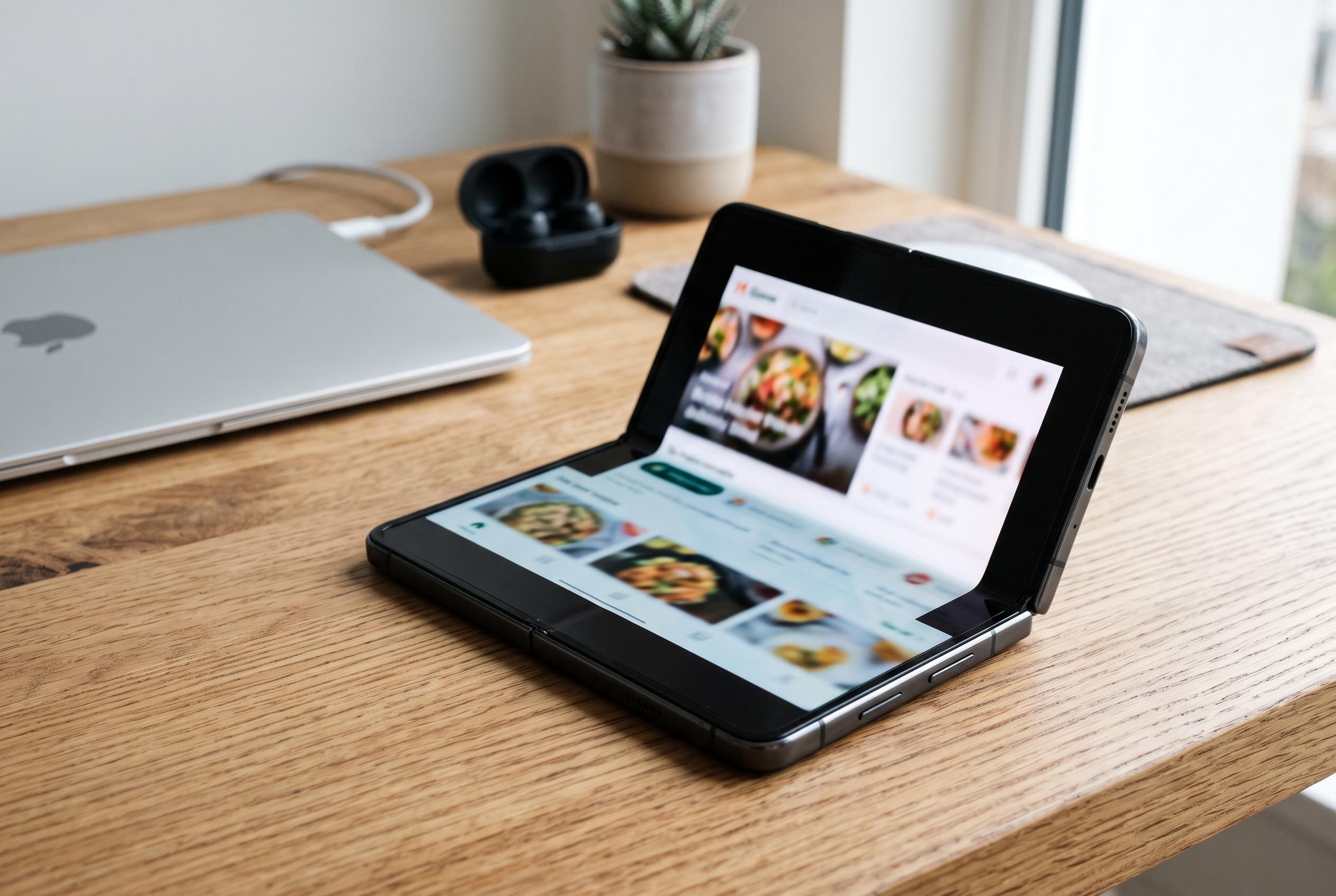

Apple’s first foldable phone is winning praise for its premium design and display, but black bars, letterboxing and inconsistent app layouts are exposing how far software support still has to catch up.
Apple’s first foldable phone has arrived in South Korea with strong hardware impressions but uneven app support, underscoring the gap between premium design and software readiness. In a hands-on review published by Newsis on 23 October, the 329만원 iPhone Duo was praised for its build quality, display finish and feel in the hand, yet many popular apps still failed to make full use of the large inner screen.
That mismatch was most visible in services such as Naver Webtoon, banking apps, office tools and some video platforms. Even after updating to the latest versions, several still opened with black bars on both sides of the 7.6-inch display, leaving content confined to a narrow central area. Newsis reported that some apps improved after emergency patches, but others remained only partially adapted, which diluted one of the main reasons to buy a foldable in the first place.
The experience was not uniform across the app ecosystem. According to Newsis, apps including KakaoTalk, YouTube, Instagram, ChatGPT, Naver Series, KakaoPage and Netflix were able to take advantage of the wider screen. By contrast, banking apps such as KB Star Banking, Woori WON Banking, Hyundai Card and Woori Card still showed letterboxing, while Kakao Webtoon, Wave and a number of games behaved in a similar way. Even where an app filled the display, usability was not always ideal: Newsis said Tving expanded to full width but could flip into portrait orientation unexpectedly when launched in landscape mode.
The core reason appears to be development timing. Newsis cited Apple’s guidance that apps built with iOS 26 or earlier software development tools may appear centred on the screen, while those using the iOS 27 SDK can occupy most of the panel and iOS 27.1 or later can use the full display. Apple plans to require iOS 27 or newer SDKs for apps submitted to the App Store from April 2027, but that deadline does not guarantee immediate consistency across existing software. Naver said it had responded as quickly as possible, but noted that the depth of its app architecture, including shopping tabs and in-app search browsers, meant review and release timings could slip to the day of launch.
Even so, the hardware itself appears to have made a favourable first impression. Newsis said the foldable’s titanium-like finish, opening experience and general display quality were satisfactory, while the inner panel’s nano-texture surface reduced glare without an obvious loss of clarity in short use. Some details felt unfamiliar, including the absence of Face ID and the placement of the camera, but the overall impression was of a polished first-generation device.
That assessment broadly matches reviews from overseas outlets. Tom’s Guide and TechRadar both described the iPhone Duo as a premium foldable with strong performance, solid cameras and a crease that is difficult to notice, while also noting the trade-offs of its matte inner screen, heavier build and lack of Face ID. Tom’s Guide also suggested that Apple may shape the wider foldable market through features such as Apple Pencil support and improved reachability tools, although those additions are still being rolled out.
For now, the larger question is not whether Apple has built an impressive folding device, but how quickly app developers can catch up. The iPhone Duo’s hardware may already be close to ready for mainstream use. The software ecosystem, however, still looks unfinished, and that will determine how compelling the product feels beyond the first wave of curiosity.
Disclaimer: This content is intended for informational purposes only. Readers are advised to exercise their own judgement, conduct due diligence, or consult a qualified expert before acting on any information provided.