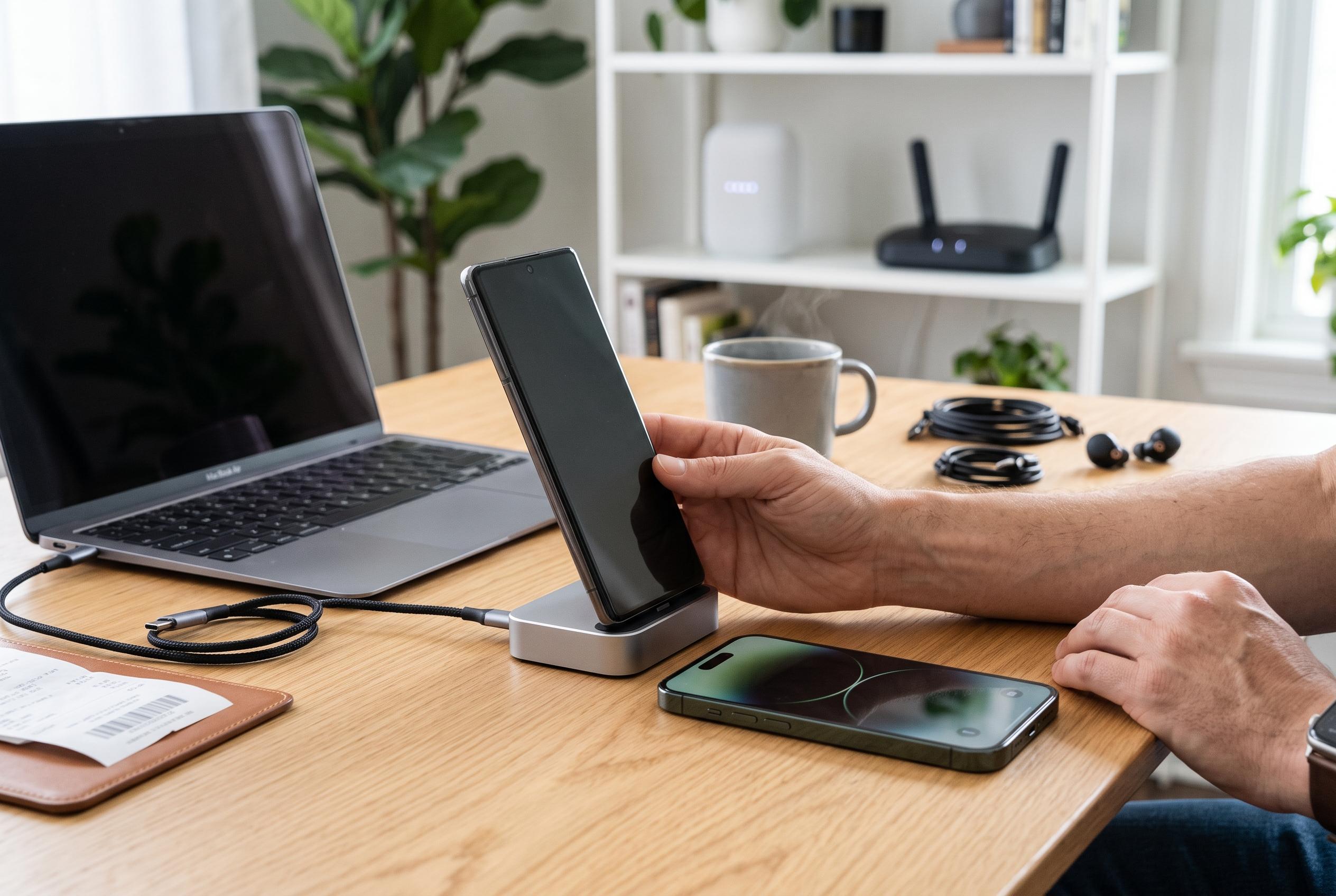

Despite Samsung’s flagship capabilities, many users switching to iPhone cite faster updates, higher resale values, seamless ecosystem integration, and easier data transfer as key reasons for the move.
Switching from a Galaxy to an iPhone is rarely about one bad phone. For many users, it is a calculation about timing, resale, ecosystem lock-in and day-to-day convenience. Samsung’s flagship handsets remain highly capable, with strong displays, powerful cameras and extensive customisation through One UI. But the reasons some owners move to Apple tend to be practical rather than emotional: faster software delivery, better residual value, deeper integration with other devices and a simpler migration path.
The clearest advantage Apple has is the speed and consistency of its software releases. Apple released iOS 27 on 14 September 2026, and the update was made available to compatible iPhone 11 models and newer on the same day, according to MacRumors. That matters to people who want new features quickly, because Samsung’s One UI 9 rollout has been staggered across devices and weeks, rather than delivered all at once. Samsung now promises seven generations of Android upgrades and seven years of security updates on recent flagship phones, which narrows the long-term support gap. The difference is not the length of support, but the pace at which updates reach users.
Resale value is another major factor. Market data cited by BGR and SellCell shows iPhones typically retain more of their original price than equivalent Galaxy models, even when the Apple handset has been on sale for longer. In practical terms, that means owners of Samsung flagships often lose more money to depreciation before they sell. Recent resale tracking also suggests strong demand for the iPhone 17 Pro Max in the United States, with a higher share of trade-ins than any other model, reinforcing Apple’s advantage in the second-hand market.
For users who already own a Mac, iPad or Apple Watch, the move can be even easier to justify. Apple’s Continuity features, including Handoff, Universal Clipboard, AirDrop and Continuity Camera, are designed to make the phone a shared component of a wider ecosystem rather than an isolated device. The Apple Watch remains a major draw as well, but it depends on an iPhone for setup and use. For some switchers, that makes the phone choice secondary: they buy the iPhone because it unlocks the rest of the hardware they already use.
Privacy defaults are also part of the appeal. Since iOS 14.5, apps have had to ask before tracking users across other companies’ apps and websites, and that permission system can be disabled entirely in settings. That does not make iPhone a perfect privacy platform, and it does not stop in-app data collection. But it does shift the default in a way that many users find easier to understand and control than Android’s more fragmented privacy tools.
The social case for switching is harder to ignore in the United States. Piper Sandler’s 2025 Taking Stock With Teens survey found that 87% of US teenagers own an iPhone, which helps explain why many families and group chats gravitate towards Apple’s messaging system. Cross-platform texting is better than it used to be, thanks to RCS support on iPhone, but mixed chats still favour the blue-bubble side of the divide. For anyone whose daily communication already lives inside iMessage-heavy circles, that can be reason enough.
The final argument is the least glamorous, but often the most persuasive: moving data is no longer a major obstacle. Apple’s Move to iOS tool can transfer contacts, messages, photos, videos, calendars, bookmarks, mail accounts and WhatsApp data during setup. Samsung’s newer Android versions can also move data and eSIM details with little friction. That removes one of the oldest barriers to switching. The trade-off is simple. If you value deep customisation, zoom camera hardware and the freedom of Android, a Galaxy still makes sense. If you care more about software arrival times, resale value, cross-device integration and a cleaner transition between phones, the iPhone has a strong case.
Disclaimer: This content is intended for informational purposes only. Readers are advised to exercise their own judgement, conduct due diligence, or consult a qualified expert before acting on any information provided.