
Lenovo’s Legion Go 2 redefines portable gaming by combining a large OLED display, powerful AMD Ryzen Z2 Extreme processor, and flexible controls, delivering a premium Windows gaming experience on the move, but with notable size and battery trade-offs.
Lenovo’s Legion Go 2 is a reminder that the handheld PC category has moved far beyond the idea of a simple portable console. It is closer to a compact Windows machine with controls attached, and that identity shapes almost every part of the experience. The device is undeniably large at 920g with its controllers fitted, yet that bulk gives Lenovo room for an 8.8-inch OLED panel, a 74Wh battery, 32GB of RAM and AMD’s Ryzen Z2 Extreme processor. According to reviews from Tom’s Hardware, Tom’s Guide and PCWorld, that combination places the Go 2 among the most fully specified handheld gaming PCs currently available.
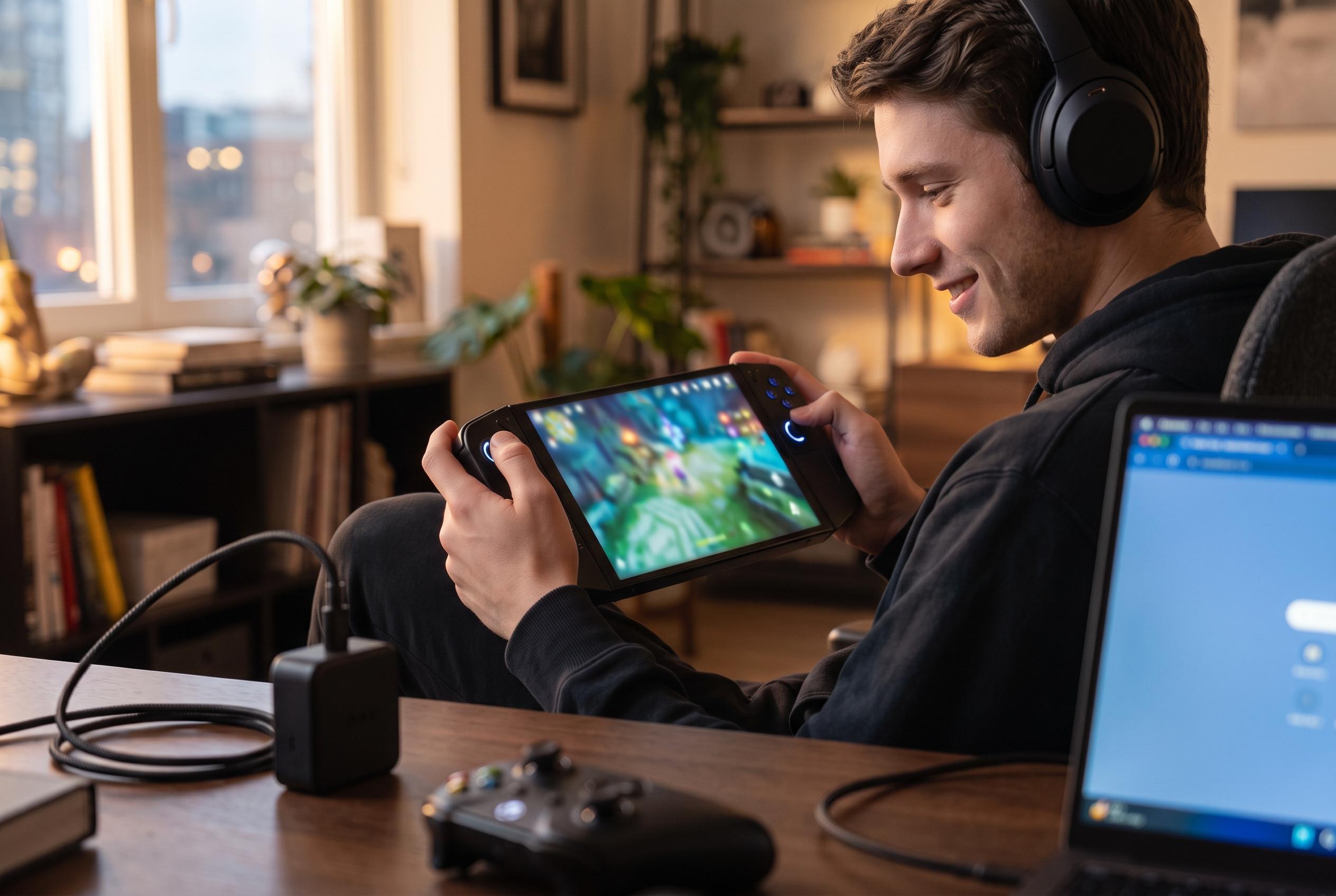
That size is both the machine’s chief advantage and its main compromise. The redesigned detachable TrueStrike controllers feel more substantial than the thin grips found on many Windows handhelds, and the Hall-effect joysticks should help reduce wear over time. The built-in kickstand and removable controllers make the Go 2 more versatile than most rivals, allowing it to work as a tabletop gaming system or a small desktop setup when paired with a keyboard, mouse and monitor. TechSpot and TheEffectDotNet both note that Lenovo has improved the ergonomics over the first-generation model, even if the overall footprint remains difficult to ignore.
The display is the Go 2’s strongest argument for itself. Lenovo has paired the 8.8-inch OLED panel with a 1920 x 1200 resolution, a 144Hz refresh rate and variable refresh rate support, a change that TechRadar says was part of the company’s move to balance visual quality with the limits of integrated graphics. The lower resolution makes more sense than the original model’s sharper but heavier-to-drive panel, particularly once modern games start pushing the Radeon 890M-class graphics to their limit. OLED contrast, wide colour coverage and HDR support give the screen an immediate advantage in darker games and more stylised titles, where black levels and colour separation matter as much as raw pixel density.
Performance is strong, but only when the device is used on its own terms. The Ryzen Z2 Extreme and 32GB of LPDDR5X memory are enough to keep Windows 11 responsive and load times short, while the 1TB SSD provides fast storage for large games and applications. The trade-off, as several reviewers observed, is that this is not a machine meant to brute-force every new release at native resolution and maximum settings. In practice, the Legion Go 2 asks users to think like PC players: reduce resolution, use upscaling where appropriate and choose graphics settings that match the game rather than the box label.
That approach pays off in real play. Games such as Cyberpunk 2077, Shadow of the Tomb Raider and Red Dead Redemption 2 can run at playable rates with sensible settings, while lighter or better optimised titles can make much more use of the display’s higher refresh rate. The machine also appears especially well suited to games that sit between mobile-style design and full-scale PC complexity, including Genshin Impact, Honkai: Star Rail and Zenless Zone Zero. For those titles, the OLED screen and variable refresh rate support help smooth out performance swings that would otherwise be more noticeable on a conventional LCD panel.
Thermal management is one of the reasons Lenovo could make the Go 2 this powerful, but it is also one of the areas where the format shows its limits. The larger chassis gives the cooling system room to work, and the device can sustain demanding workloads better than many slimmer handhelds. Even so, fan noise becomes noticeable under pressure, particularly in performance-oriented modes. The heat is handled well enough that the grips remain usable, yet the system is still clearly balancing portability with sustained power rather than eliminating the usual compromises entirely.
Battery life remains a practical constraint. The larger 74Wh pack is a welcome improvement, but demanding games will still drain it quickly, particularly with high-performance modes enabled and the display running at a high refresh rate. In that sense, the Legion Go 2 behaves more like a portable PC than a traditional handheld console: it can travel, but it is most comfortable when used near power. Lenovo’s inclusion of two USB-C 4.0 ports, a microSD card reader and a 3.5mm audio jack makes the machine easier to live with, while the connectivity also helps it function as a compact workstation when needed. In the Philippines, WalasTech says the Legion Go 2 starts at PHP 74,995 for the Ryzen Z2 model and PHP 137,995 for the Ryzen Z2 Extreme version, reflecting just how premium Lenovo has positioned the range.
The result is a device with a very specific audience. The Legion Go 2 makes the most sense for buyers who want a full Windows gaming PC in handheld form and who are willing to accept its size in exchange for screen quality, performance headroom and flexibility. It is less convincing for anyone prioritising light weight, low cost or console-like simplicity. But for players who already live in the PC ecosystem and want that library available on the move, Lenovo has built one of the most capable and complete handhelds yet.
Disclaimer: This content is intended for informational purposes only. Readers are advised to exercise their own judgement, conduct due diligence, or consult a qualified expert before acting on any information provided.