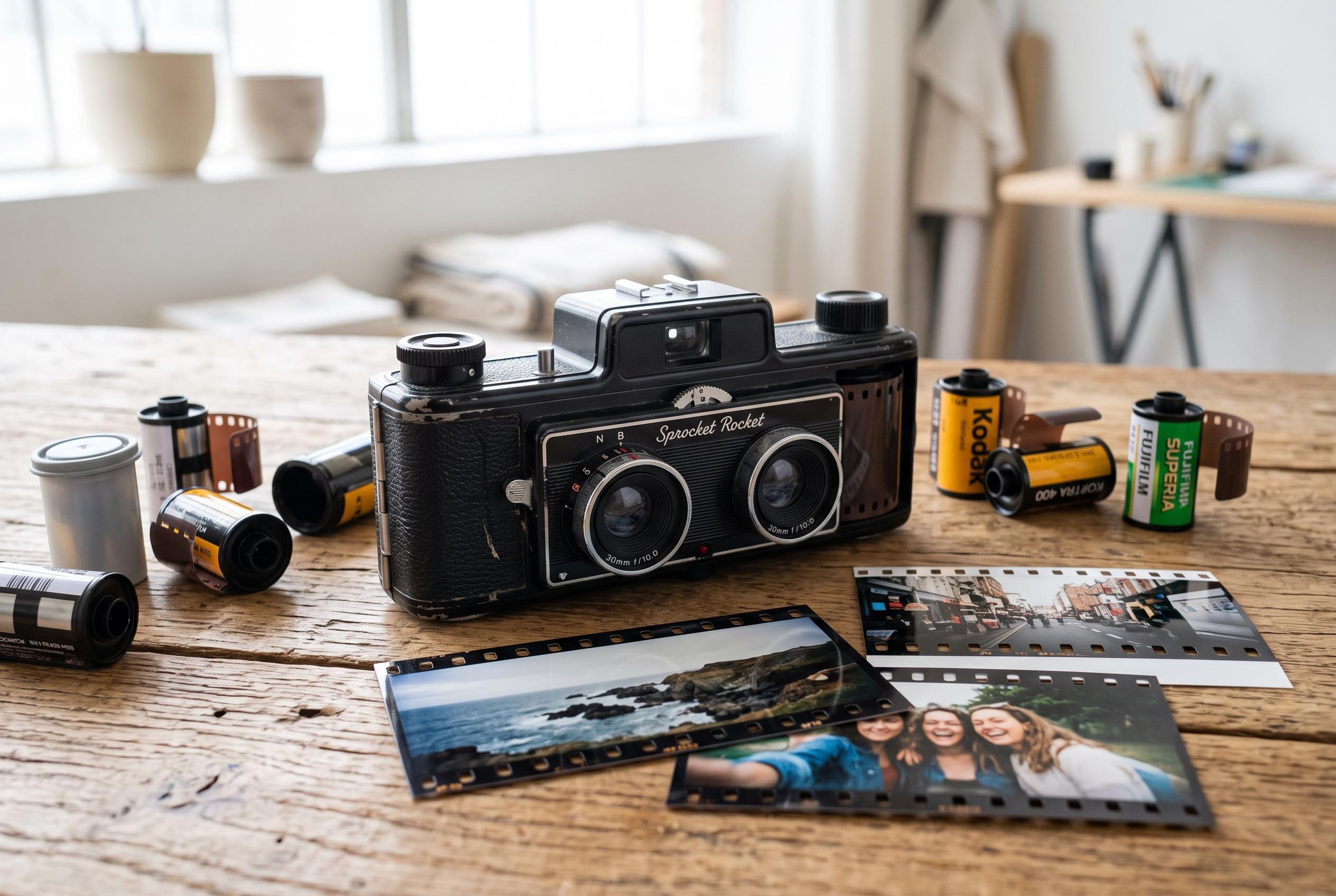

A decade after its launch, the Lomography Sprocket Rocket remains unexplained in its longevity, thanks to its unique panoramic format that turns the sprocket holes into part of the image, appealing to deliberate imperfection enthusiasts amid ongoing updates and colour editions.
More than a decade after its launch, the Lomography Sprocket Rocket is still being refreshed rather than retired, which says something about how unusual its niche remains. Angela Izzo, writing in May 2025, dates the camera’s introduction to 2010, while Lomography and PetaPixel describe it as a model that has been on sale since 2011. PetaPixel reported in February 2024 that Lomography added Bittersweet and Baja Blue editions at $79, and Lomography’s current US product page still lists the camera as a battery-free 35 mm panoramic model with a 30 mm lens, bulb mode, hot shoe and tripod mount. Its premise is still distinctive: instead of hiding the mechanics of 35 mm film, it turns the sprocket perforations into part of the final image. (shootitwithfilm.com)
What the Sprocket Rocket actually offers is not merely a wide frame, but a different way of using ordinary 35 mm film. Barnaby Nutt at EMULSIVE describes it as producing 72×35 mm images, or 72×24 mm when the supplied mask is fitted, with one exposure spanning the width of two standard frames. That leaves 18 pictures from a 36-exposure roll. Lomography markets the format as a 1:3 panorama, and PetaPixel used the same description in its 2024 report, though the masked and unmasked results are plainly not identical. Nutt’s comparison is useful: even the much costlier Hasselblad XPan makes 24×65 mm frames without exposed perforations, so this is not a budget copy of a classic panoramic camera so much as its own eccentric format. (emulsive.org)
The camera’s styling also has more history behind it than its all-plastic shell first suggests. Izzo traces the idea back to the 1930s Falcon Miniature, while Nutt describes the body as art deco and derived from an older bakelite design. On build quality, however, owners are not entirely in agreement. Alex Vye wrote on 35mmc that the lack of electronics and delicate internals made it the sort of camera one could drop at a fairground without much concern. Izzo takes a less forgiving view, advising users to treat it “like a precious toy” because knobs can come loose and the plastic lens is easy to scratch. The combined picture is of a camera that is light and simple rather than truly durable. (shootitwithfilm.com)
Where the Sprocket Rocket wins people over is in actual shooting. Vye’s account of taking it to a travelling fair is more revealing than any specification sheet. Using expired Lomography 400 colour film, he found the fixed exposure unexpectedly useful in scenes with both bright highlights and dark shade, writing that it “gives the whole picture, as my eyes saw it”. He also notes that pointing it towards the sun is less troublesome than with a metered camera that might turn foreground subjects into silhouettes. The trade-off was predictable overexposure: with sunny-16 conditions, ISO 100 would have been the neater match, and his ISO 400 roll ended up roughly one to two stops hot. Izzo’s travel-based review reaches a similar conclusion from a different direction, arguing that the camera is at its best outdoors for landscapes, architecture and motion-heavy double exposures. (35mmc.com)
The bulb setting expands that remit beyond bright daytime use. In Analogue Wonderland’s 2022 community test, Toby Mason paired the Sprocket Rocket with Lomography Babylon 13 and worked on a wet, windy Brighton seafront using a GorillaPod and a light-meter app on his phone. Because the film was so slow, exposures ran to more than four seconds, and Mason said the smoothed water gave the pictures a “dreamy, pinhole quality”. He also found the camera especially good for ghostly double exposures because deciding whether to advance the film is the only real operation required. Lomography’s own specification page confirms that there is no cable-release socket, which keeps the long-exposure experience simple but limits precision. (analoguewonderland.co.uk)
That same simplicity is also the Sprocket Rocket’s main source of frustration. Vye says he sometimes failed to advance the film fully, causing one frame to bleed into the next, and he identifies the shutter-speed lever as another weak point because it can slip into bulb mode unexpectedly. Izzo makes much the same warning, and says her first encounter with the camera was awkward enough that she had to watch a YouTube tutorial “just to figure out how to load and shoot with it!” Nutt adds that the uncoupled shutter and twin winding knobs allow the film to be moved forwards or backwards at will, which is excellent for deliberate remixes and continuous panoramas but equally helpful if one wants accidental doubles, uneven spacing or blank frames from a forgotten lens cap. (35mmc.com)
The hidden complication comes after the film has been exposed. Processing is straightforward because the camera uses ordinary 35 mm stock, but scanning is another matter. Vye says his home scanner cropped away the sprocket holes completely, which rather defeats the point of the format. Nutt recommends Lomography’s DigitaLIZA scanning mask or a sheet of anti-reflective glass to keep negatives flat on the scanner bed. Lomography still sells DigitaLIZA accessories specifically described as suitable for exposed sprocket holes, extra-long panoramas and overlapping exposures, which is a practical acknowledgement that the Sprocket Rocket’s most recognisable look is not automatically supported by normal lab workflows. (35mmc.com)
Taken together, these reviews describe a camera that is far narrower in purpose than a standard compact, but more coherent than a mere novelty. Nutt calls the plastic lens merely “OK”, and none of the writers pretend the controls are foolproof. Even so, the Sprocket Rocket has persisted from the early 2010s into a period of new colour editions and continued shop listings because it offers something that very few other cameras provide straight from the box: genuinely panoramic 35 mm pictures in which the film’s own edges are part of the composition. For photographers who want a dependable all-rounder, it makes little sense. For those who want repeatable, intentional imperfection, it remains one of Lomography’s more persuasive ideas. (emulsive.org)
Disclaimer: This content is intended for informational purposes only. Readers are advised to exercise their own judgement, conduct due diligence, or consult a qualified expert before acting on any information provided.