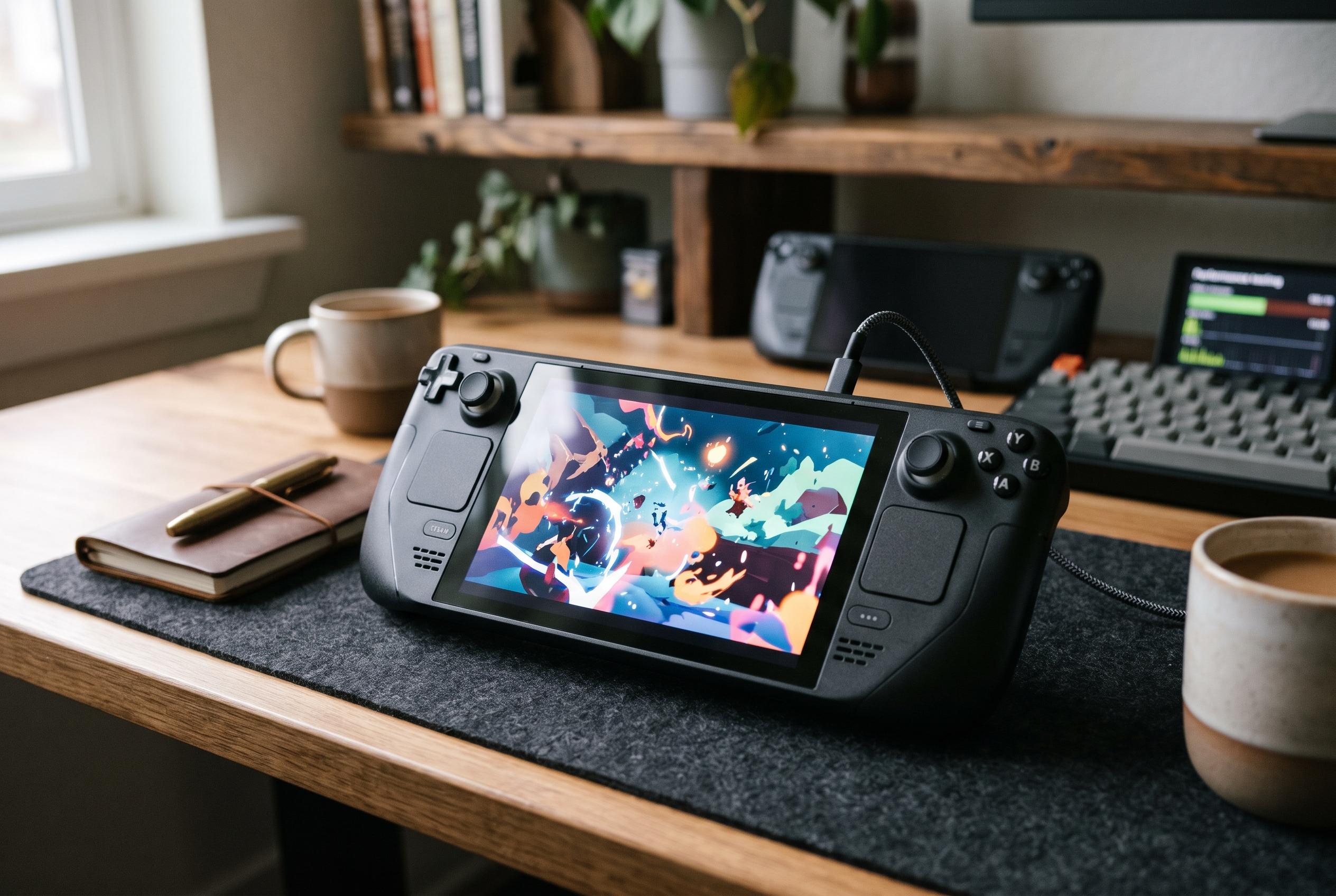

The Claw 8 EX AI+ delivers the fastest portable gaming performance tested by Trusted Reviews, but its IPS display and £1,399.99 price make the trade-offs hard to ignore.
MSI’s Claw 8 EX AI+ CG3EM is a rare thing in the Windows handheld market: a machine that appears to have been designed first around performance, and only afterwards around price. Trusted Reviews says it is the first handheld to use Intel’s new Arc G3 Extreme platform, and that the result is the fastest portable gaming system it has tested so far. That power comes in a large 8-inch chassis with 32GB of LPDDR5X memory, a 1TB SSD and an 80Wh battery, but it also pushes the retail price to £1,399.99, a level that places it well above several major rivals.
The design is more restrained in use than its dimensions might suggest. Trusted Reviews found the body wider than many competing devices, but still steady in the hand, helped by a weight of 785g that is lower than some larger alternatives. MSI has also kept its unusual colour choices, with the review describing a dark purple finish and illuminated thumbstick rings. The control layout follows the familiar Xbox pattern, while Hall effect thumbsticks, Hall effect triggers and a revised D-pad give the device a more premium feel. Ports are sensible rather than expansive, with two USB4 Type-C connections, a microSD card slot and a headphone jack, though no integrated kickstand is included.
The display is the most obvious compromise. According to Trusted Reviews, MSI has stayed with a 1920 x 1200 IPS panel at 120Hz rather than moving to OLED, even as that technology becomes more common in premium handhelds from Asus, Lenovo and Valve. Independent reviews from Tom’s Hardware, Notebookcheck and TechRadar reach the same broad conclusion: the screen is bright, sharp enough for the size and perfectly adequate for gaming, but it lacks the contrast and depth of an OLED alternative. Trusted Reviews measured peak brightness at 483.4 nits and found colour coverage suitable for mainstream play, but not especially strong beyond sRGB work.
Performance, however, is the device’s defining feature. Trusted Reviews reported major gains over AMD-powered rivals, both when the handheld was plugged in and when running on battery. In its testing, games such as Cyberpunk 2077 and Returnal ran at notably higher frame rates than on the Legion Go 2, while lighter titles were able to approach the panel’s 120Hz ceiling. Intel’s own XeSS documentation explains that Panther Lake supports XeSS Super Resolution, Frame Generation and Low Latency, with Multi Frame Generation limited to Intel hardware, which helps to explain the Claw’s performance claims. Trusted Reviews said the handheld could use Intel’s frame-generation tools to push Cyberpunk 2077 far higher still, although that does not remove the usual latency trade-offs associated with generated frames.
Battery life is respectable rather than class-leading. Trusted Reviews recorded about two and a half hours in a gaming test, even though the 80Wh cell delivered much longer endurance in lighter office-style use. Charging is reasonably quick with the included 65W adapter, but the numbers still place the Claw 8 EX AI+ in the same general range as other high-power handhelds rather than creating a clear advantage. Software remains the other sticking point. The unit runs full Windows 11, and while Microsoft’s Xbox full-screen experience makes launching games easier, Trusted Reviews noted that desktop-style tasks remain awkward on a handheld with no trackpad. MSI’s own launcher is useful, but not as polished as the better handheld interfaces on the market.
For buyers who prioritise raw frame rates above all else, the Claw 8 EX AI+ CG3EM is one of the strongest arguments yet for Intel in portable gaming. The broader review consensus is that MSI has built a technically impressive machine with strong controls, a comfortable shape and class-leading performance, but one that still asks users to accept an IPS screen and a very high asking price. In a market where OLED panels are becoming increasingly standard in premium devices, that trade-off may matter just as much as the benchmark charts.
Disclaimer: This content is intended for informational purposes only. Readers are advised to exercise their own judgement, conduct due diligence, or consult a qualified expert before acting on any information provided.