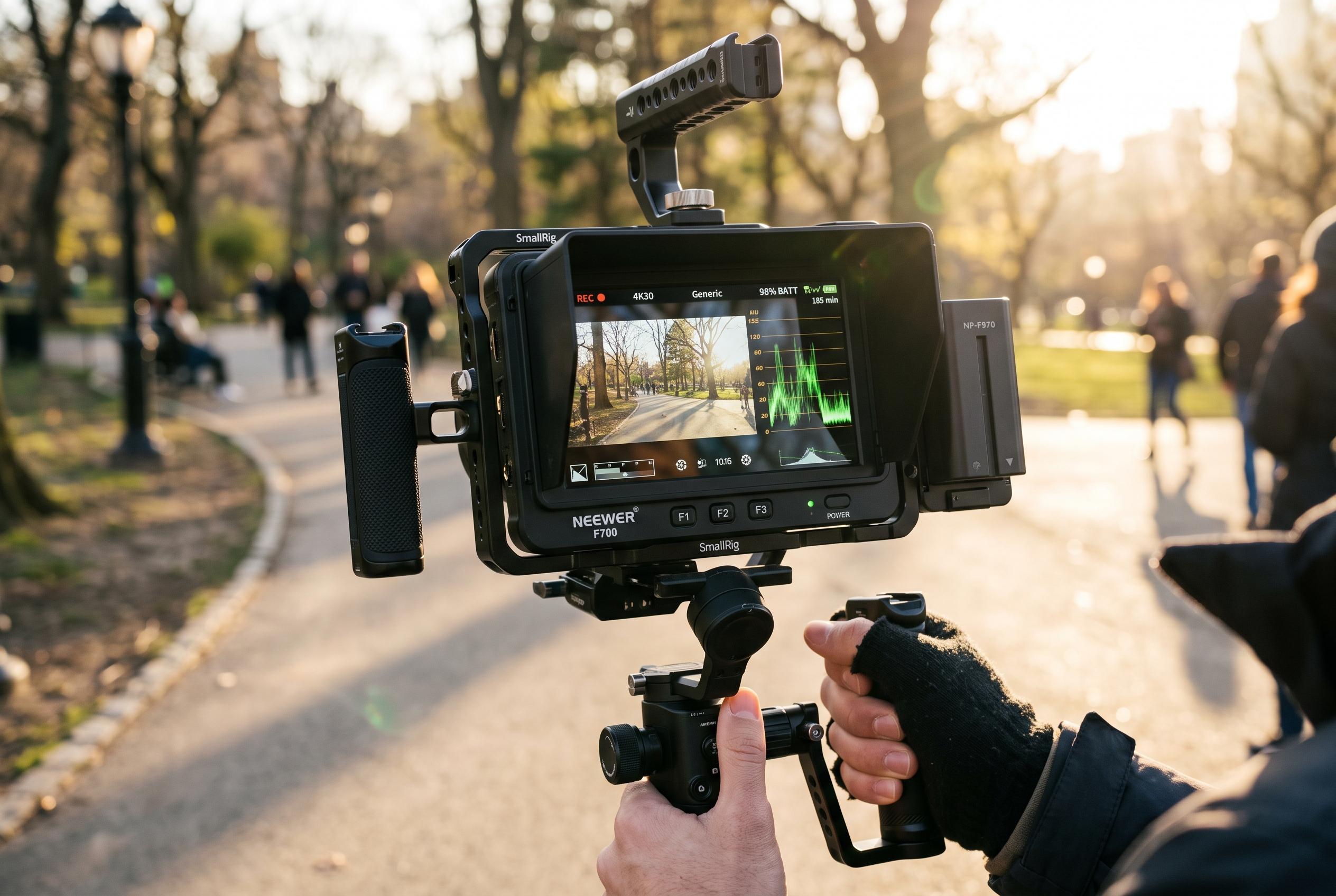

As bright daylight challenges camera screens, the latest field monitors like the NEEWER F700 are setting new standards in brightness, usability, and power efficiency, transforming outdoor shooting for filmmakers.
In bright daylight, a field monitor is less a convenience than a control surface. A camera’s built-in display can look fine indoors and fail badly once direct sun, reflective ground or a low-angle sky enters the frame. That is why the better monitors in this category are judged not only on their claimed brightness, but on anti-glare treatment, toolset, power options and how usable they remain when the light turns hostile. Short Film Central’s August 2026 roundup, supported by recent reviews from Digital Camera World and Review & Rating, places the NEEWER F700 at the front of the pack for combining a 2,000-nit panel with a practical professional feature set.
The NEEWER F700 stands out because it does several things well at once. Digital Camera World describes it as bright, clear and easy to use, while Review & Rating highlights the responsive touchscreen, full exposure tools and 4K HDMI loop-through. That matters on set, where a monitor has to do more than display an image: it may need to feed a director’s screen, help with focus and exposure, and run long enough to finish the day. Short Film Central also notes that the F700’s included batteries make it a particularly strong choice for solo operators and small crews working outdoors.
For buyers trying to balance cost and visibility, the FEELWORLD F5 Prox remains the most obvious value option in the guide. Short Film Central says its 1,600-nit panel is bright enough for most outdoor work, and the included sunshade, battery and cabling reduce the hidden cost that often makes cheaper monitors less attractive in practice. Its 5.5-inch size also keeps it light enough for gimbals and handheld rigs, which is why it suits run-and-gun documentary work better than bulkier seven-inch displays. The same guide positions the osee T5+ as the more frugal route still, but one that is best treated as a minimum daylight solution rather than an all-condition monitor.
At the high end of brightness, the FEELWORLD LUT7 and VILTROX DC-X3 show the two ways manufacturers approach difficult light. The LUT7 pushes to 2,200 nits and adds an ambient-light sensor, which helps it react to changing conditions without constant manual adjustment. The VILTROX DC-X3 reaches 2,000 nits but pairs that with a matte anti-glare finish and SDI connectivity, making it more suitable for cinema-camera workflows where signal locking and longer cable runs matter. Short Film Central treats both as serious daylight tools, but for different users: the LUT7 for sheer brightness, the DC-X3 for professional integration.
The practical lesson across the field is that brightness alone is not enough. Short Film Central’s testing suggests that 1,000 nits is a workable floor for outdoor use, but a sun hood becomes essential as soon as light gets hard or reflective. Between 1,200 and 1,600 nits, most shooters can work comfortably in ordinary daylight; at 2,000 nits and above, visibility becomes far more dependable in sand, snow or water reflections. Power remains the other limiting factor. Higher-brightness screens drain batteries faster, so built-in batteries, USB-C power or loop-through power options can matter as much as the panel itself when the shoot runs long.
Taken together, the market has settled into clear tiers. The NEEWER F700 is the most rounded choice for working daylight visibility; the FEELWORLD F5 Prox is the most sensible value buy; and the brightest displays are best reserved for crews that genuinely face punishing light rather than simply wanting a larger number on the spec sheet. For most shooters, the right answer is not the brightest monitor available, but the one whose screen, hood, power system and connector layout match the way they actually work.
Disclaimer: This content is intended for informational purposes only. Readers are advised to exercise their own judgement, conduct due diligence, or consult a qualified expert before acting on any information provided.