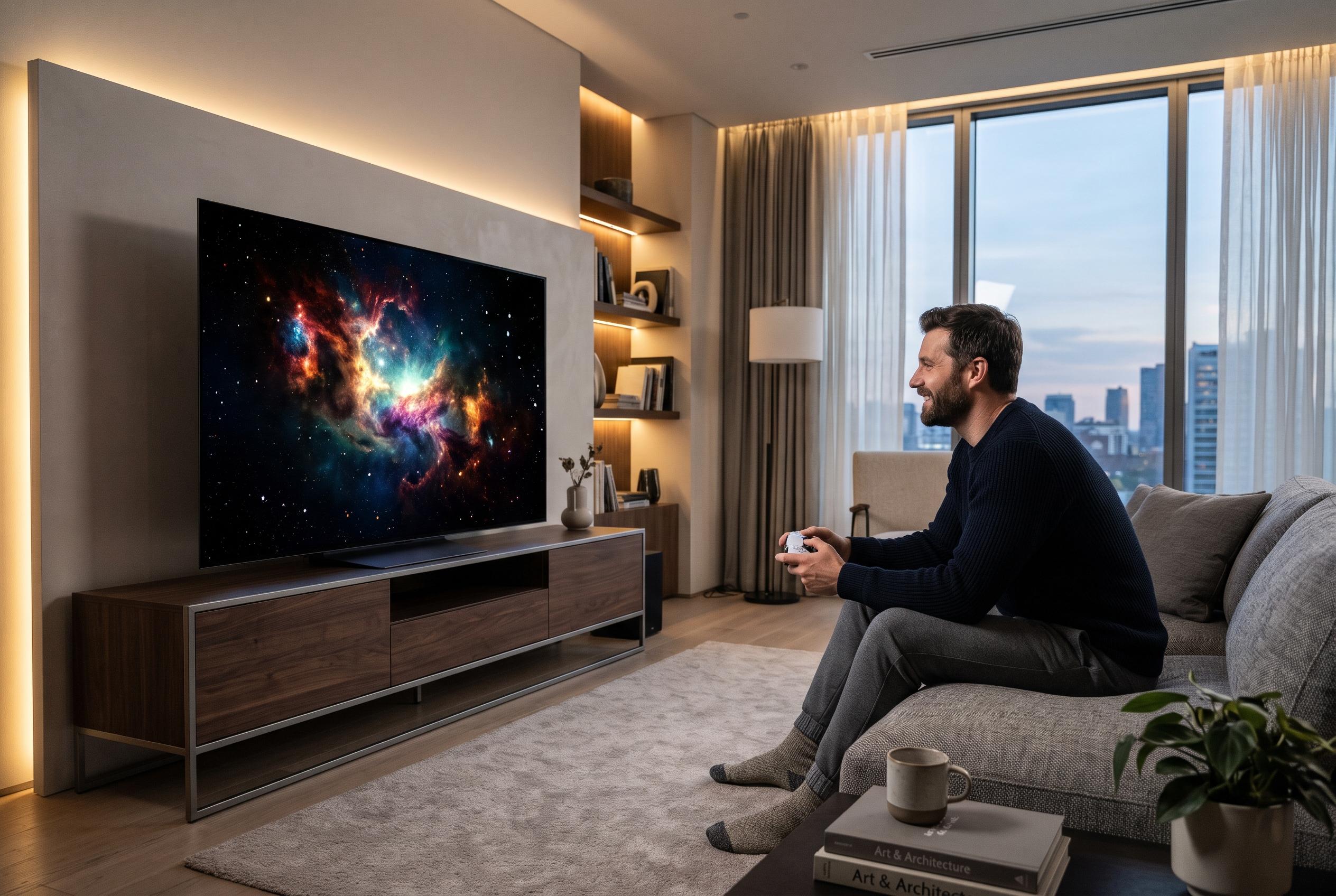

Philips’s flagship OLED delivers exceptional brightness, deep contrast and a 165Hz gaming specification, but its high price and less mature Titan OS make the upgrade a qualified one.
Philips’ OLED951 is pitched as a statement television: a flagship OLED built around a new tandem panel, four-sided Ambilight and a more ambitious gaming spec than Philips has offered on many previous models. At nearly €3,200, though, expectations are correspondingly high, and the shift from Google TV to Titan OS means the set is not simply competing on picture quality. It is also being judged on software maturity, app choice and how well it fits into a modern living room.
The screen is the centrepiece. Reviewers note that the tandem WOLED panel delivers unusually high brightness for an OLED, while preserving the deep blacks and strong contrast the technology is known for. Les Numériques measured a peak of 2,670 cd/m² on a 10% window and reported accurate colour reproduction in its reference mode, with a very low average delta E of 1.7. Other testing went further, with Netzwelt saying the OLED951 reached as much as 4,855 nits in its measurements, a figure that underlines how aggressively Philips is pushing the panel. The result, according to multiple reviews, is a picture that can look both vivid and controlled, even in difficult HDR material.
Philips also appears to have invested heavily in image processing. The television uses a dual-engine processor, and reviewers say motion handling, highlight control and scene management are among its strengths. That matters because high-brightness OLED sets can easily overdo processing and introduce artefacts. Les Numériques did note some banding in complex scenes and said the anti-artifact system could occasionally add its own distortions, suggesting the processing is powerful but not flawless. Even so, the balance of the verdicts points towards a set that is technically accomplished and aimed at viewers who want a reference-grade picture with extra punch.
Gaming support is similarly well specified. The OLED951 includes four HDMI 2.1 ports, a 165Hz refresh rate and variable refresh rate support, with coverage in the reviews pointing to compatibility with both AMD FreeSync and Nvidia G-Sync. That makes the set particularly attractive to owners of current-generation consoles and gaming PCs who want a large screen without giving up high-end video features. Reviewers also highlight a dedicated gaming menu with detailed settings, which should help advanced users tune the panel more precisely.
The bigger question is whether Philips has made the software trade-off worth it. Titan OS is generally presented as lighter and less mature than Google TV, with a smaller app library and more limited casting from a phone. That is a meaningful change for a premium television, particularly for buyers who use streaming apps extensively or rely on simple wireless sharing from mobile devices. The set’s sound system, meanwhile, does not appear to match its price, with some reviewers saying audio performance is underwhelming for a flagship model. Design was also described as more restrained than distinctive, despite the presence of Ambilight.
Taken together, the OLED951 looks like a television built for buyers who place picture quality and gaming capability above all else. If the goal is to get one of the brightest OLED images currently available, plus Philips’ immersive backlighting and a dense feature set for console and PC play, it has a strong case. But the software downgrade from Google TV, the mixed comments on audio and the premium price mean this is not an automatic recommendation. It is a specialist product, and one that will appeal most to enthusiasts prepared to pay extra for the panel and the performance that sit at its core.
Disclaimer: This content is intended for informational purposes only. Readers are advised to exercise their own judgement, conduct due diligence, or consult a qualified expert before acting on any information provided.