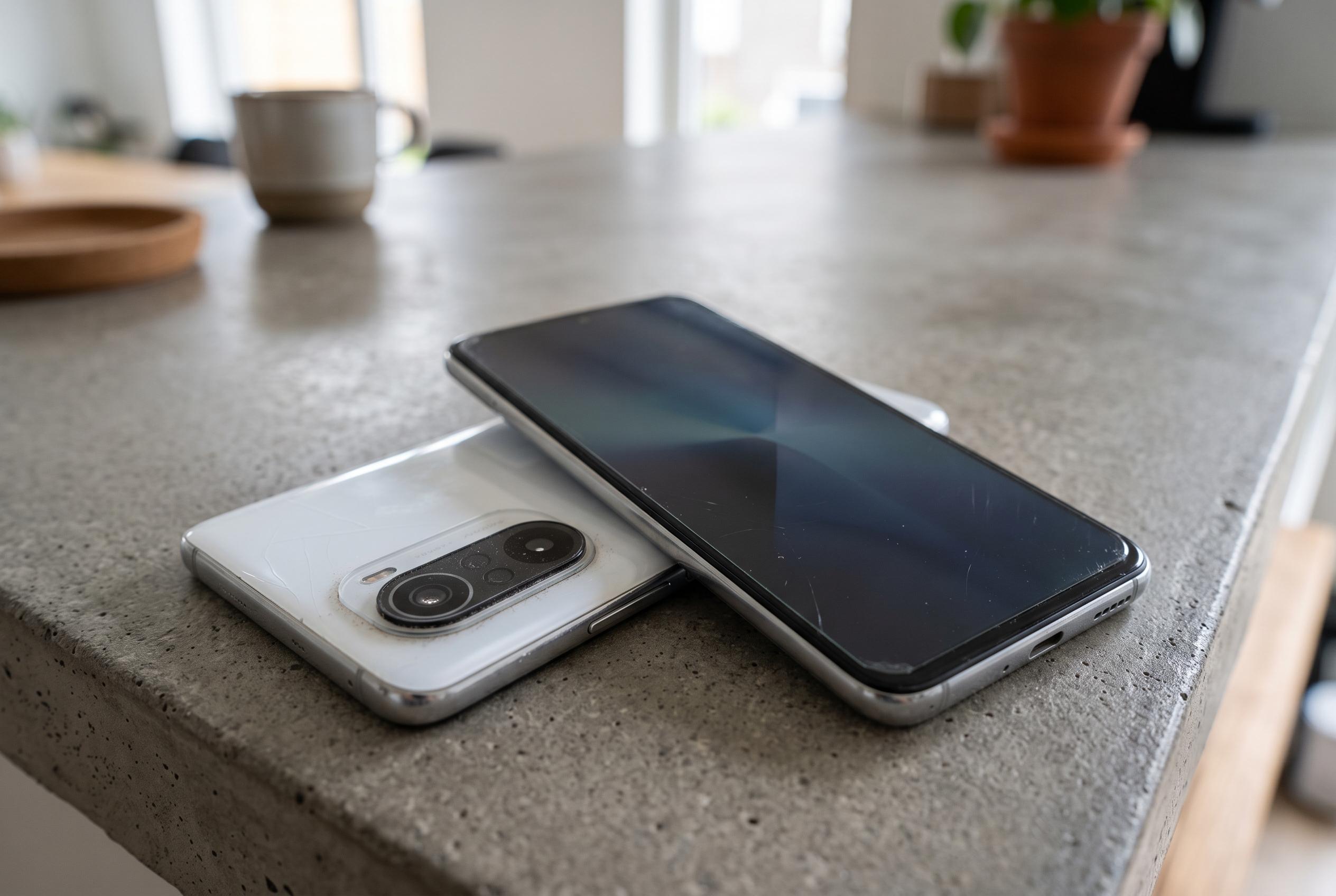

Five years on, the POCO F3 remains physically resilient and displays strong performance, but its software support and battery life reveal its age as a mid-range device in 2026.
Five years on, the POCO F3 still looks like a phone from a different era, but it has not fallen apart in the way many mid-range devices do. The handset in this long-term test remains physically intact, with only light surface wear on the screen and no major damage to the body. Its slim profile, matte finish and side-mounted fingerprint reader still feel practical by modern standards, while the Gorilla Glass 5 front has clearly helped it survive daily use. TechAdvisor and TechRadar both praised the phone’s overall build and design at launch, and that judgement appears to have aged well.
The display is another area where the POCO F3 continues to hold up. It was widely commended for its bright AMOLED panel, and that strength still matters in 2026: colours remain vivid, video playback still looks clean, and there is no sign of burn-in in this unit. The weakness is auto-brightness, which can feel slow or slightly inconsistent in low-light situations. That is less a flaw of the panel itself than a sign of how much smarter current phones have become in day-to-day light sensing. TechRadar’s original review highlighted the screen’s colour accuracy and brightness, and the long-term experience broadly confirms that assessment.
Performance is where the Snapdragon 870 still earns its reputation. For browsing, messaging, streaming and general app switching, the phone remains responsive enough to serve as a light-to-medium daily driver. That lines up with earlier reviews from Android Central and TechAdvisor, which described the chip as delivering near-flagship speed for the class. In practical terms, the POCO F3 no longer feels cutting-edge, but it also does not feel slow in ordinary use.
Software support is now the clearest limitation. The device is stuck on HyperOS 1, and the long-term test found it running version 1.0.6.0 with no path to newer feature releases. Xiaomi’s newer HyperOS rollout has moved well beyond this generation, leaving the F3 behind. That matters because security, polish and compatibility all depend on continued support, and this is now a handset that relies on its hardware rather than its software future. TechRadar had already noted MIUI’s ad-heavy behaviour and other software irritations when the phone was new; those complaints are easier to overlook now simply because support has largely ended.
The camera system is mixed, but still usable. Daylight shots from the main and 2x modes remain the most convincing, while the ultrawide lens is less consistent in colour and tone. Portrait mode can still produce clean results if AI processing is left off, and video capture remains serviceable, particularly from the main camera. The battery is the real compromise: the original 4,520mAh cell has degraded to the point that light use delivers only a little over two hours of screen-on time. That is a sharp fall from the stronger endurance reported in launch-era testing by Android Central and CHIP, both of which found the F3 capable of all-day use and relatively quick charging. The final verdict is simple: the POCO F3 is no longer a sensible new purchase, but as a used phone it still offers a rare blend of durability, speed and display quality, provided the buyer can live with poor battery life and frozen software.
Disclaimer: This content is intended for informational purposes only. Readers are advised to exercise their own judgement, conduct due diligence, or consult a qualified expert before acting on any information provided.