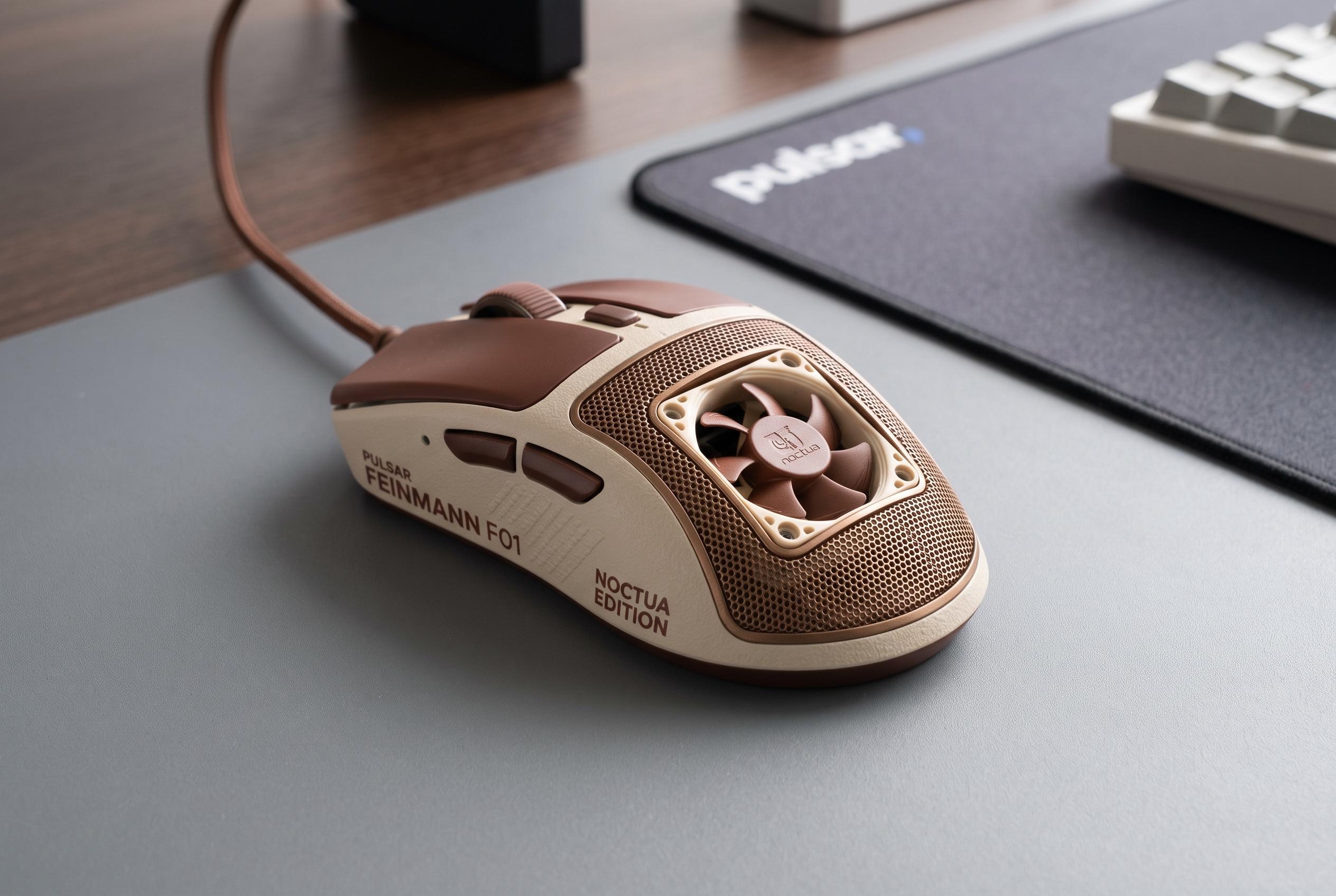

Pulsar’s latest gaming mouse, the Feinmann F01 Noctua Edition, introduces a built-in Noctua fan to combat sweaty hands, offering a novel but niche solution with premium price and mixed reviews.
Pulsar’s Feinmann F01 Noctua Edition is a striking example of hardware engineering built around a very narrow problem: sweaty hands. PC Gamer’s review describes it as one of the most unusual gaming mice in years, and also one of the most expensive, with a £199 asking price in Europe and $180 in the US. The concept is simple enough. An integrated Noctua fan pushes air through the shell to cool the palm during play, while the rest of the mouse aims to behave like a serious competitive device rather than a novelty.
The specification sheet is not lacking. Noctua’s published details list the mouse at 121.7 x 66.5 x 43.3 mm and 73 g, with Pulsar’s XS-2 sensor offering up to 42,000 DPI, 800 IPS tracking and an 8,000 Hz polling rate. Pulsar says the mouse also includes a 500mAh battery and right-handed ergonomics, while Noctua identifies the fan as its NF-A4x10 5V PWM unit, rated for 0 to 5,000 rpm and up to 8.9 m³/h of airflow at 19.6 dB(A). In practice, that puts the F01 firmly in premium territory, both in feature set and in price.
The design is as divisive as its purpose. The mouse uses a perforated carbon-composite shell to make room for airflow and reduce weight, but the open structure gives it an unmistakably industrial look. PC Gamer said the shell felt sturdier than it looked, with little flex under pressure, and noted that the fan remained stable during rapid movement. The review also highlighted the fan’s on-device controls, which let users change intensity without going into software, and described the airflow as a gentle stream rather than a harsh blast.
Where the F01 earns its keep is in use. PC Gamer found the cooling especially valuable in fast, hand-intensive games such as Counter-Strike 2, where the reviewer’s palm stayed noticeably fresher during longer sessions. The same benefit carried over to horror and action titles, where tension and repeated movement can quickly raise hand temperature. The mouse’s optical switches were also praised for their speed and crisp sound, and the reviewer said its sensor felt accurate in slower, more relaxed work such as digital painting.
The trade-offs are harder to ignore. Battery life falls sharply when the fan and high polling rate are used together, and PC Gamer reported that the mouse could lose nearly half its charge in a little over two hours under heavy settings. Even at lower polling rates, it still needed regular charging, which weakens the case for wireless use. That leaves the Feinmann F01 Noctua Edition as a clever but very specific product: technically impressive, comfortable and genuinely useful for a subset of players, but difficult to recommend when lighter, longer-lasting competitive mice cost less.
Disclaimer: This content is intended for informational purposes only. Readers are advised to exercise their own judgement, conduct due diligence, or consult a qualified expert before acting on any information provided.