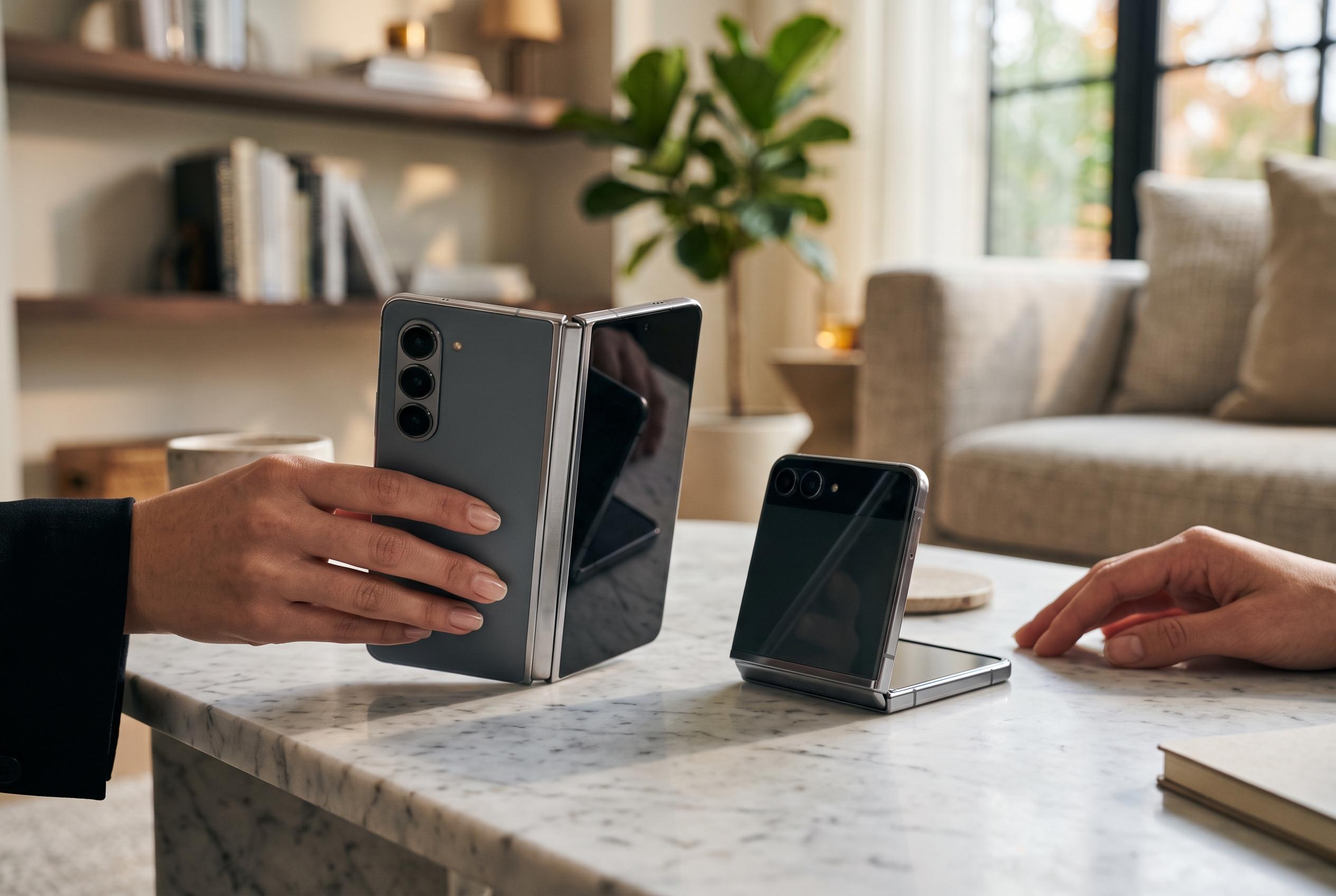

Samsung’s Galaxy Z Fold 8 and Motorola’s Razr Fold showcase contrasting approaches to the premium foldable market, shifting focus to usability versus practical features like battery life and camera quality, leaving buyers to decide which aligns best with their priorities.
Samsung and Motorola have each taken a different route into the premium foldable market, and the contrast now feels sharper than ever. The Galaxy Z Fold 8 has been redesigned around a wider cover screen and a landscape-friendly inner panel, while the Motorola Razr Fold is positioned as a more conventional book-style rival with stronger cameras, a larger battery and a lower-friction approach to hardware value. Android Authority’s hands-on assessment suggests there is no obvious wrong choice, but the better option depends on what buyers value most.
Samsung’s case rests on usability. According to Android Authority, the Fold 8’s 5.5-inch outer display is wide enough for comfortable typing and general use, while the 7.6-inch inner screen makes multitasking and media consumption feel natural. That is reinforced by Samsung’s One UI 9 software, which has been refined for split-screen work, app pairs and flexible window sizing. Samsung has also doubled down on long-term support, a point that matters in a device that starts at $1,899 and is meant to last for years. The company’s latest foldables, launched on 7 August 2026, also use silicon-carbon battery technology, with Samsung opting for a conservative implementation that balances capacity gains against safety and thermal stability, according to Android Central.
Motorola’s Razr Fold, by contrast, leans on practical advantages that are easier to see in daily use. Android Authority says its 6.6-inch cover screen and 8.1-inch inner display are both easy to live with, and the phone adds stylus support, which Samsung still omits from this category. The Razr Fold also uses a 6,000mAh silicon-carbon battery, and Motorola has paired that with 80W wired charging and 50W wireless charging, giving it a clear lead on endurance and recharge speed. That battery setup is larger than Samsung’s and is one reason the phone can stretch to roughly two days on a charge, even with heavier inner-screen use.
Camera hardware is where the Motorola model appears to pull ahead most decisively. Android Authority reports that the Razr Fold’s triple 50-megapixel system, including a 3x telephoto lens, produces sharper and more versatile results than the Fold 8’s more modest camera array. That matters because Samsung’s foldable, despite its improved design and lower weight of 201g, is still seen as making trade-offs in imaging. Motorola’s phone is heavier at 243g, but its camera package and larger battery make it feel more complete as an all-round flagship alternative.
Performance and software support remain the most nuanced part of the comparison. Samsung’s Fold 8 uses the Snapdragon 8 Elite Gen 5 with 12GB of RAM, according to Android Authority, while Motorola has chosen the Snapdragon 8 Gen 5 and pairs it with 16GB of RAM and 512GB of storage as standard. Reviews from Tom’s Guide and TechRadar say the Razr Fold still feels fast and capable in everyday use, despite using the slightly less ambitious chip. Samsung’s stronger software track record may still make it the safer long-term bet, but Motorola has shown enough progress that the gap is no longer as wide as it once was.
For buyers, the decision comes down to intent. The Galaxy Z Fold 8 is the more polished choice for people who want foldables to feel immediately useful without demanding a productivity-first workflow. The Razr Fold is the stronger option for anyone who wants the best battery life, better cameras and more storage for the same $1,899 outlay. In a category still defined by compromise, Motorola appears to have cut fewer corners.
Disclaimer: This content is intended for informational purposes only. Readers are advised to exercise their own judgement, conduct due diligence, or consult a qualified expert before acting on any information provided.