
After two weeks of use, Raymond Wong highlights a behavioural shift towards frequent unfolding and reliance on the device’s inner screen, marking a significant milestone for foldable smartphones as Samsung refines its most immersive foldable yet.
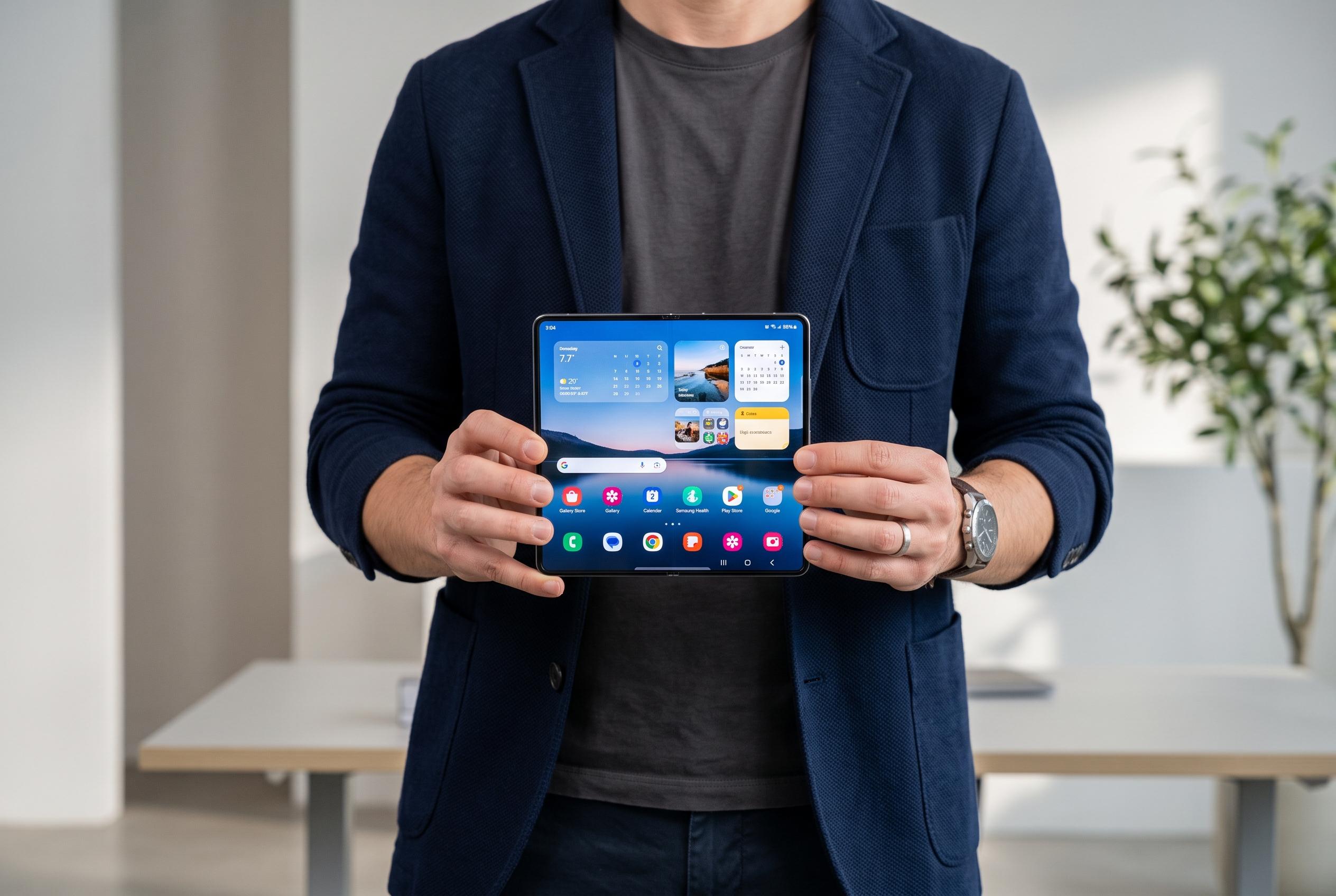
Raymond Wong’s review of the Samsung Galaxy Z Fold 8 suggests the most important change is not a headline feature, but a shift in behaviour. After two weeks of use, he wrote in Gizmodo that he unfolded the device more often than not, and the 7.6-inch inner screen became his default display. That is a notable verdict for a category that has long struggled to justify itself beyond novelty.
The standard Fold 8 is built around use, not specification vanity. Samsung has given it a 7.6-inch inner panel with a 4:3 shape, which makes it particularly well suited to films and games, while the wider Ultra model from the same launch favours reading and vertical multitasking. Reviewers have also noted that the phone is thinner, lighter and easier to live with than earlier generations, helped by the Flex Titanium hinge and an anti-reflective coating that make opening it feel less forced. In broader testing, Tom’s Guide said the Fold 8 stood out for its polished software, light weight and nearly invisible crease.
Samsung has not tried to win on battery alone, but it has improved the fundamentals. The phone uses Qualcomm’s Snapdragon 8 Elite Gen 5 for Galaxy, with 12GB of memory in the base model and 16GB in the 1TB version. It also adopts silicon-carbon battery chemistry, a first for a Samsung foldable, with a 4,800mAh cell and 45-watt wired charging. That combination appears to be enough for full-day use, though reviewers say the handset can run warm under sustained pressure.
The biggest compromise is the camera system. The Fold 8 uses two 50-megapixel rear sensors and omits a telephoto lens, which makes it less versatile than the Ultra, whose 200-megapixel main camera and 3x telephoto give it a clear advantage for zoom. Samsung appears to have accepted that trade-off to keep the Fold 8 slimmer and lighter. According to reviewers, the result is a better-handling device with solid low-light performance and less aggressive HDR processing, even if it cannot match the Ultra for range.
Durability remains a more complicated question. The Fold 8 carries IP48 protection, which means it can handle limited exposure to water and larger dust particles, but it is not fully dustproof. Android Central reported that the rating covers immersion in fresh water, not fine dust or high-pressure jets, while iFixit’s teardown highlighted how sand can still interfere with the hinge. That makes the device more resilient than early foldables, but still sensitive to the kind of grit that ordinary pocket life can bring.
Samsung has also removed S Pen support from this generation, and the narrow outer screen still requires some adjustment. App behaviour across both displays remains uneven, as it does across much of Android’s foldable market. Even so, the Fold 8 is shaping up as the strongest book-style foldable yet, with Gizmodo giving it an Editor’s Choice award and T3 reporting unexpectedly strong demand strong enough to force Samsung to plan additional production. At $1,900, it is still expensive. But for the first time, unfolding it seems less like a compromise and more like the point.
Disclaimer: This content is intended for informational purposes only. Readers are advised to exercise their own judgement, conduct due diligence, or consult a qualified expert before acting on any information provided.