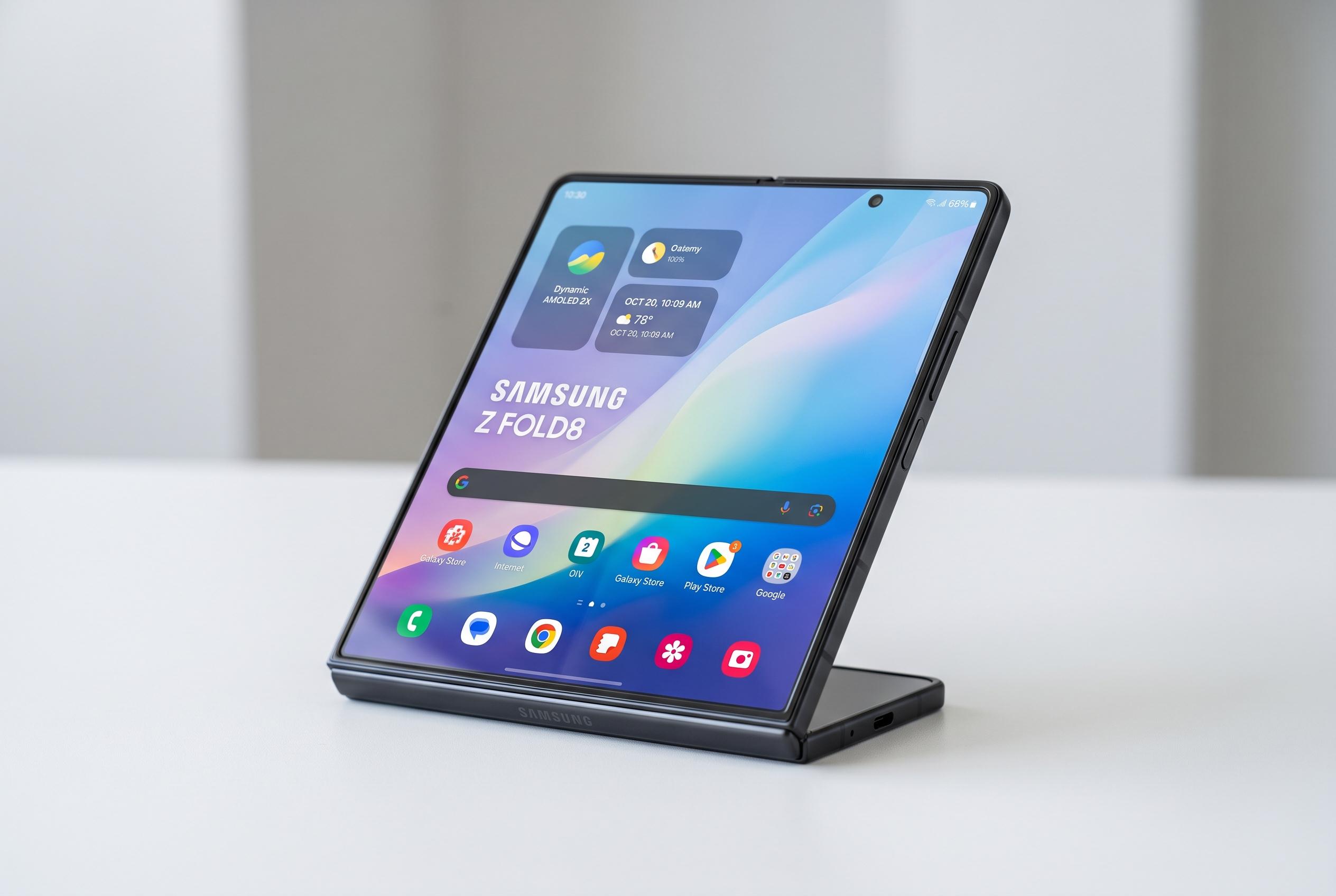

Samsung’s Galaxy Z Fold8 emerges as a significant breakthrough in foldable smartphone design, boasting a balanced shape, enhanced screens, and top-tier hardware, setting a new standard for the category.
Samsung’s Galaxy Z Fold8 is a more convincing argument for foldables than any of its predecessors, chiefly because Samsung has finally settled on a shape that works in both states. The device closes into a wider, more pocketable handset rather than a tall, awkward slab, while opening it reveals a small tablet with a 7.6-inch inner display and a 5.5-inch cover screen. Xataka’s review said that combination makes the phone feel genuinely useful when folded and far better suited to video, browsing and messaging when unfolded. TechRadar and Android Central both noted the same redesign, alongside the Snapdragon 8 Elite Gen 5 processor, up to 16GB of RAM and Samsung’s latest software.
The design is one of the Fold8’s biggest wins. At 201 grams and 4.5mm thick when open, it is still a serious piece of hardware, but the balance and proportions make it feel less like a compromise than earlier Fold models. Xataka praised the sturdier hinge and the noticeably reduced crease, while also pointing out that the device no longer holds a 90-degree Flex position as easily as previous generations. SamMobile’s hands-on report also highlighted the wider cover display and the more compact footprint, which are central to Samsung’s new “passport” format.
The screens are the Fold8’s strongest argument. The outer panel is a 5.5-inch AMOLED display with a 120Hz refresh rate, while the inner 7.6-inch Dynamic AMOLED 2X panel uses a 4:3 aspect ratio that makes it much better for video and split-screen multitasking than the taller format seen on some rivals. Xataka said both panels are bright, sharp and well calibrated, with the inner screen benefiting from anti-reflective coating that cuts down on the plastic feel of older generations. PhoneArena’s specification listing matches those display dimensions and the 4:3 ratio.
Performance is not where Samsung has cut corners. The Fold8 uses the Snapdragon 8 Elite Gen 5 for Galaxy, paired with 12GB of RAM in the reviewed model and up to 16GB in the 1TB version. Xataka reported smooth day-to-day use, strong gaming performance and respectable thermal management despite the slim chassis. TechRadar likewise praised the phone’s speed, while Android Central said Samsung is promising up to seven years of software support on One UI 9 over Android 17.
Battery life is helped by a 4,800mAh cell using silicon-carbon technology, with support for 45W wired charging and 20W wireless charging. That should get most users through a full day, but Xataka found endurance varied depending on how much time was spent on the inner display, with heavy use of the larger screen leaving less headroom by evening. TechRadar also pointed to the battery upgrade as one of the practical gains of this generation.
The camera system is where the Fold8 feels less ambitious. It carries a 50-megapixel main camera, a 50-megapixel ultra-wide and dual 10-megapixel selfie cameras, but there is no telephoto lens. Xataka said the main camera is solid in good light but loses detail as scenes become more complex, while the ultra-wide is the weakest part of the setup. Video is strong from the main sensor and less convincing elsewhere. That matters because Samsung is asking a premium for the device: the Fold8 starts at €1,999 in Europe, with U.S. pricing listed at $1,899 and availability beginning on August 7, 2026 according to Android Central and SamMobile.
Disclaimer: This content is intended for informational purposes only. Readers are advised to exercise their own judgement, conduct due diligence, or consult a qualified expert before acting on any information provided.