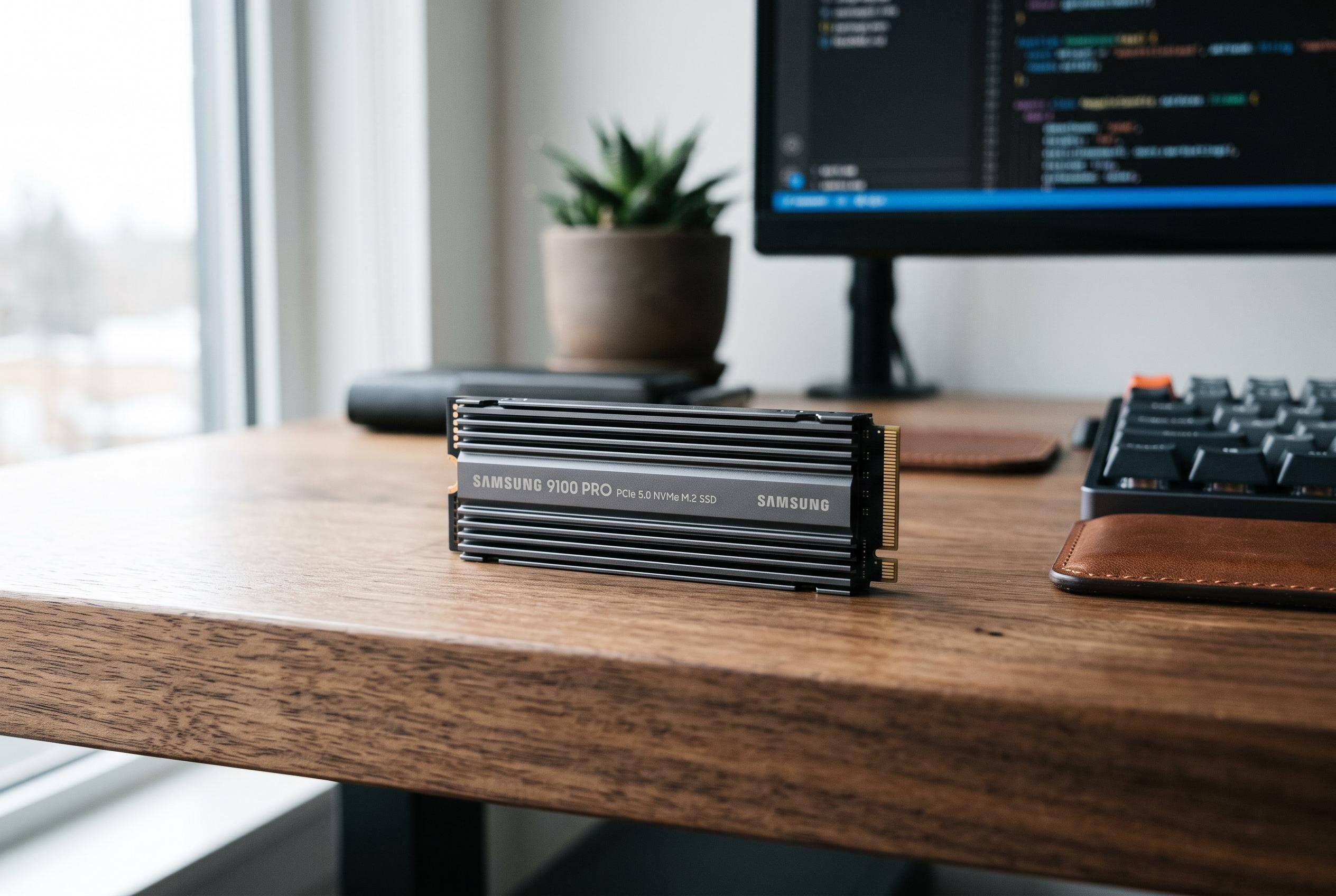

Samsung’s latest 9100 PRO with heatsink signals a significant leap in consumer storage, offering top-tier speeds tailored for demanding gaming and large data tasks, while highlighting the evolving role of SSDs in next-generation systems.
Samsung’s 9100 PRO with Heatsink is a clear sign that consumer storage has moved into a new class of performance, even if that speed is not equally visible in every task. In testing, the drive delivered markedly stronger sequential performance than a capable PCIe 4.0 model, and that gap matters most when a PC is pushing large volumes of data rather than opening apps or loading a desktop. Samsung positions the 9100 PRO as its first true PCIe 5.0 SSD, with quoted top speeds of up to 14,800MB/s read and 13,400MB/s write on higher-capacity models, although independent reviews have found real-world results below the headline figures.
That distinction is important for gamers. A fast PCIe 4.0 drive is already more than adequate for Windows, everyday software and many current titles, and several reviews have said the same thing in different terms: the 9100 PRO is exceptional, but not always transformative in ordinary use. Where it becomes more compelling is in heavy workloads such as moving a game library, installing a very large title, unpacking updates or working with recorded gameplay and other big files. Samsung’s drive is built for exactly that sort of bandwidth-hungry activity, and that is where PCIe 5.0 begins to look less like a benchmark exercise and more like a practical upgrade.
The case for the drive is strengthened by the direction gaming is heading. Microsoft’s DirectStorage is designed to reduce CPU overhead and let compatible games make better use of NVMe storage, which should matter more as game worlds become larger and asset streaming becomes more important. That does not mean every game will suddenly load several times faster, and it does not remove bottlenecks elsewhere in the system. But it does mean that a very fast SSD can increasingly be part of the performance path rather than just a place to store files. Gaming Australia’s testing also found a sizeable jump when DirectStorage was paired with GDeflate compression, underscoring how much modern storage and GPU-assisted decompression can change data movement in supported workloads.
Samsung’s heatsink version adds a sensible layer of practicality. PCIe 5.0 drives can run noticeably hotter under sustained load, and the bundled cooling solution helps the SSD hold performance without relying entirely on a motherboard’s M.2 heatsink. That makes the 9100 PRO easier to drop into a high-end build, and Samsung also lists compatibility with systems including PlayStation 5. Independent reviews have broadly agreed that the drive is efficient for its class and that the compact heatsink is well judged, even where they have been less enthusiastic about the value proposition.
The pricing question remains the biggest obstacle. Tom’s Hardware, TechRadar and PCGamesN have all pointed to the same tension: the 9100 PRO is among the fastest consumer SSDs available, but the premium is hard to justify for many users unless they are buying into a new top-end system or regularly dealing with very large files. For existing PCs with a strong PCIe 4.0 drive, the most sensible arrangement may be to keep the older SSD for Windows and daily apps, then use the Samsung for demanding games and data-heavy work. For a new build, though, the 9100 PRO with Heatsink is a genuinely forward-looking option that shows where storage is heading next.
Disclaimer: This content is intended for informational purposes only. Readers are advised to exercise their own judgement, conduct due diligence, or consult a qualified expert before acting on any information provided.