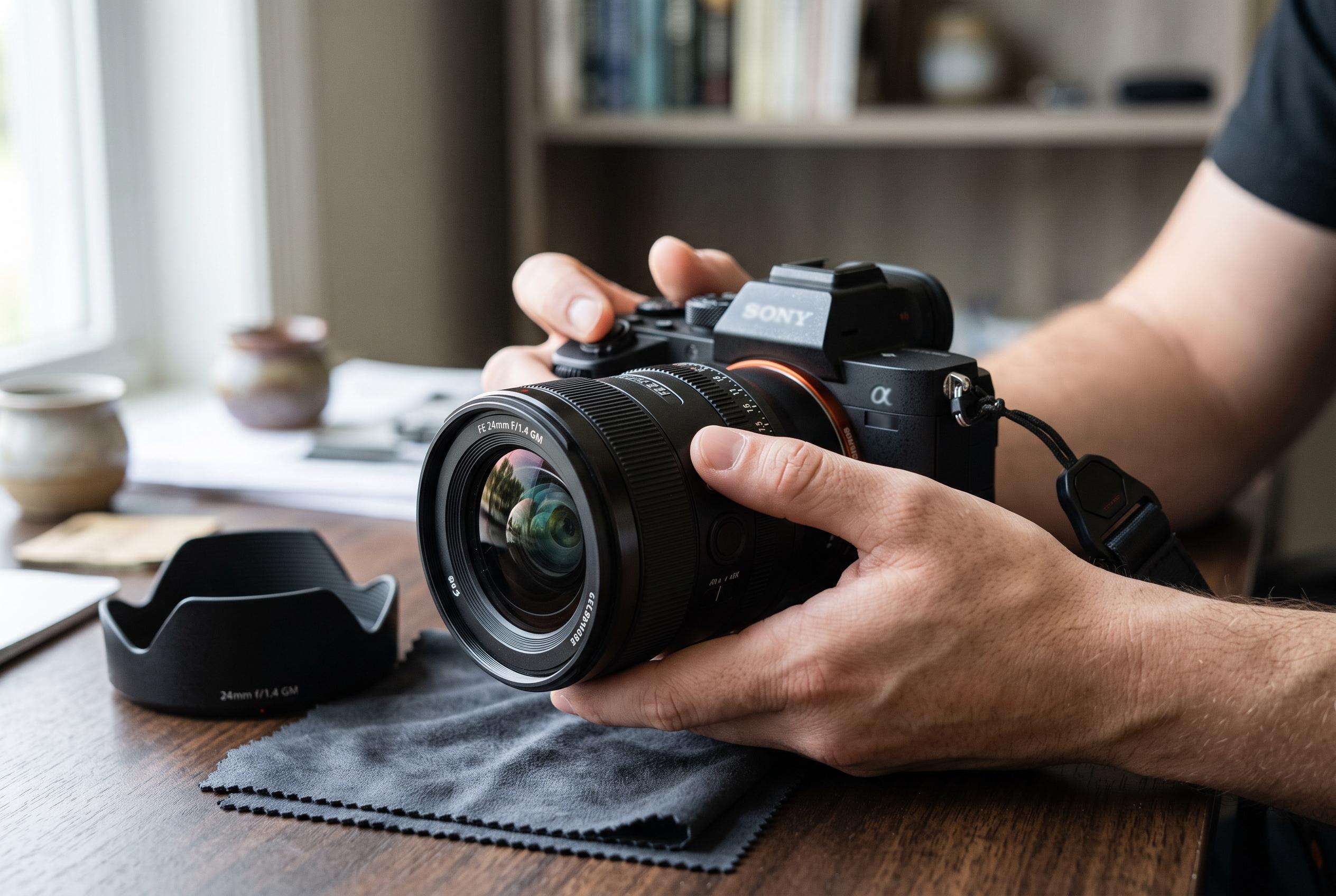

A detailed review confirms the Sony FE 24mm f/1.4 GM’s continued relevance as a compact, optically refined, and reliable wide-angle prime for Sony full-frame cameras, despite the evolution of autofocus technology and changing market prices.
The Sony FE 24mm f/1.4 GM remains one of the clearest examples of how Sony reset expectations for wide-aperture primes on its E-mount system. When it arrived in 2018, it was notable not only for its compact dimensions, but also for how thoroughly it outclassed older DSLR-era 24mm f/1.4 designs. Later reviews have continued to treat it as a reference lens, and updated assessments still describe it as a flagship optic with very few obvious weaknesses.
At 445g, the lens is still unusually light for a full-frame 24mm f/1.4, and its handling reflects Sony’s more established G Master design language. The aperture ring can be clicked or de-clicked, there is a programmable function button, and the focus ring uses linear response, so rotation is consistent regardless of speed. Camera Labs also praised the de-clickable aperture ring, the lockable hood and the focus hold button, while ShutterRelease noted the lens’s compact form and fluorine-coated front element, which helps resist dust, moisture and fingerprints.
Optically, the lens remains highly competitive. Phil Reeve’s updated review found very strong sharpness and contrast across the frame, with particularly good correction of coma and only modest distortion. That matters in practice because wide-angle primes are often compromised at the edges, especially at maximum aperture. Here, the Sony performs well enough that the centre-to-corner transition is controlled rather than distracting, and by f/5.6 the frame is said to be consistently strong. TechRadar likewise described image quality as excellent, with impressive sharpness and contrast even at f/1.4, along with well-managed vignetting.
The rendering is one of the reasons the lens has aged so well. According to Phil Reeve’s testing, it produces especially clean out-of-focus areas for a 24mm f/1.4, with low optical vignetting and little of the cat’s-eye effect that can make backgrounds look harsh near the frame edges. That is important for environmental portraits and close-focus work, where a wide lens can still provide separation without looking nervous or smeared. Cameralabs also highlighted the lens’s pleasing background blur, and several reviews agree that its bokeh is unusually refined for this focal length.
Flare resistance is another area where the Sony still stands out. Phil Reeve found only minor artefacts when strong light sources were in or near the frame, provided the hood was used properly. Cameralabs and TechRadar both reached similar conclusions, describing the lens as resistant to flare, glare and ghosting. That makes it more dependable than many earlier wide primes, which often struggled once bright light entered the composition.
Autofocus is not the newest or fastest type Sony now offers, as the lens uses the company’s older DDSSM system rather than the later XD linear motors found in some recent GM lenses. Even so, the review evidence suggests it is quick and reliable in real use. The lens also focuses close enough at 0.25m to be useful for detail work, and Phil Reeve found that it remained fully usable at minimum focus distance, with field curvature and softness far better controlled than on several competing designs.
What has changed since launch is price. The lens was expensive at introduction, but the used market has made it much easier to justify. For buyers who want a premium 24mm prime for Sony full-frame bodies, the FE 24mm f/1.4 GM still sits close to the top of the list. Specdex went as far as calling it an Editor’s Pick and said it has no significant weak points, while newer lens round-ups from TechRadar still place Sony’s best E-mount glass in a highly competitive field. Even with stronger third-party alternatives now available, this Sony remains the benchmark for compactness, optical polish and practical usability in a 24mm f/1.4.
Disclaimer: This content is intended for informational purposes only. Readers are advised to exercise their own judgement, conduct due diligence, or consult a qualified expert before acting on any information provided.