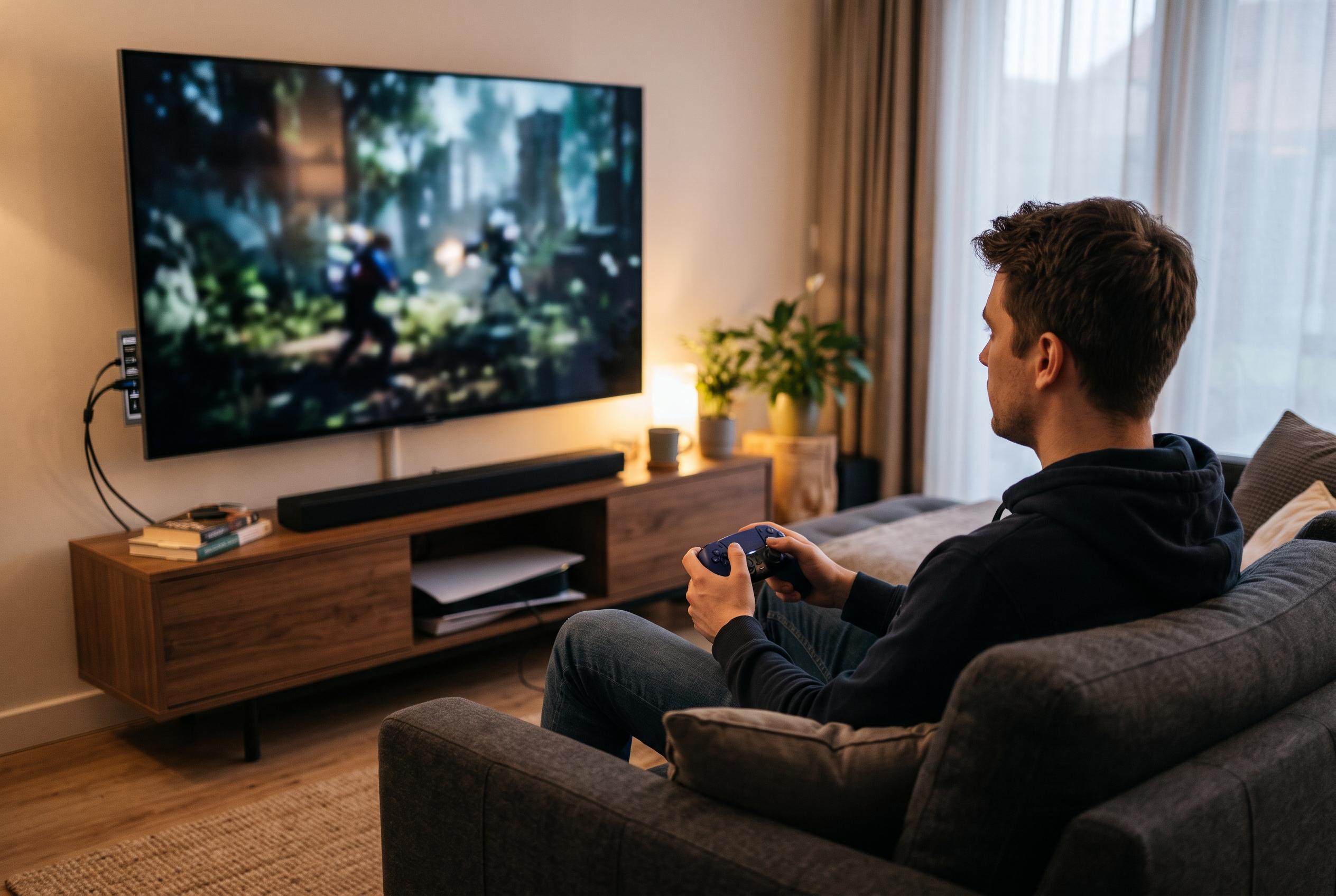

Port-by-port bandwidth, HDR and VRR support separate TCL’s strongest gaming sets from rivals whose HDMI 2.1 labels do not guarantee every feature will work together.
For buyers comparing television specification tables, the real question is not what a port label suggests, but whether a set can sustain 4K at 120Hz with HDR and VRR at the same time on the input a console will actually use. That is where many models fall short. In this comparison, the emphasis falls on usable bandwidth per port, the width of the VRR range, measured latency, dimming behaviour during variable refresh, and how well the backlight and processing hardware hold up over time.
TCL comes out on top because it treats gaming features as part of the hardware rather than as a vague badge. RTINGS says the company’s 2024 QM9K line includes QD-Mini LED panels, a high-refresh display, Game Accelerator 288 VRR, a Game Bar with frame-rate and latency read-outs, and AMD FreeSync Premium Pro. The point of that on-screen Game Bar is practical: it lets a player verify that the television is receiving the mode that was selected, which helps avoid the common problem of a port quietly defaulting to a lesser configuration. Tom’s Guide’s review of the TCL QM8 Mini-LED also found the set strong on brightness and gaming features, although it noted compromises in colour accuracy, reflectivity and sound quality. The broader appeal is that TCL documents port behaviour more clearly than many rivals and offers larger screen sizes, including cinema-scale models, for buyers who want gaming capability without moving into the premium tier.
Sony ranks second because its motion processing remains a key advantage, particularly for mixed libraries that include 40fps and 120fps content. FlatpanelsHD reported that Sony took the LCD category in the 2024 TV Shootout, underscoring the company’s strength in image processing and overall picture quality. That kind of performance matters in games as well as films, especially when frame rates vary or when older titles need careful scaling. The trade-off is cost and, in some models, less generous port allocation than buyers may expect at the price.
Panasonic sits higher for accuracy than for raw gaming specification. Its appeal is the discipline of its picture modes, which makes it attractive to users who divide time between film playback and gaming and do not want to keep switching settings. The downside is a narrower US range and fewer size options, so the brand is less flexible for shoppers trying to match a particular room or budget. Sharp, by contrast, competes on size and price. But Tom’s Guide’s review of a Sharp Aquos QLED model found limited brightness, visible blooming, washed-out colour, poor shadow detail, choppy motion and weak viewing angles, which is a reminder that a large panel is not enough if gaming responsiveness and contrast performance are compromised.
The value end of the market is more uneven. RTINGS says the Roku Pro Series 2024 offers strong contrast, high HDR brightness, low input lag, fast response time and full VRR support over two HDMI 2.1 ports that can carry 4K at 120Hz. That makes it a credible choice for a casual gaming setup, even if image processing and off-angle viewing are less convincing. Skyworth, Sceptre and Element fill the lower-cost side of the market, but their compromises are more visible: coarse dimming, limited high-refresh support, basic operation and, in some cases, a hard 60Hz ceiling. Those televisions can be acceptable for secondary rooms or budget-led purchases, but they do not deliver the same level of gaming consistency.
The practical lesson is that a gaming television should be judged by verified behaviour, not by the presence of an HDMI 2.1 label alone. A port may support some features but not all of them at once, and VRR can alter brightness if the dimming system is not designed to track frame-by-frame changes cleanly. Most buyers should look for clear port-by-port documentation, a VRR window that reaches down to around 48Hz, and a set that can confirm its active input mode on screen. On that basis, TCL is the most complete all-round option, Sony remains the strongest for motion, Panasonic is the accuracy pick, and the lower tiers are best treated as compromises rather than full gaming displays.
Disclaimer: This content is intended for informational purposes only. Readers are advised to exercise their own judgement, conduct due diligence, or consult a qualified expert before acting on any information provided.