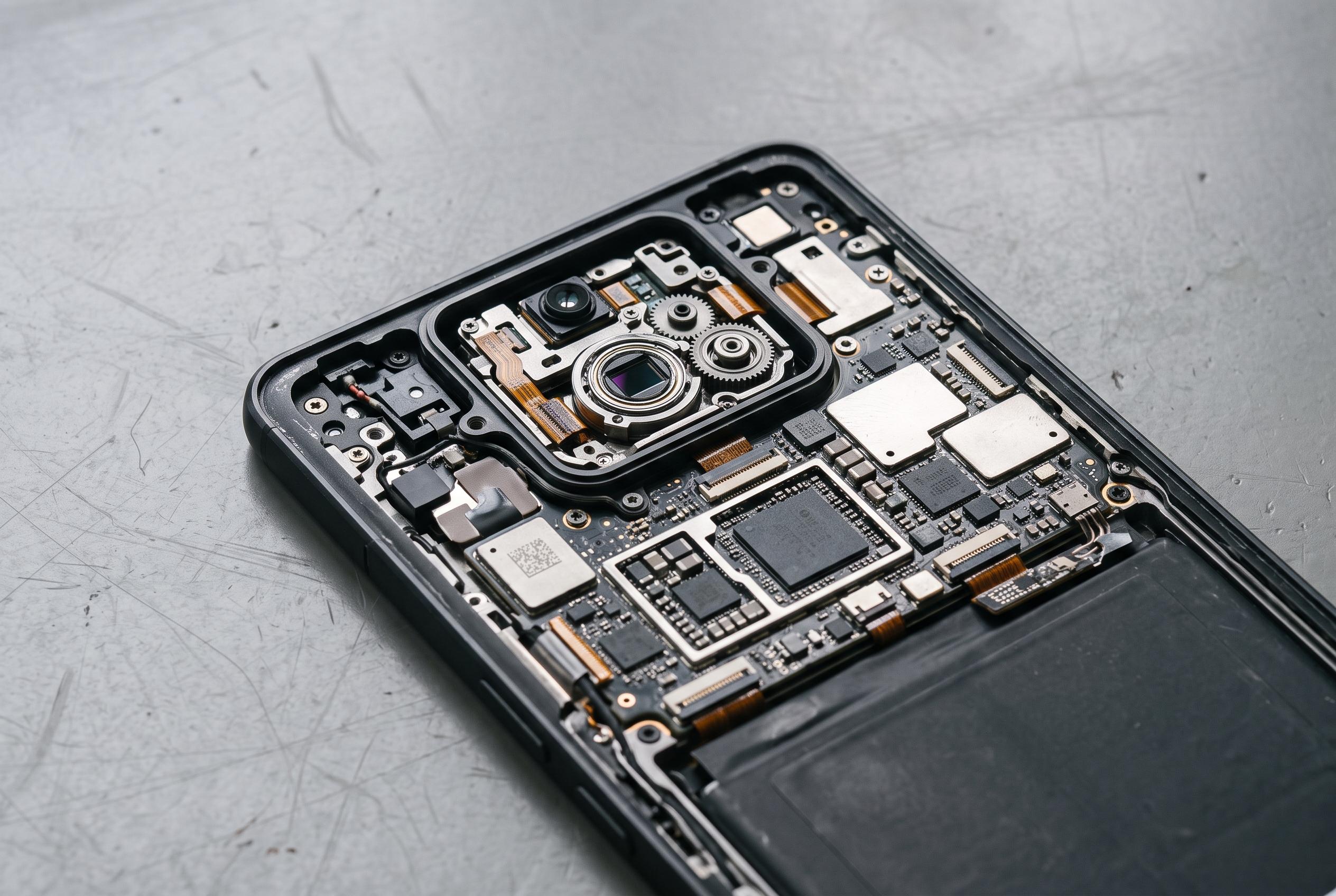

A detailed teardown of iKKO’s MindOne Pro exposes structural weaknesses in its innovative rotating camera and highlights compromises in internal components, raising questions about its flagship status amid high expectations for durability and performance.
A teardown of iKKO’s MindOne Pro has sharpened the case against the device’s most distinctive feature. JerryRigEverything’s test found that the phone’s sapphire-protected display appears to be the genuine article, but the 180-degree rotating camera module, the part on which much of the product’s identity rests, failed under pressure. That matters more because iKKO is not pitching the handset as a cheap novelty: Gadgety said the Pro model is priced at $499, or $429 on pre-order, placing it in territory where buyers can reasonably expect more durable engineering.
The MindOne Pro attracted attention earlier in 2026 because it tried to solve two niche demands at once: a genuinely small Android handset and an AI-focused companion device. Android Authority, reporting from CES in Las Vegas on 10 January, described an almost-square phone that can switch between Android 15 and iKKO’s own AI interface, with tools for note-taking, translation and other assisted tasks. The same report said the single 50MP Sony 1/1.56-inch camera rotates to face either direction, while an optional snap-in keyboard case adds typing space, a 3.5mm headphone jack and a Hi-Fi DAC. Ryan Haines wrote at the time: “I need a status report on how many flips the camera can handle, because I know I’m going to fidget with it.”
The teardown makes that concern look well founded. Notebookcheck reported that the camera assembly relies on narrow pivot pins rather than a more substantial hinge bar. IXBT said the rest of the chassis resisted bending without obvious deformation, but the camera mechanism could be torn away because the structure holding it in place was comparatively slight. Notebookcheck also noted that the speaker and vibration motor were not reinforced or sealed against water ingress, reinforcing the sense that the phone’s unusual layout has been achieved by accepting trade-offs elsewhere inside the body.
Those compromises extend beyond the moving camera. The handset uses a MediaTek MT8781, identified by Gadgety as the Helio G99, a 4G-focused chip dating from 2022. IXBT and Notebookcheck both listed 8GB of RAM and 256GB of eMMC 5.1 storage, while the battery capacity is only 2,200mAh. Cooling is handled with a graphite layer rather than thermal paste, and the device carries an IP54 rating, meaning modest protection from dust and splashes rather than anything close to full waterproofing. Taken together, those are modest internals for a handset being sold on premium materials and an unconventional form factor.
The premium-materials claim, however, appears to be one area where iKKO has not exaggerated. IXBT said scratches became visible only at Mohs hardness level 8, and Gadgety pointed out that this is closer to what buyers would associate with watch-grade sapphire than with the hardened glass normally used on smartphones. Both reports also said the panel came through direct flame exposure without visible damage. For a device whose specification sheet leans heavily on sapphire as a differentiator, that result is significant: the protective layer seems materially more robust than the mechanism attached above it.
The more contentious promise concerns connectivity. The MindOne concept was promoted as offering free AI-linked data access in more than 60 countries, with Android Authority saying the system relied on NovaLink and also supported both vSIM and a nano-SIM slot. But IXBT and Zamin said the “free global internet” pitch did not amount to unrestricted mobile data. In practice, they reported, the no-cost service was tied to the manufacturer’s AI functions, while normal data access required a virtual SIM arrangement or a physical SIM card. They also said the bundled chatbot was slow and unable to analyse images, and that pricing for the vSIM option was not clearly available during testing.
The product’s route to market helps explain why the teardown is being read as more than a curiosity. TechRadar reported in January 2026 that iKKO’s Kickstarter campaign had finished in August 2025 after raising HK$11.5m, or about $1.4m, and that the company had previously pointed to a February 2026 release. The same report said the handset had still not shipped when TechRadar wrote its CES follow-up, and added that campaign materials suggested a later non-Pro model with tempered glass instead of sapphire and without the included AI internet features. In other words, the Pro version was always intended to be the flagship expression of the concept, not merely an experiment.
That leaves the MindOne Pro in an awkward position. It still offers ideas that are unusual in the current phone market: a truly compact 4-inch class display, dual software environments, a shared front-and-rear camera, and an accessory path aimed at people who miss physical controls and wired audio. Yet the teardown indicates that the handset’s most important moving part is also its least convincing from a durability standpoint, while the processor, storage class, battery size and ingress protection all suggest restraint rather than refinement. For buyers assessing it as a technology product rather than a conversation piece, the MindOne Pro now looks less like a breakthrough small phone and more like an ambitious prototype that reached retail with too many caveats intact.
Disclaimer: This content is intended for informational purposes only. Readers are advised to exercise their own judgement, conduct due diligence, or consult a qualified expert before acting on any information provided.