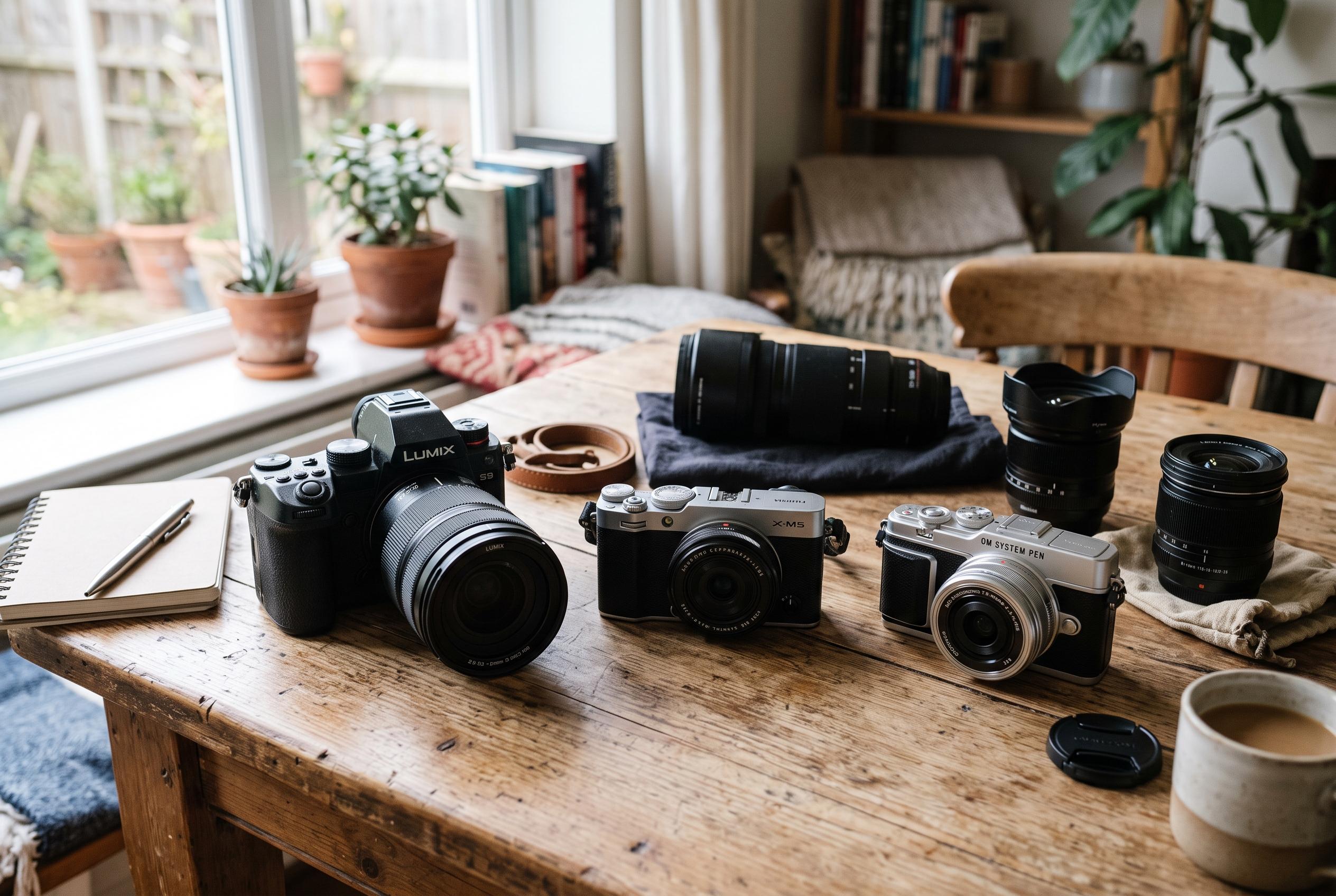

The Panasonic Lumix S9, Fujifilm X-M5 and OM System PEN offer contrasting answers to the everyday-carry brief, with viewfinders, stabilisation, weather sealing and lenses often mattering more than sensor size.
The Panasonic Lumix S9, Fujifilm X-M5 and OM System PEN sit in broadly the same price band in 2026, but they solve the everyday-carry question in very different ways. For photographers moving up from a phone, that makes the choice less about a simple specification comparison and more about how the camera will actually be used from day to day.
Jimmy Cheng, who has spent considerable time with all three bodies, argues that sensor size matters far less in routine shooting than many buyers assume. In his view, reading light well and timing a frame cleanly are more important than whether the sensor is full-frame, APS-C or Micro Four Thirds. That is especially true for newcomers arriving from a phone, where any of these cameras can deliver a substantial step up in image quality and creative control.
The Lumix S9 has become more compelling than it looked at launch. Panasonic’s smallest full-frame body was initially criticised for its price and its thin lens selection, but lower street prices and a growing range of compact primes from Panasonic, Sigma and Viltrox have improved its appeal. According to Panasonic’s recent firmware rollout, the camera has also gained expanded video options, including new 4K and Full HD modes in MP4 Lite, plus additional customisation for the lens function button. Even so, the S9 still has clear compromises. It has no built-in viewfinder, no weather-sealing and relies on an electronic shutter capped at 1/8,000 sec, which can make wide-aperture shooting in bright light awkward. As DPReview notes, Panasonic positioned the model as a creator-focused camera intended to speed up sharing with custom looks and direct-to-camera output.
The Fujifilm X-M5 takes a different route. Rtings describes it as Fujifilm’s current entry-level mirrorless model and its first new X-M body since the X-M1 in 2013, using a 26-megapixel APS-C sensor and a notably compact shell. It is also the company’s most affordable mirrorless option, but the lower cost comes with familiar trade-offs: no electronic viewfinder and no in-body stabilisation. Cheng still rates it highly for practical shooting, pointing to its mechanical shutter and an electronic shutter that reaches 1/32,000 sec, which gives far more flexibility in daylight with fast lenses. He also found its autofocus more accurate in direct comparison than the higher-resolution X-T5. For JPEG shooters, Fujifilm’s film simulations remain a major draw, but the lack of stabilisation and sealing means the X-M5 is less convincing in poor weather or when hand-holding at slower shutter speeds.
The OM System PEN offers the most complete handling package of the three for those who want a compact body with a built-in viewfinder. Cheng’s case for it is practical rather than romantic: rear screens can wash out in harsh sun, and an eyepiece makes it easier to judge framing and exposure when the light is difficult. The PEN also inherits the sensor and processor used in the Olympus OM-D E-M1 Mark III, which Cheng knows well from professional use. He says its face tracking is among the strongest in OM System’s range, making it better suited to children and other fast-moving subjects, while in-body stabilisation opens up slower handheld work and computational features such as Live Composite, Live Bulb and Starry Sky AF. He also tested it in steady rain, underlining the value of sealing and the system’s resilience in less forgiving conditions.
The wider lesson is that the best everyday camera is not simply the one with the largest sensor or the most familiar brand badge. Many makers now omit the viewfinder to keep bodies small and prices down, and that approach suits people who are used to composing on a phone. But the omission is not trivial. A camera that will be used mainly indoors, in shade or for casual family work may be perfectly served by a rear screen and a flip-out display. One used long term in direct sun or frequent rain benefits more from a finder and weather protection. Lenses matter just as much as the body, too: a compact full-frame camera still needs full-frame glass, which can quickly erode the size advantage. In that sense, the real decision is less about spec sheets than about where, when and how the camera will be carried.
Disclaimer: This content is intended for informational purposes only. Readers are advised to exercise their own judgement, conduct due diligence, or consult a qualified expert before acting on any information provided.