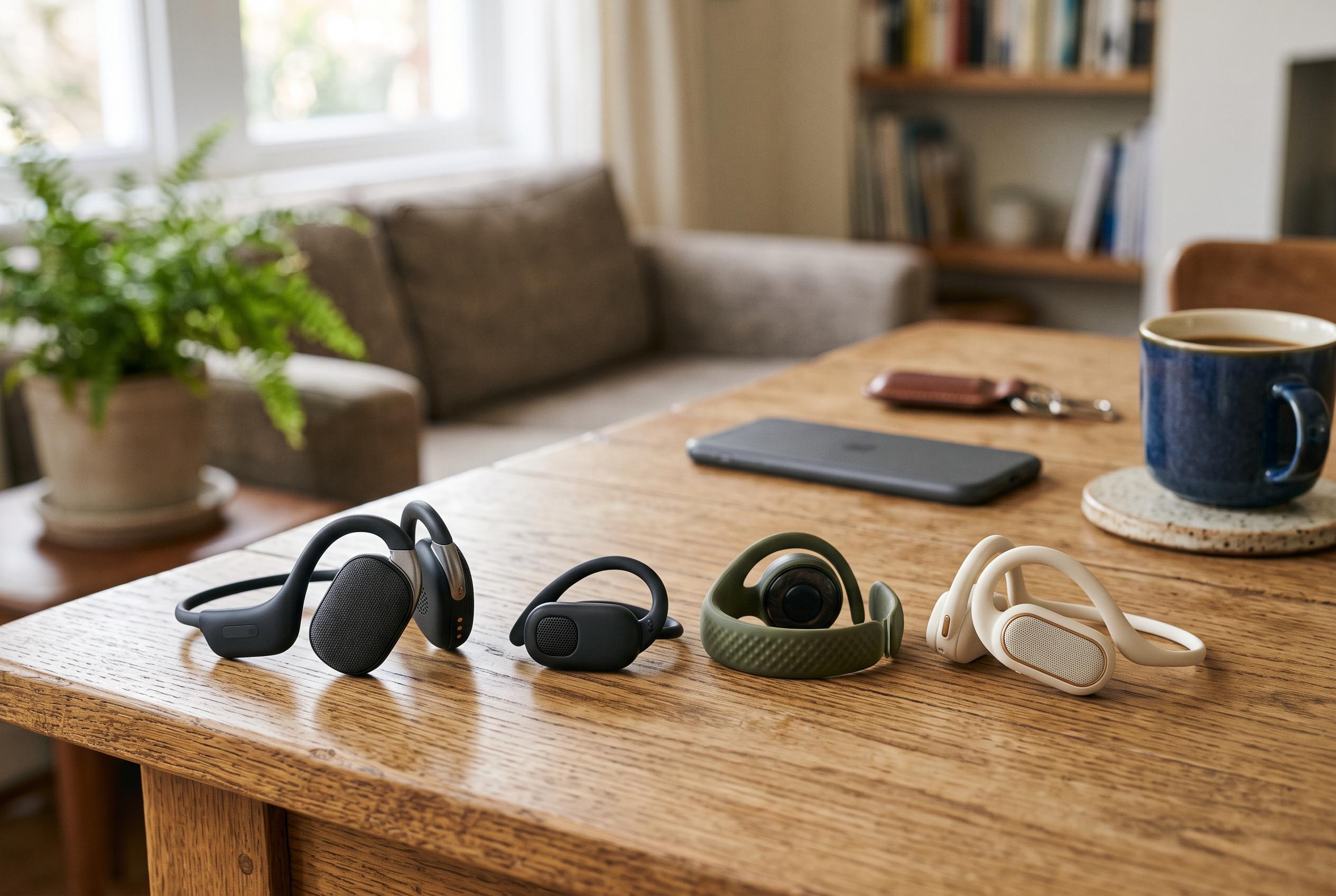

A comparison of four clip-on models finds Hongmi Ultra the most balanced, while Huawei, Soundcore and Xiaomi target ecosystem features, battery life and ambitious sound in different ways.
Open-ear clip-on headphones have become a crowded category, and the choice is no longer only about price. Recent round-ups from SoundGuys and other specialist reviewers suggest that buyers now tend to split into two camps: those prioritising comfort and stability for exercise, and those chasing fuller sound, stronger battery life or tighter integration with a phone ecosystem. Against that backdrop, the four models compared here each lean in a different direction.
Among the four, Hongmi Ultra stands out as the most balanced option. The review describes it as an open-ear model built around a lightweight 8g body, liquid silicone materials and an ear-hook shape that sits securely without creating the sense of pressure that some heavier designs can cause. That matters in this segment, where even small differences in fit can determine whether a pair is comfortable for a commute, a workout or several hours at a desk. SoundGuys’ broader 2026 buying guide makes the same point in a general sense: clip-on and open-ear designs tend to succeed or fail on whether they stay stable without becoming fatiguing.
Huawei’s FreeArc is positioned more clearly as the premium, ecosystem-friendly choice. The review credits it with a secure triangular structure, useful translation features and close integration with Huawei devices, while noting that its 9g single-ear weight can become noticeable over long listening sessions. The company’s acoustic tuning and anti-leakage design are intended to keep sound directed towards the ear, which should help privacy in shared spaces. In practical terms, that makes FreeArc more attractive to users already invested in Huawei’s wider product range than to shoppers looking for the lightest possible fit.
Soundcore’s Feiyuexian Plus, from Anker’s audio arm, appears to be the strongest option for listeners who value big sound and battery endurance over all-day comfort. The review highlights a large 20 x 11.5mm driver, bass enhancement tuning and a total battery life of 52 hours, which is a meaningful figure for long journeys or frequent use away from a charger. Its adjustable hook should also improve compatibility across different ear shapes, although the 10g weight means it is not the lightest design in the group. That reflects a wider trend in the category: some brands are still optimising for audio scale rather than minimum mass.
Xiaomi’s Open Earbuds Pro sit somewhere between convenience and outright performance. According to the review, they use a five-driver acoustic system, an 18 x 13mm bass unit and Harman tuning, which gives them the most technically ambitious specification in this comparison. The trade-off is comfort: the ear-hook fit is described as less refined, and the 9.7g weight may be hard to ignore during longer listening sessions. That makes the Xiaomi model a sensible choice for buyers who already use the brand’s wider smart-home ecosystem and want good sound without moving into a much more expensive tier.
Taken together, the comparison shows that there is no single best open-ear earphone for everyone. Hongmi Ultra appears to offer the most even mix of fit, sound and leakage control. Huawei FreeArc is the most obvious pick for people who value translation tools and ecosystem continuity. Soundcore Feiyuexian Plus suits users who want long battery life and a fuller presentation. Xiaomi’s Open Earbuds Pro are the most feature-rich on paper, but the weakest on long-wear comfort. As SoundGuys and other recent buying guides also suggest, the right choice in this category depends less on headline specifications than on whether the design matches the way it will actually be worn.
Disclaimer: This content is intended for informational purposes only. Readers are advised to exercise their own judgement, conduct due diligence, or consult a qualified expert before acting on any information provided.