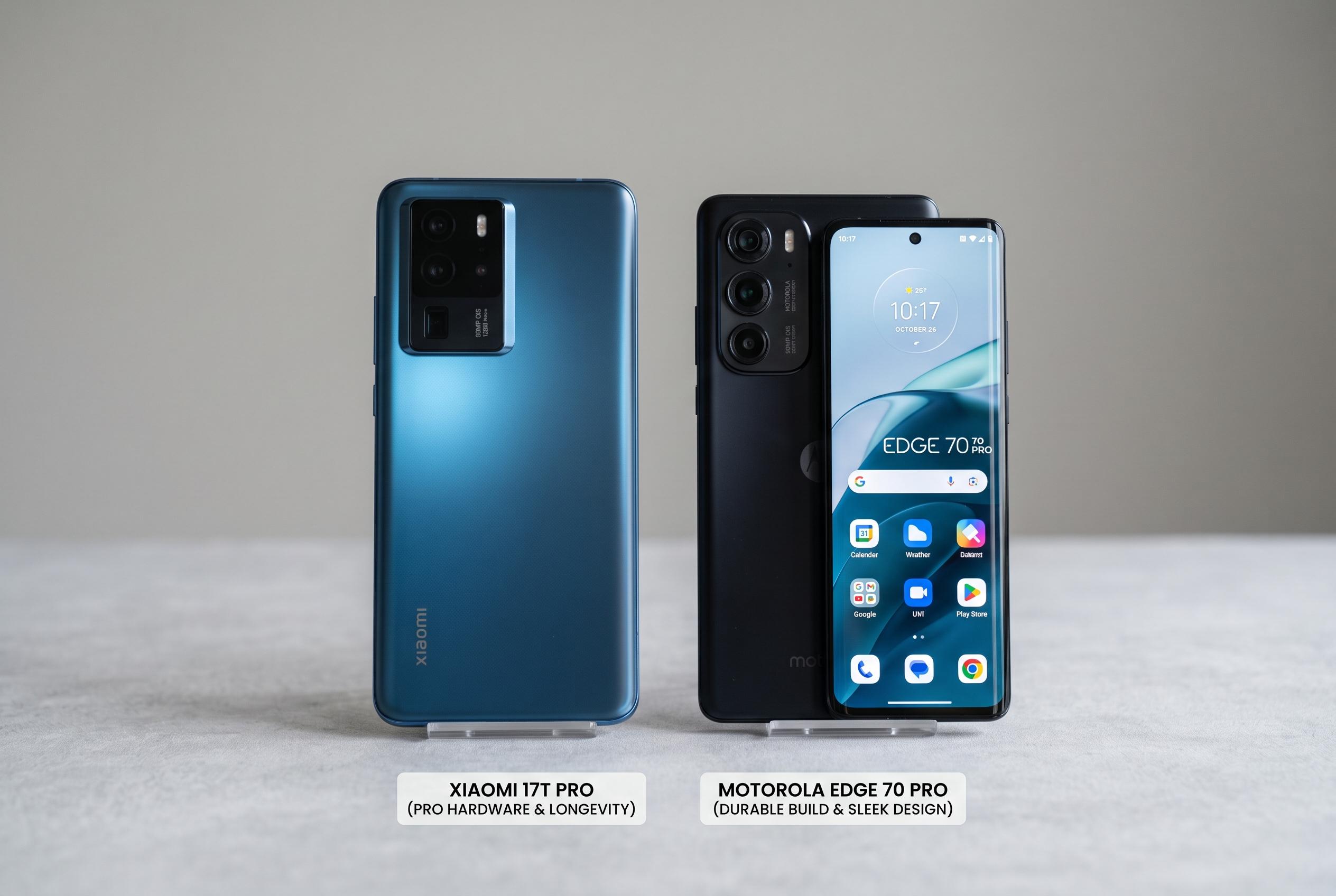

The Xiaomi 17T Pro offers superior performance, battery life, and longer software support compared to the Motorola Edge 70 Pro, but the latter’s durability and price appeal to different buyers.
Motorola’s Edge 70 Pro and Xiaomi’s 17T Pro sit in the same high-end bracket, but they take different routes to get there. Motorola’s phone, launched in April, leans on durability, a lighter body and a lower entry price. Xiaomi’s model, announced in May, pushes harder on raw performance, battery capacity and camera hardware. On paper, both are strong value propositions, but the better buy depends on which features matter most.
The two phones are closely matched in display quality, though not identical. The Edge 70 Pro uses a 6.78-inch AMOLED panel with 1272 x 2772 resolution, a 144Hz refresh rate, HDR10+ support and peak brightness of 5,200 nits. Xiaomi’s 17T Pro is slightly larger at 6.83 inches, with 1280 x 2772 resolution, a 144Hz refresh rate, HDR10+, Dolby Vision and a 3,500-nit peak brightness rating. Motorola’s screen is therefore the brighter of the two, while Xiaomi adds Dolby Vision for broader high-dynamic-range support.
Build quality is another clear point of contrast. Motorola combines a vegan leather back with plastic sides, but it counters that with IP68 and IP69 protection, as well as MIL-STD-810H certification, which signals better resistance to harsh conditions and drops. Xiaomi takes a more premium route with aluminium sides and a glass back, yet it stops at IP68. The Edge 70 Pro is also the thinner and lighter handset, at 162.7 x 75.6 x 7.2 mm and 190 grammes, compared with 162.2 x 77.5 x 8.3 mm and 219 grammes for the 17T Pro.
Performance favours Xiaomi. The Edge 70 Pro runs on MediaTek’s Dimensity 8500 Extreme with 12GB of RAM and either 256GB or 512GB of storage. Xiaomi pairs 12GB of RAM with the Dimensity 9500 and 512GB of storage. In practical use, both should feel fast, but the 17T Pro has the stronger chip and is better suited to heavier gaming and more demanding tasks. Motorola still offers more than enough power for everyday use, so the gap may matter most to users who regularly push their phone hard.
The camera systems also tilt towards Xiaomi. Motorola fits three 50MP sensors on the rear, including a main camera, a 3.5x telephoto lens and an ultrawide camera, plus a 50MP front camera. It records video at up to 4K 60fps. Xiaomi’s triple camera array includes a 50MP main sensor, a 50MP telephoto camera with 5x optical zoom and a 12MP ultrawide camera, along with a 32MP selfie camera. Its headline advantage is Leica-branded imaging and support for 8K video at 30fps. That makes it the more ambitious camera phone, although Motorola’s all-50MP setup may appeal to buyers who value consistency across lenses.
Battery life and charging are another area where Xiaomi has the edge. Motorola equips the Edge 70 Pro with a 6,500mAh battery, 90W wired charging and 15W wireless charging. Xiaomi responds with a larger 7,000mAh cell, 100W wired charging, 50W wireless charging and 22.5W reverse charging. For heavy users, that combination gives the 17T Pro a clear advantage in both endurance and convenience.
Software support is also stronger on the Xiaomi side. The Edge 70 Pro ships with Hello UI based on Android 16, and Motorola promises three major operating system upgrades and five years of security updates. Xiaomi’s 17T Pro runs HyperOS 3 based on Android 16, with five major Android upgrades and six years of security patches. That longer support window strengthens Xiaomi’s case for buyers who keep phones for several years.
Connectivity is broadly similar. Both phones offer Wi-Fi 7, 5G, NFC, in-display fingerprint readers and stereo speakers. Motorola includes Bluetooth 5.4, while Xiaomi moves to Bluetooth 6.0. In pricing, however, the advantage swings back to Motorola. The Edge 70 Pro launched at R$4,499 and can already be found for around R$3,600. Xiaomi’s 17T Pro has not officially launched in Brazil, but it is being sold by trusted retailers for about R$4,700.
Taken as a whole, Xiaomi’s 17T Pro is the more complete device. It has the stronger processor, larger battery, faster wireless charging, longer software support and a more advanced camera package. Still, the Edge 70 Pro is far from a compromise. It is lighter, better protected against water and dust, and significantly cheaper. For buyers prioritising value and durability, Motorola makes a compelling case. For those willing to pay more for top-end hardware and imaging, Xiaomi is the stronger choice.
Disclaimer: This content is intended for informational purposes only. Readers are advised to exercise their own judgement, conduct due diligence, or consult a qualified expert before acting on any information provided.