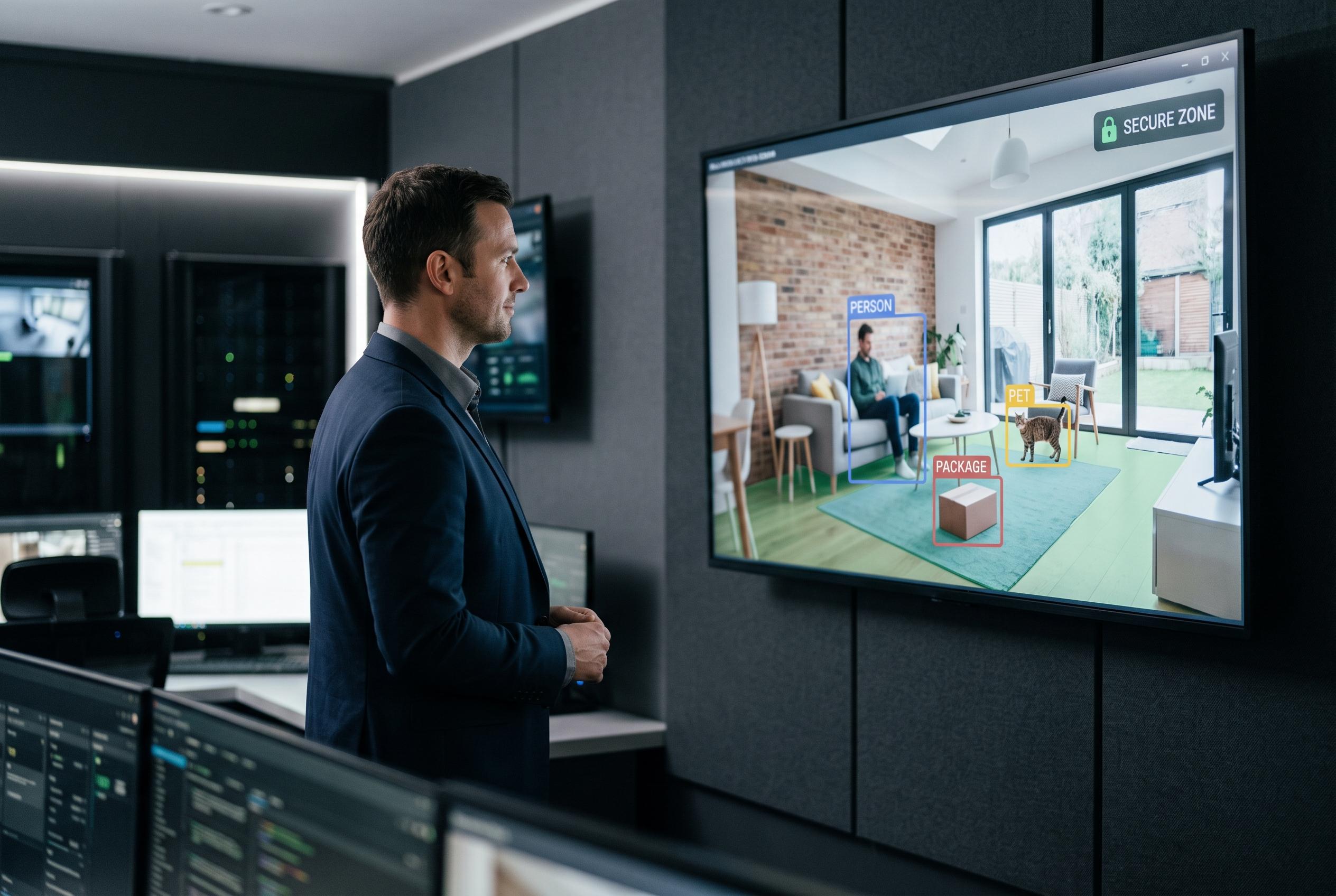

Recent shifts in computer vision technology are enabling faster object detection and more nuanced scene interpretation, paving the way for intelligent security applications that balance rapid alerts with contextual analysis.
The evolution of computer vision has not been a single leap but a series of distinct shifts in capability. OCR made machines useful for extracting text from images; modern detectors such as YOLO11 pushed vision into real-time object localisation; and vision-language models are now moving the field towards scene-level interpretation and natural-language responses. As the Ultralytics material on YOLO11 shows, the current generation of models is designed for efficient deployment across detection, segmentation, classification and pose estimation, with model sizes scaled for different speed and accuracy needs.
That progression matters in practice because each stage solves a different problem. OCR works on symbol extraction and does not understand context. Object detectors operate on spatial structure, returning bounding boxes and class labels for known categories. According to Ultralytics’ guidance, YOLO11 is intended for real-time computer vision tasks and is presented as a practical option where latency and throughput matter. The result is a narrow but fast form of interpretation that is well suited to live monitoring, even if it cannot recognise anything outside its training labels.
The more recent shift is towards models that can answer questions about an image rather than merely name objects in it. In the system described here, that means pairing a detector with a vision-language model that can describe what is happening in a room in plain language. The trade-off is speed: the detector can run continuously, while the language-based engine is sampled at longer intervals because it requires more compute and takes longer to respond. That split reflects the broader architecture of contemporary vision systems, where fast classification and deeper reasoning are increasingly used together rather than as substitutes.
The build itself combines a FastAPI back end, a Next.js dashboard and a shared webcam pipeline. A mutex-style camera manager prevents two engines from trying to own the device at once, which is important because a webcam can normally be opened by only one process at a time. Frame streaming is capped separately from inference frequency, so the interface stays responsive even when the model does not inspect every frame. Events are written to a JSON Lines store with snapshots attached, which keeps the storage layer simple now while leaving room to move to a database later.
The result is closer to a real security product than a demonstration. The detector can flag known objects quickly, the language model can add context more slowly, and the alerting layer can suppress repeated messages so a lingering event does not cause a flood of texts. The remaining gap is identity recognition rather than generic detection: moving from “a person is present” to “this specific person has arrived” would require facial embeddings or a similar recognition pipeline. That is why the strongest systems are not built around a single model family, but around a layered design in which each model does the part of the job it is best at.
Disclaimer: This content is intended for informational purposes only. Readers are advised to exercise their own judgement, conduct due diligence, or consult a qualified expert before acting on any information provided.