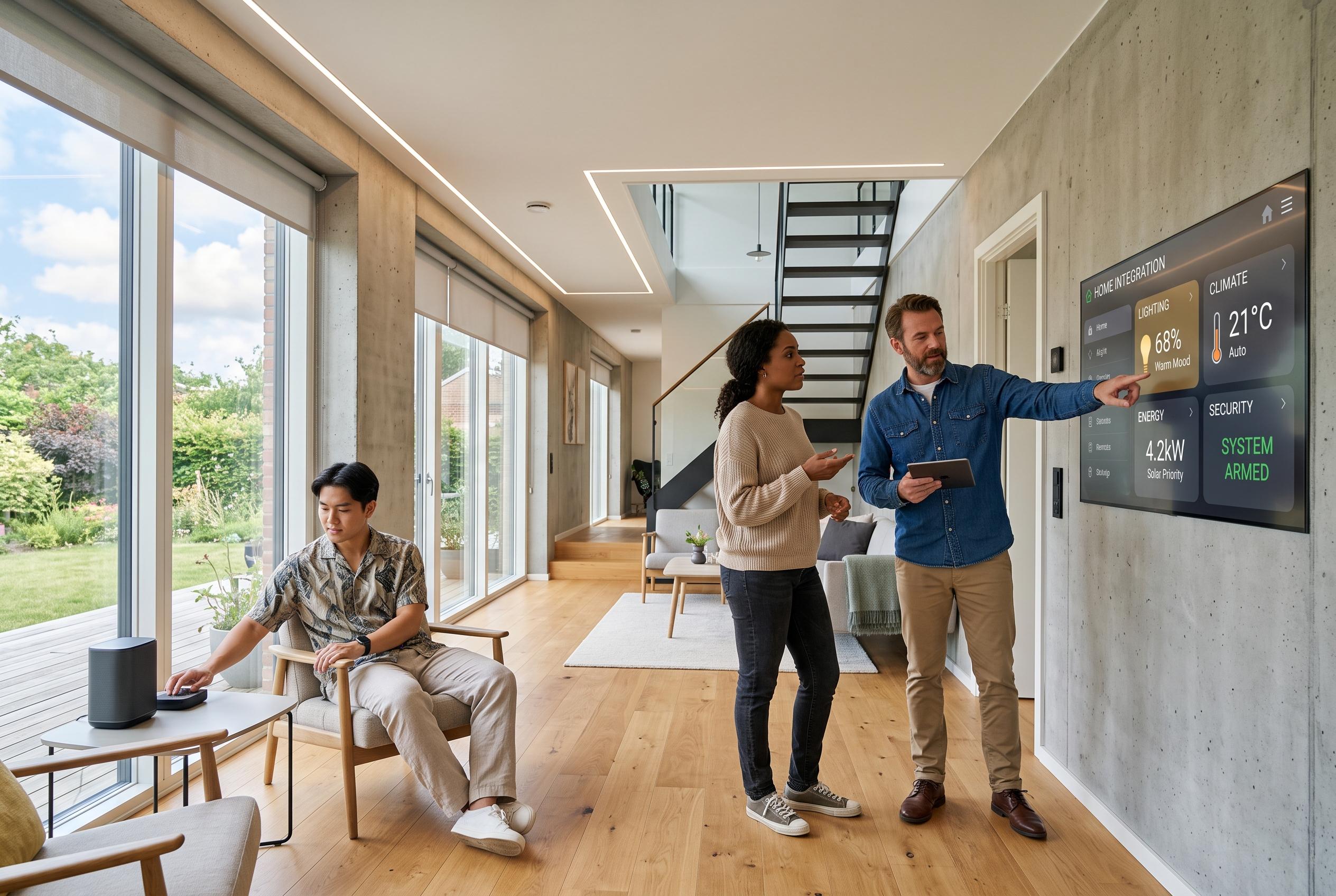

The smart home industry is experiencing rapid expansion in 2026, driven by AI-enhanced systems that unify lighting, security, climate and energy controls. Regional variations highlight diverse priorities, from security in the US to energy efficiency in the UK and cost-effective retrofit solutions in India.
Smart home automation has moved well beyond connected bulbs and voice assistants. In 2026, it increasingly means a single control layer for lighting, locks, cameras, heating, cooling, curtains, security and energy management. Artificial intelligence is making those systems more adaptive, allowing them to recognise routines, respond to speech and adjust to activity inside the home.
The market backdrop is strong, although estimates vary depending on how broadly analysts define the sector. Analytics Insight cites one forecast that places the global smart home market at about $133 billion in 2026, rising to $283.03 billion by 2034, while other market studies put the starting point higher. Grand View Research estimates the smart homes market at $162.8 billion in 2025, with growth to $887.4 billion by 2033, and IMARC Group values it at $151.5 billion in 2025, forecasting $351.7 billion by 2034. The different baselines reflect different methodologies, but the direction of travel is the same: sustained expansion.
That growth is being driven by a mix of security demand, retrofit installations and wider use of hybrid connectivity protocols, according to Grand View Research. The report also says the U.S. holds the largest share by country, while Asia-Pacific accounted for 38.2% of the market in 2025. IMARC Group likewise points to North America as the largest regional market, with a 35.8% share in 2025. In practical terms, that means mature markets remain anchored by security, access control and energy efficiency, while newer markets are expanding through affordable retrofit systems.
Against that backdrop, the competitive field is broad and increasingly technical. Grand View Research lists ABB, Control4, Crestron, Honeywell, Ingersoll Rand, Johnson Controls, Legrand, Leviton, Lutron, Schneider Electric and Siemens among the leading names in smart home automation. GlobeNewswire also highlighted product launches from Johnson Controls and ABB in June 2026, along with Siemens’ partnership with ADMARES on digital twin-based housing, underscoring how security, integration and scalability are now central product themes rather than add-ons.
For India, the United States and the UK, the market is developing along different lines. Analytics Insight says India is the fastest-growing of the three, the U.S. is the largest and most established, and the UK is especially focused on heating, energy control and home security. That distinction matters because the most successful systems are usually the ones that match local priorities: whole-home security and access control in the U.S., energy optimisation in the UK and scalable, cost-conscious automation in India.
Disclaimer: This content is intended for informational purposes only. Readers are advised to exercise their own judgement, conduct due diligence, or consult a qualified expert before acting on any information provided.