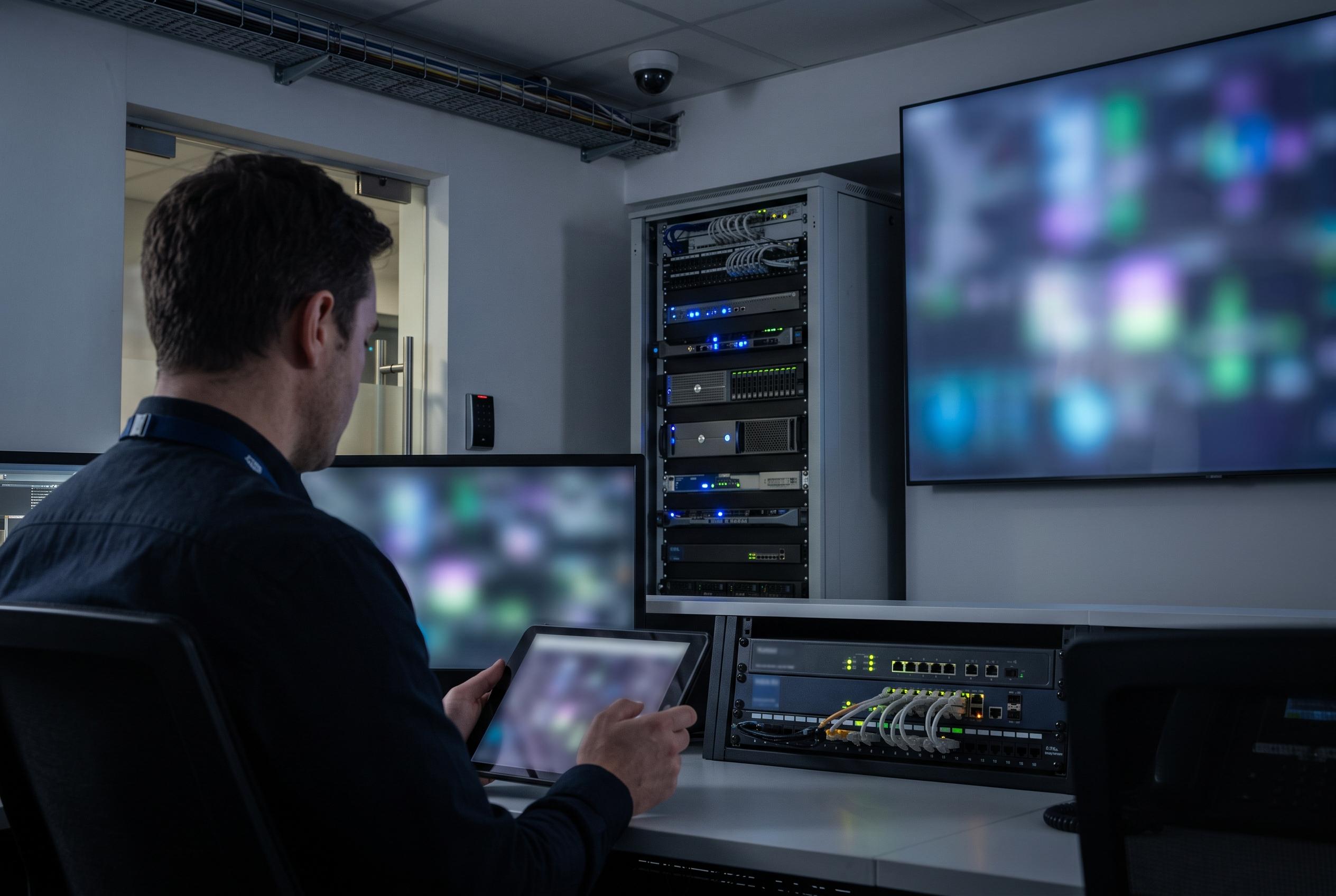

Artificial intelligence is redefining physical security by overlaying existing systems with intelligent, actionable insights, shifting business models from hardware sales to ongoing services, and broadening its appeal beyond traditional security teams.
For decades, physical security has been built from separate parts that rarely speak to one another. Cameras record, access control opens and closes, intercoms carry calls, and visitor systems log arrivals. The result is familiar to integrators: multiple screens, multiple systems and too little context when someone asks what happened at a doorway. Marco Quintero, founder and chief executive of Alocity, argues that artificial intelligence will matter only if it improves that day-to-day reality, not if it is sold as a vague technical novelty.
The central sales lesson, he says, is that buyers do not purchase intelligence for its own sake. They buy a problem disappearing. That means the strongest use cases are practical ones: faster investigations, fewer false alarms and earlier warning when a door is forced or left open. In Quintero’s view, the right pitch is not about computer vision or inference models. It is about reducing the time, effort and uncertainty involved in finding out what actually happened.
Several AI functions are already mature enough for deployment, and that is where the market is moving now. Natural-language video search can cut hours of review down to seconds. Real-time detection of people, vehicles and number plates is accurate enough to support action. Systems can also correlate events so that, for example, a forced-door alarm automatically brings up the right clip instead of leaving an operator to hunt for it. More advanced platforms are now moving towards an AI assistant that can answer plain-language questions and trigger authorised actions across connected systems.
The bigger commercial opportunity, however, lies not in greenfield projects but in the installed base. Most sites already have cameras and doors in place, and many of those devices are still perfectly serviceable. Vendors are increasingly positioning AI as an overlay rather than a replacement, using open standards such as ONVIF for video and OSDP for readers, together with edge appliances that process data on site and reduce bandwidth demands. AtomVision, for example, says its on-premises AI appliance connects to existing IP cameras through ONVIF, while Aithentics and Sightward Technologies also promote edge-based systems that work with current infrastructure rather than requiring rip-and-replace projects.
That shift also changes the business model. Hardware sales are one-off transactions, but software-driven AI can become a recurring service. For integrators, that opens the door to ongoing work such as tuning detection rules, refining workflows, producing reports and extending deployments to new locations. Quintero also stresses that any vendor should be questioned on openness, processing location, ownership of the customer relationship, data handling and how false positives are measured. Those issues matter because the promise of AI only holds if it is reliable, compliant and compatible with the customer’s estate.
Demand is widening beyond security departments as well. According to Quintero, the most useful conversations at this year’s GSX event were not only with security leaders but also with facilities managers, property teams and operations staff. They want cameras and access systems to reveal occupancy trends, deliveries, after-hours activity and compliance issues as well as intrusions. That broadens both the buyer group and the budget. In that environment, the integrator who can speak to security, IT, facilities and compliance in one room is likely to have the advantage.
Disclaimer: This content is intended for informational purposes only. Readers are advised to exercise their own judgement, conduct due diligence, or consult a qualified expert before acting on any information provided.