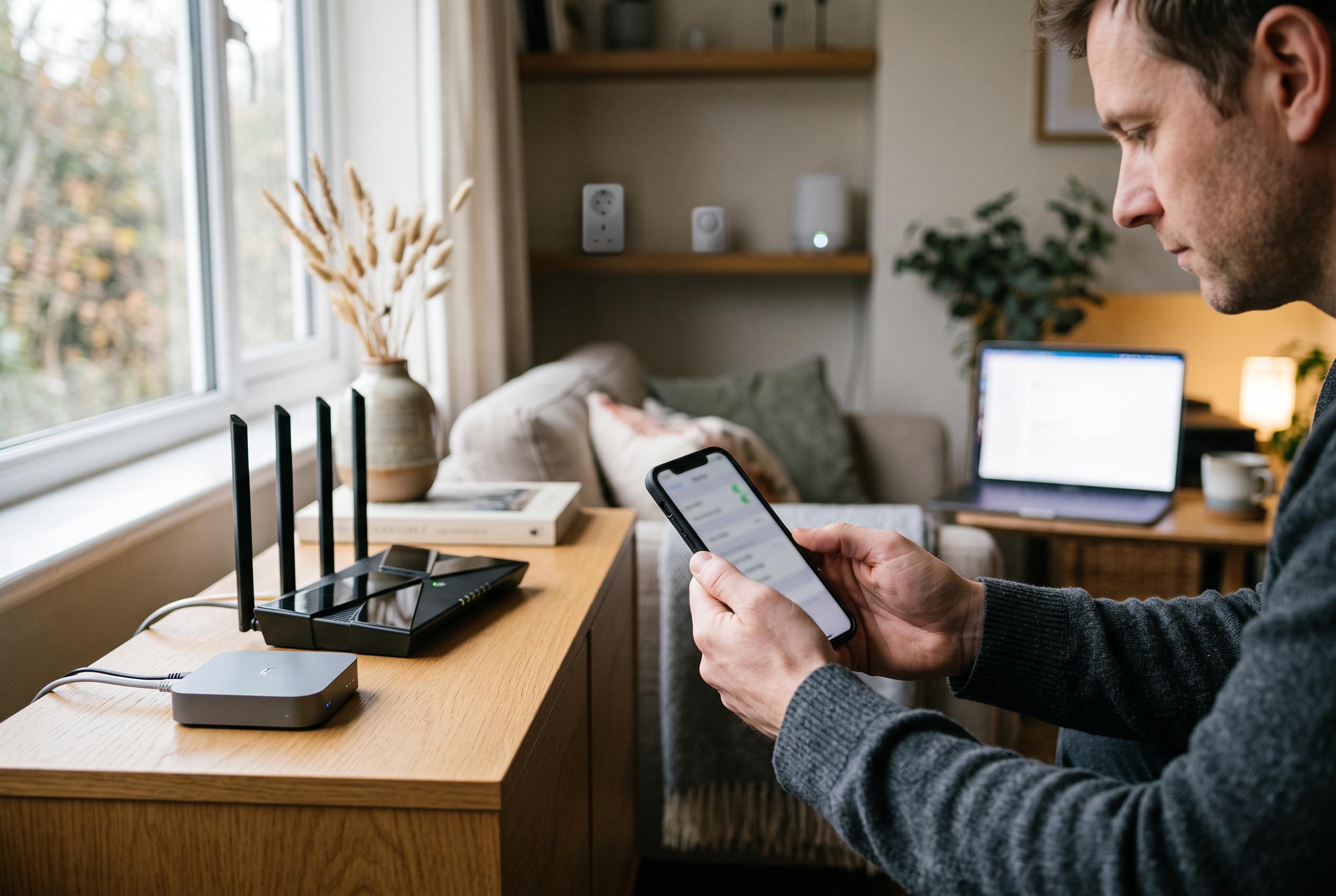

An experiment using AI agents reveals how easily unknown devices and overlooked settings can threaten the security of connected homes, highlighting the ongoing importance of manual household network management.
An experiment described by Iván Linares has put a practical question at the centre of home network security: how well do most people really know what is connected to their router? Using two AI agents, the answer turned out to be more unsettling than reassuring. The setup was familiar enough for a modern household: a tri-band Wi-Fi 7 router linked to phones, laptops and a growing collection of smart-home devices. But once Hermes, running locally, and ChatGPT Codex, working through a browser session, were asked to inspect the network, the review quickly exposed how easy it is for the unexpected to disappear into the routine background of domestic connectivity.
According to Linares’ account, Hermes first parsed the list of connected devices and ranked them by trustworthiness, while Codex checked the router’s settings from the administration page. Both tools flagged unfamiliar devices, prompting a more old-fashioned verification process: disconnecting appliances one by one and watching what vanished from the router’s device list. In a house full of connected kit, including cameras, sensors and smart plugs, that proved laborious. Two apparent intruders were eventually identified as legitimate devices, including a security camera and a Wi-Fi sensor that had largely been forgotten. The exercise underlined a basic problem in connected homes: once every bulb and sensor has an address, distinguishing the expected from the suspicious becomes increasingly difficult.
The most important finding, however, was not an unknown device but a neglected setting. The router’s WPS function was still enabled, despite the user believing it had already been switched off. WPS, or Wi-Fi Protected Setup, is intended to simplify the process of pairing devices, but it has long been treated as a security weakness when left active unnecessarily. Codex then suggested changes to the configuration, explained why they mattered and, after approval, applied them before rebooting the router. The restart completed without incident, avoiding the kind of disruption that can easily follow a misplaced setting in a home network.
The broader lesson is that AI can be useful as a diagnostic assistant, but it should not be treated as an autonomous network administrator. A tool that can read long device lists and point out forgotten options may save time and reduce oversights. Yet the same access could also alter passwords, DNS settings, port rules or other controls that determine both reliability and security. Router makers such as ASUS, TP-Link and GL.iNet are already marketing Wi-Fi 7 models with increasingly advanced security, mesh support and smart-home features, but hardware capability does not replace basic housekeeping. Regularly reviewing connected devices, disabling features such as WPS when they are not needed, keeping firmware updated and using strong credentials remain the most dependable defences. AI may help to surface problems. It is not, at least yet, a substitute for judgement.
Disclaimer: This content is intended for informational purposes only. Readers are advised to exercise their own judgement, conduct due diligence, or consult a qualified expert before acting on any information provided.