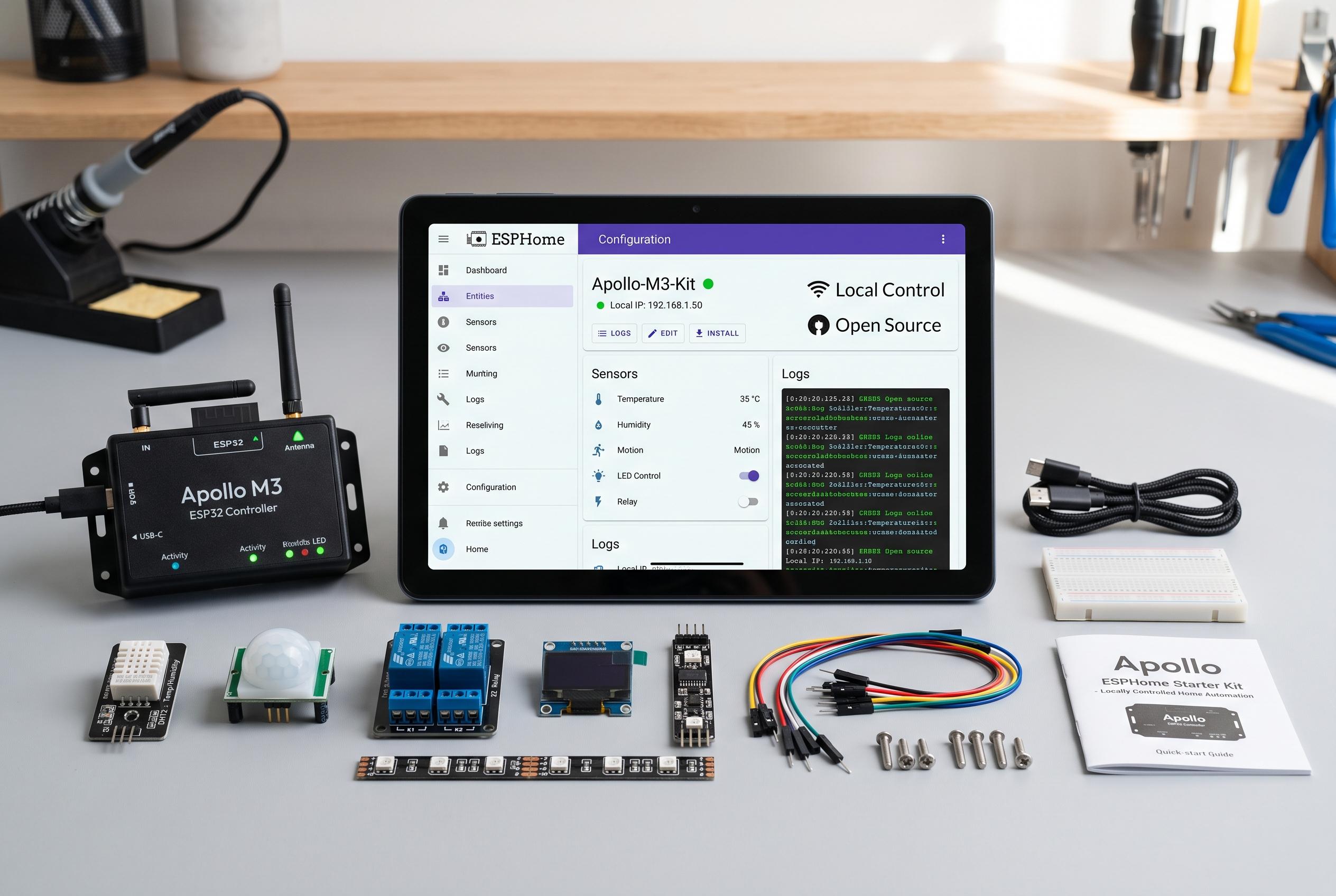

Apollo Automation launches an accessible ESPHome Starter Kit featuring modular hardware and visual configuration, supporting local control and open-source initiatives for home automation enthusiasts and beginners alike.
Apollo Automation has launched an ESPHome Starter Kit aimed at making local smart home automation easier to understand and build, while still leaving room for users who want more control than a typical plug-and-play system. Notebookcheck reported that the bundle is intended as an accessible entry point for home automation, but one that still appeals to people willing to learn how the pieces fit together. The kit centres on an ESP32-C6 mainboard and a set of interchangeable modules, giving buyers a hands-on way to experiment with sensors, buttons and connected devices.
According to Apollo Automation, the hardware includes a PIR motion sensor, a temperature and humidity sensor, a button module and a notification module with RGB LEDs and a piezo buzzer. The motion sensor is rated for detection at up to 3.5 metres, which makes it suitable for lighting triggers or basic security rules. The environmental sensor can be used to track comfort conditions and decide when to ventilate, heat or cool a room. Apollo says the kit supports Wi-Fi, Bluetooth and Thread, with ZigBee available for advanced users.
The company’s documentation says the kit is designed to avoid soldering and coding. Its start-up guide walks users through removing the modules from the panel, identifying each part and connecting them with the included FPC ribbon cables. Apollo also says ESPHome runs the device and connects it to Home Assistant through a visual configuration tool, so beginners can build working automations without writing code. The documentation further describes a local web interface and an accessory power rail for the LEDs and modules, underscoring the kit’s focus on self-contained, local control rather than cloud dependence.
Pricing and timing differ slightly across Apollo’s own materials. The product page lists the kit at $39.99 and says it is expected to ship in August 2026, while a company blog post said it would ship around June 2026. Apollo also said a majority of profits from the kit will support the Open Home Foundation, linking the launch to broader efforts around open-source smart home software. That positions the starter set not just as a consumer product, but as part of the growing ecosystem around Home Assistant and other local-first home automation tools.
Disclaimer: This content is intended for informational purposes only. Readers are advised to exercise their own judgement, conduct due diligence, or consult a qualified expert before acting on any information provided.