
Apple has extended Siri’s AI voice customisation options in the fifth beta of iOS 27, offering users greater control over voice pace and expressivity, but with new hardware requirements for its most advanced features.
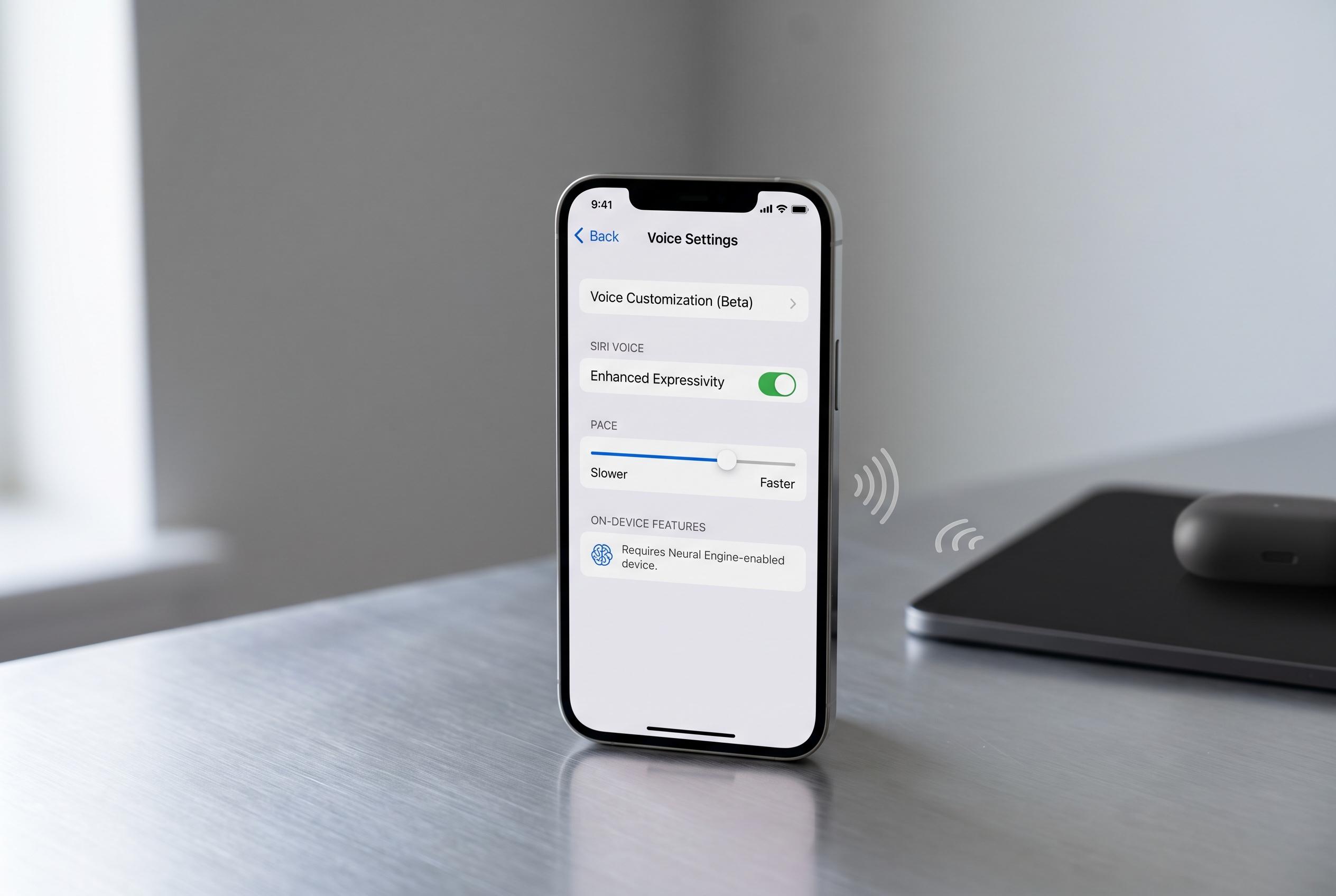
Apple has broadened Siri AI voice customisation in the fifth beta of iOS 27, extending the feature beyond the narrow set of voices it first supported. Users can now change both pace and expressivity across seven American voices and four British voices, giving them more control over how Siri sounds and responds. Pace adjusts speaking speed, while expressivity alters emphasis and delivery to make replies sound less mechanical.
The change builds on Apple’s wider effort to turn Siri into a more capable AI assistant in iOS 27. MacRumors has reported that the platform is being rebuilt around a more advanced on-device system that can draw on personal context from apps such as Mail, Messages and Photos, while using Apple’s own models and system indexes to handle requests more intelligently.
The expansion also highlights the hardware limits Apple has placed on its most demanding AI features. Because the voice customisation is processed on the device, it needs newer chips and more memory. On iPhone, the feature is limited to the iPhone 17 Pro, iPhone 17 Pro Max and iPhone Air. Apple also supports Macs with an M3 chip or newer and at least 12GB of RAM, plus M4 iPad Pro models and later devices with the same memory threshold.
That restriction is in line with earlier reporting from MacRumors that Apple’s most advanced on-device AI model in iOS 27 requires 12GB of unified memory. The same reporting said the standard iPhone 17, with 8GB of memory, cannot run those features, which helps explain why the company has reserved the new Siri controls and other high-end AI tools for its highest-spec devices.
Disclaimer: This content is intended for informational purposes only. Readers are advised to exercise their own judgement, conduct due diligence, or consult a qualified expert before acting on any information provided.