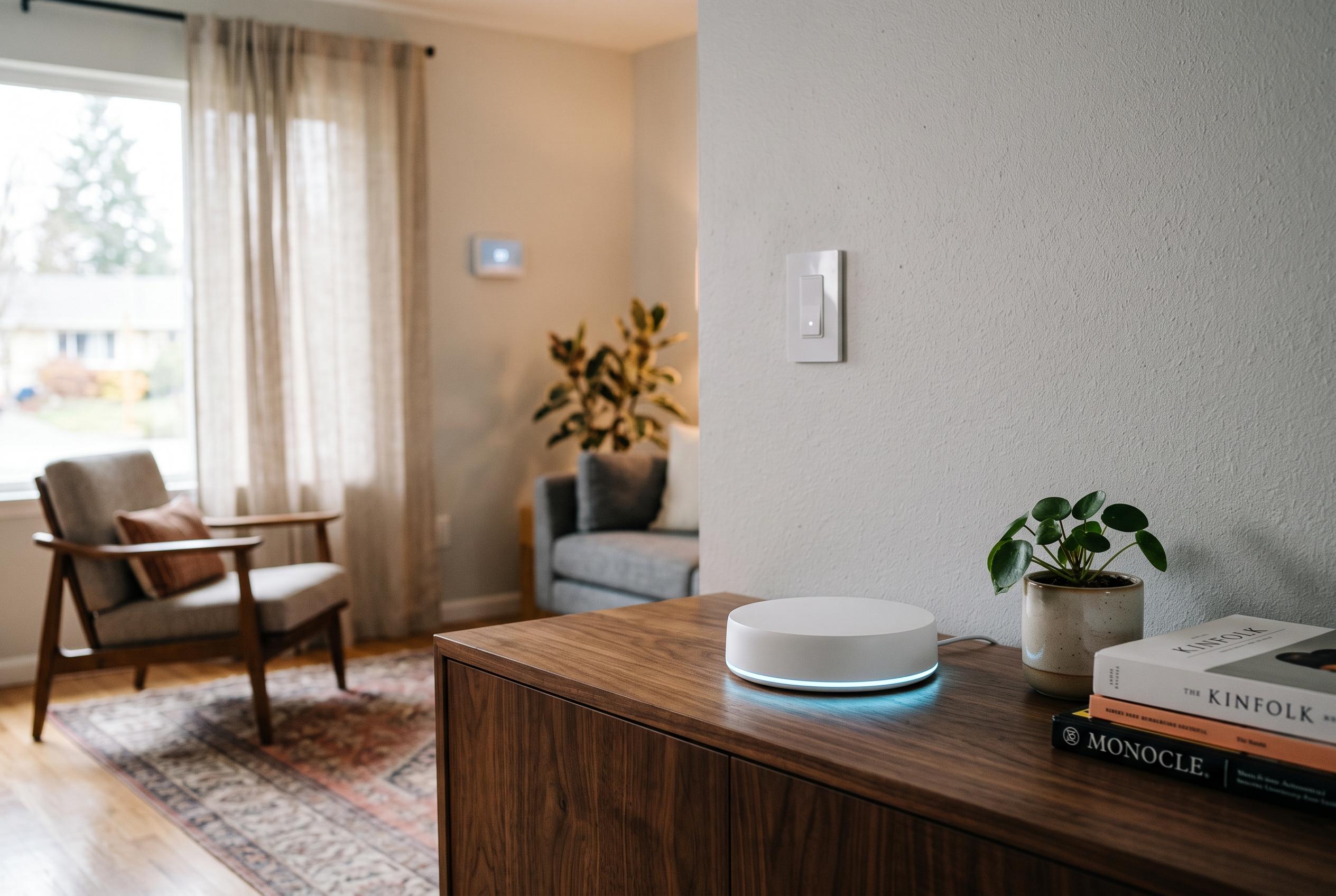

Brilliant NextGen is broadening its Shelly sensor support beyond subscribers, enabling smarter automation and control over wired devices in homes, signalling a strategic shift towards managed residence services.
Brilliant NextGen is turning a sensor bundle that debuted with its subscription service in July into a broader Shelly integration for the whole platform, extending support beyond Brilliant Max subscribers and into the company’s wider installed base. Trade publication CE Pro reported on 1 September that the first phase covers Shelly’s Bluetooth motion and door or window sensors, plus the Bluetooth-to-Wi-Fi gateway, while Apple’s App Store listing shows the software groundwork had already reached Brilliant’s mobile app in version 26.07.22, posted on 4 August, which said support for Shelly sensors had been added and that more was still on the way.
The practical value is in how those devices connect and what they can feed into automations. CE Pro said users can pair Shelly sensors either directly over Bluetooth with Brilliant Controls or indirectly through Shelly’s Bluetooth-to-Wi-Fi gateway. Once linked, the sensors can give the Brilliant system live signals on movement, door activity and occupancy, creating the context needed for routines that react to whether someone has arrived, left or moved through the home. CE Pro also said the next phase, due by the end of September 2026, is meant to pull Shelly’s relay range into the same environment, giving Brilliant a route to control not only switches and outlets but also appliances, low-voltage devices, pumps, motors and other wired electrical loads that would otherwise sit outside its interface.
That September announcement matters because the Shelly relationship did not start there. Forbes reported on 22 July that Brilliant Max, launched the previous day, bundled a Shelly Bluetooth door and window sensor with every subscription and allowed additional Shelly sensors to extend coverage around the property. Matterhome’s review of the same launch said the service opened with Away Mode and Vacation Mode, with Home Mode and Night Mode due later, while Brilliant’s own launch post described the sensor package as part of a larger effort to make those Modes useful without the homeowner having to build automations from scratch.
The broader strategy is a shift in how Brilliant is trying to sell itself after its revival. Forbes said the company returned in late 2025 after being acquired and recapitalised under the Brilliant NextGen name, and that its first major post-relaunch move was to stop presenting itself mainly as a premium wall control and start selling a managed smart-home service. In Brilliant’s own words, Jonathan Temlock, the company’s president and chief executive, said: “Consumers don’t want another system to manage – they want a home that simply works for them.” Forbes argued that this places Brilliant closer to the managed-service logic associated with Control4 and Crestron than to the more open-ended, do-it-yourself smart-home model.
There are, however, important limits in what has actually been disclosed. Matterhome noted that Brilliant did not publish subscription pricing, billing terms or regional availability when it launched Brilliant Max on 21 July 2026. It also warned readers not to over-read the Shelly tie-up: Brilliant was talking about support for selected Shelly products, not the entire Shelly catalogue, and at that stage it had identified only the bundled door and window sensor and optional motion sensors. The same report added another caution for technically minded buyers, saying Brilliant’s older promise of Matter support remained undocumented in current product material, with no active commissioning route or version support clearly set out.
For the custom-install trade, the partnership is being pitched as more than a consumer feature drop. Brilliant said in its July launch post that Max gives installers, electricians, security dealers and systems integrators a chance to turn a one-off hardware sale into recurring service revenue while reducing the support burden that comes from hand-built routines. CE Pro echoed that installer angle, arguing that relay support could bring a far wider class of wired devices under Brilliant’s control layer. Residential Systems, meanwhile, treated the Shelly news as part of its CEDIA Expo 2026 automation coverage, a sign that the announcement was being aimed squarely at the professional channel as well as end users.
The software timeline also suggests that sensor support is not merely aspirational. Apple’s App Store release history for the Brilliant Smart Home System app shows that the 26.07.22 update, displayed on 4 August 2026, introduced Brilliant Max and automated Modes, including Away and Vacation Mode with geolocation, presence alerts and light randomisation. The same release note added: “This release also adds support for Shelly sensors, so you can automate more of your home. With more to come soon!” That matters because it separates a live sensor integration from the later relay expansion still scheduled for September.
If Brilliant delivers that second step on time, the Shelly tie-up will become more consequential than a simple occupancy add-on. Sensors help Brilliant understand what is happening in a home; relays would let it act on a much larger pool of existing electrical devices, including loads that were never designed as native smart-home products. That would strengthen Brilliant’s claim that it is building a managed layer over mixed household hardware. Even so, the offer remains more defined than universal: the company has been explicit about selected devices, not blanket Shelly compatibility, and it still has unanswered questions around subscription terms and broader standards support.
Disclaimer: This content is intended for informational purposes only. Readers are advised to exercise their own judgement, conduct due diligence, or consult a qualified expert before acting on any information provided.