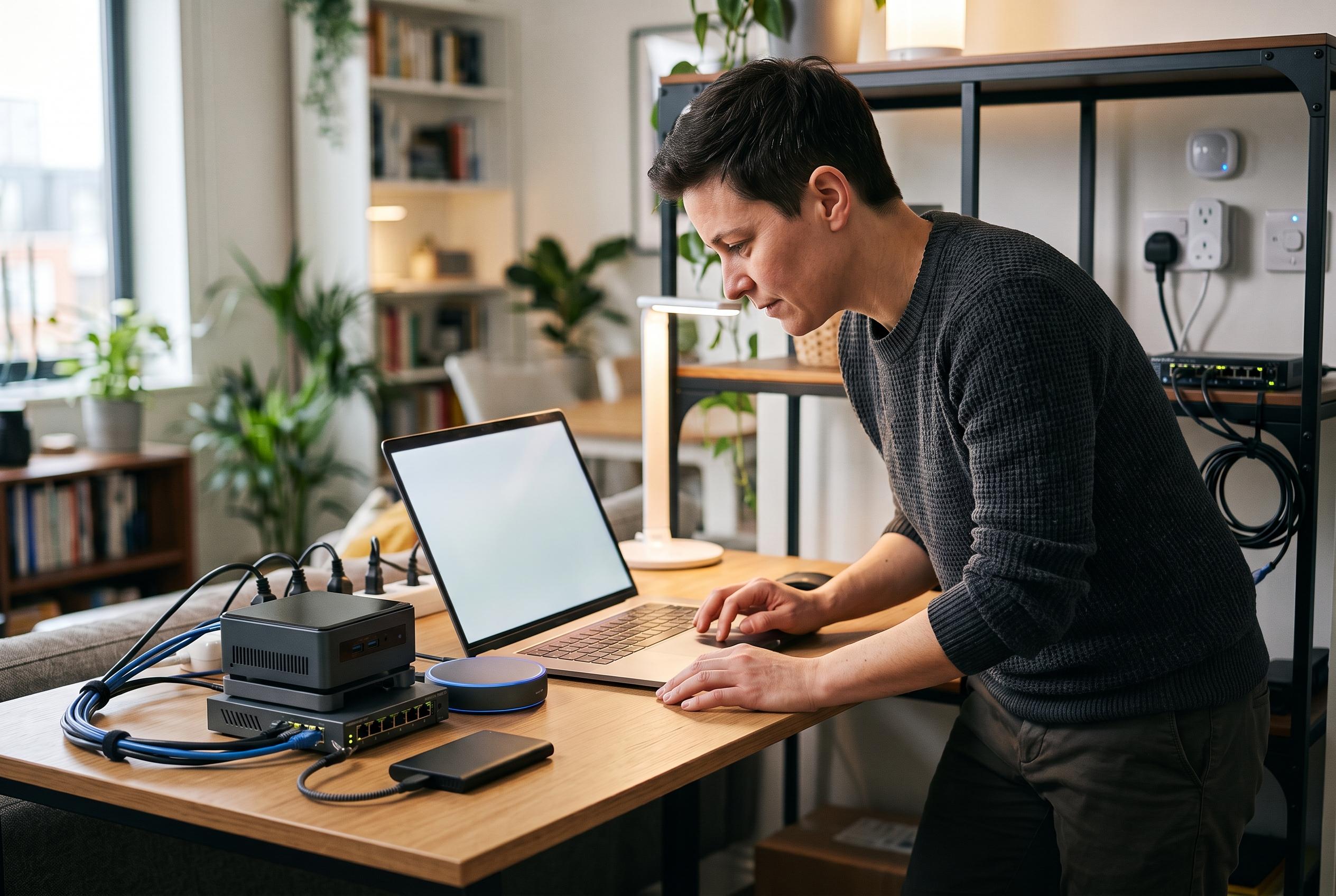

As Home Assistant users expand their smart homes, selecting the appropriate hardware becomes crucial , from the simplicity of Home Assistant Green to the power of mini PCs for advanced integrations.
Home Assistant runs best on hardware that matches how ambitious the installation will become. For a simple local smart home, the official Home Assistant Green remains the cleanest starting point: the company says it ships with Home Assistant OS on 32GB of eMMC storage, uses a quad-core ARM Cortex-A55 chip, has 4GB of RAM and runs fanlessly. Setup is deliberately minimal, needing only power and Ethernet before onboarding begins. Home Assistant also notes that Green supports Matter devices over Wi-Fi and Ethernet, with Thread support available through a separate radio. That makes it an appealing first box for users who want reliability more than tinkering.
For buyers who expect to grow into cameras, local voice, dashboards and other add-ons, small x86 machines are gaining traction. A review from Computing for Geeks highlights the Beelink Mini S12 Pro as a strong Home Assistant host because it pairs Intel’s N100 processor with 16GB of RAM and a 500GB NVMe SSD. In practice, that matters because Home Assistant itself is light, but add-ons are not. Frigate video analysis, voice services and data tools such as Grafana can quickly push a low-power board past its comfort zone. The mini PC route also suits users who want Proxmox, snapshots and easier recovery after a bad update.
That same performance argument has encouraged many users to move away from Raspberry Pi-only builds. A migration guide from Michael Leen, published on YouTube, describes the practical gains of moving Home Assistant from a Raspberry Pi 4 to a mini PC, particularly in responsiveness and day-to-day reliability. The wider lesson is straightforward: the first machine may cope with the core platform, but a home automation setup often accumulates cameras, integrations and voice control long before it is replaced. Hardware choice is therefore less about initial cost than about how much headroom the system will need in a year’s time.
Storage is another point where the cheaper option can become the more expensive one. Home Assistant’s database writes continuously, which is why eMMC, NVMe or SSD storage is far preferable to microSD for always-on use. That is one reason the Green’s built-in eMMC and the Mini S12 Pro’s NVMe drive are attractive choices. It is also why Raspberry Pi builds need to be treated carefully: they remain useful, especially for learning and low-load automation, but they are better regarded as starter systems unless they are paired with solid-state boot media.
There is also a clear divide between appliances built for convenience and machines built for expansion. The Home Assistant Green is the least complicated route to a working home hub. A Raspberry Pi kit offers a better learning platform, GPIO access and more flexibility for hardware projects. The Beelink Mini S12 Pro is the practical choice for anyone planning to add Frigate or local speech services. For those who want a quiet box in a living room, fanless x86 options remain attractive, while NAS-style mini PCs make the most sense when camera recording and storage are part of the same build.
The most useful rule is to buy for the workload you are likely to have later, not the one you have on the first day. Home Assistant can run on modest hardware, but a properly local smart home tends to expand fast once users discover automations, camera detection and voice control. Official plug-and-play hardware reduces friction. Mini PCs buy headroom. Raspberry Pi kits still have a place, but mainly for users who value learning and experimentation as much as convenience.
Disclaimer: This content is intended for informational purposes only. Readers are advised to exercise their own judgement, conduct due diligence, or consult a qualified expert before acting on any information provided.