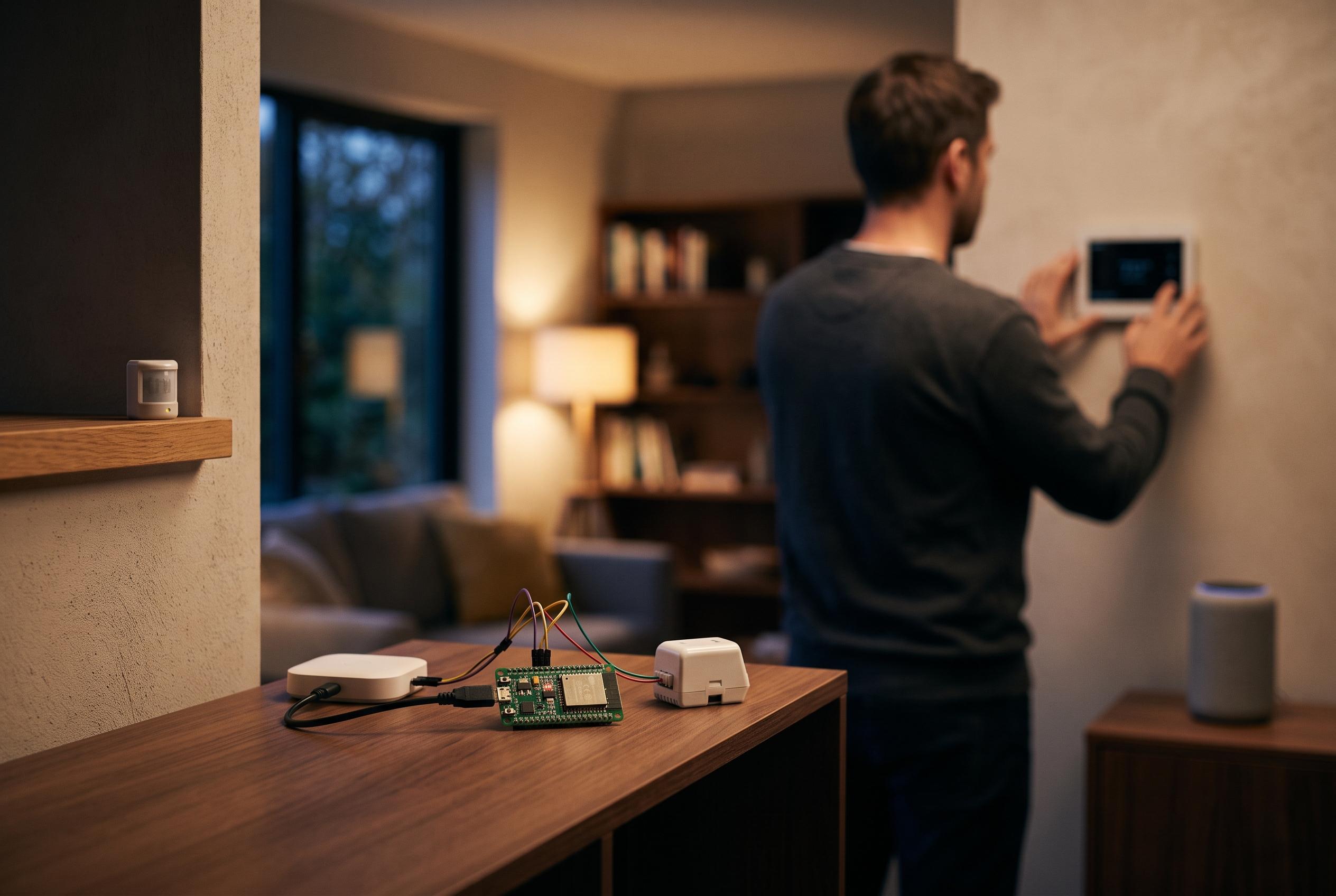

Transforming from a simple network device, the ESP32 now powers a range of smart household solutions, from climate control to local voice assistants and room presence tracking, demonstrating its adaptability as a low-cost programmable controller.
The ESP32 is often treated as a small network appliance, but that view sells it short. According to the lead article, it is better understood as a low-cost programmable controller with radios attached: capable of reading sensors, driving displays, handling infrared, processing Bluetooth data and taking on ordinary household tasks that have little to do with extending Wi-Fi. That broader use case is reflected in Espressif’s own project collections, which span everything from smartwatches to sensor builds and advanced IoT applications.
One practical example is home climate control. The lead article describes an ESP32 linked to a DHT22 temperature and humidity sensor, push buttons and Home Assistant, with cheap Tapo smart plugs acting as the switchable layer for air conditioners. The result is a simple local control system that can keep a room near a target temperature and still provide physical buttons for lights, printers or other devices. It is a useful reminder that the board’s value often lies in making ordinary equipment easier to use rather than merely more connected.
Another example is the sort of status display that turns silent failure into something obvious. The article describes an LED strip driven by an ESP32 and linked to Home Assistant automations so it can flash in different colours when a 3D print finishes, when the doorbell rings or when internet connectivity fails. That idea sits alongside other ESP32 projects that go well beyond routing and network monitoring, including weather stations, captive-portal nodes, BLE remotes, MQTT sensors and camera builds.
The same pattern appears in a local voice assistant built around an ESP32-S3. In the article’s setup, the board handles wake-word capture and sends audio to a local large language model running through Ollama, with an INMP441 microphone, a MAX98357A amplifier, a salvaged speaker and an 8×8 WS2812B LED matrix for feedback. The appeal is not novelty for its own sake, but the removal of the cloud round trip that many commercial voice assistants depend on.
The lead article also turns the ESP32 into a live usage panel for Claude spending, showing daily cost buckets, token usage, model frequency and progress against a monthly limit on a small OLED screen. Related reporting shows how flexible the chip can be in less conventional roles: one researcher modified an ESP32-powered smart bulb into a local hotspot and file server for a banned-books library, while another maker embedded an ESP32-S3 inside a USB cable for security and automation tasks. Together, these projects show how the board can be adapted into very different kinds of connected appliance.
Perhaps the most ambitious use in the article is room-level presence tracking. ESPresense turns ESP32 boards into Bluetooth Low Energy scanners that estimate where a phone, watch, beacon or tag is located and publish that data through MQTT for Home Assistant. That allows automations to follow people from room to room rather than simply registering motion. The same sense of possibility shows up elsewhere in the ecosystem, from an ESP32-S3 emulator that can boot old PC operating systems such as Windows 95 and Linux, to a tiny secondary display that mirrors a desktop over Wi-Fi. The common thread is clear: the ESP32 is at its best when it becomes a purpose-built device for a specific job, not just another networking box.
Disclaimer: This content is intended for informational purposes only. Readers are advised to exercise their own judgement, conduct due diligence, or consult a qualified expert before acting on any information provided.