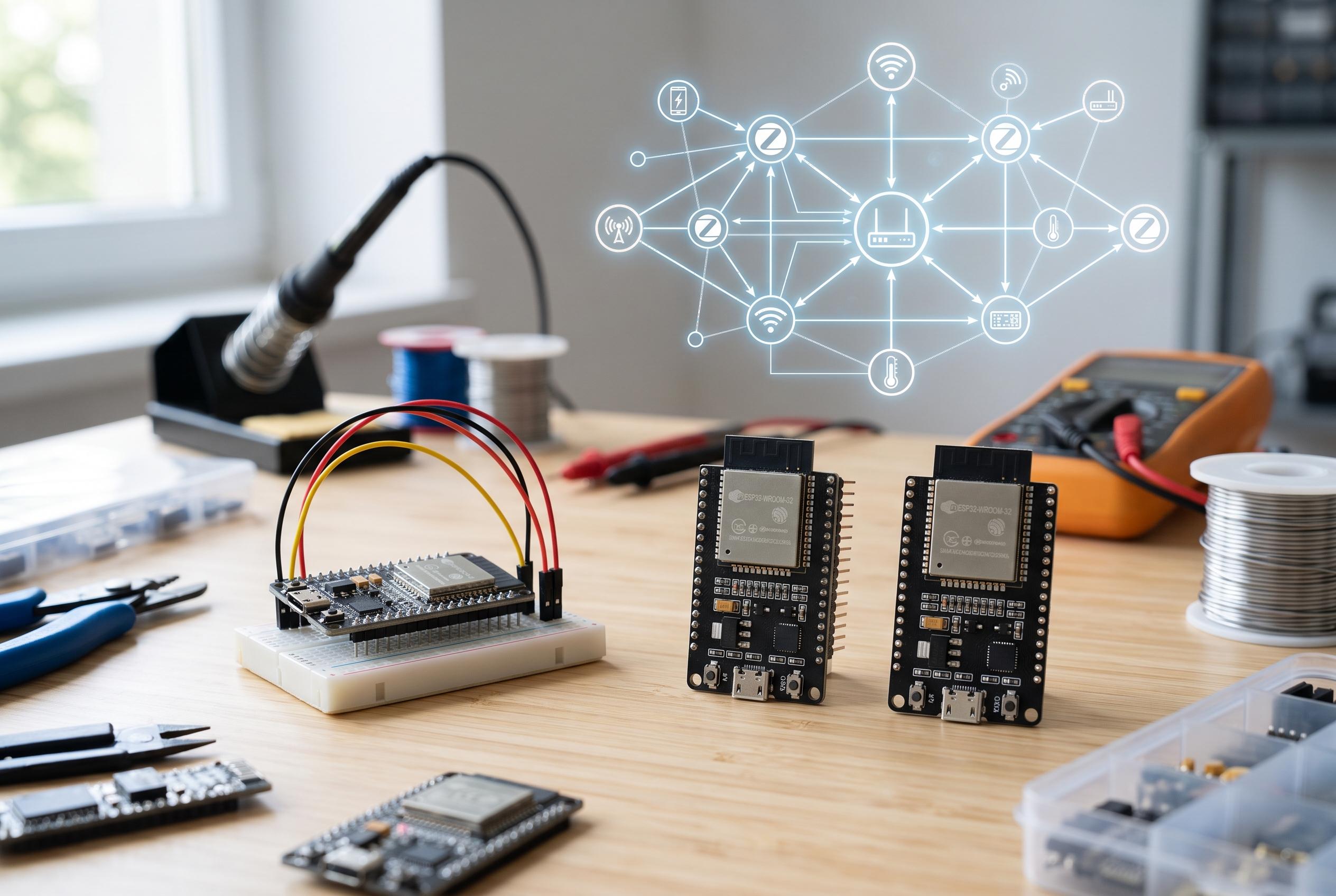

New applications of ESP32 boards demonstrate how beginners and experts alike can leverage built-in wireless radios for versatile, sensor-free home automation projects, from Wi-Fi scanners to Zigbee routing.
ESP32 boards can do more than power ambitious home automation builds. For beginners, they can also serve as a low-cost route into useful projects that rely mainly on built-in wireless radios rather than extra hardware. According to XDA Developers, that makes it possible to start with simple firmware, basic YAML configuration and an inexpensive development board rather than a full set of sensors or motors.
A good first project is a Wi-Fi strength scanner. The idea is to use the ESP32’s wireless radio to detect nearby access points and report signal strength in decibel-milliwatts, giving a quick view of coverage around the home. Instructables and a separate ESP32 tutorial site both describe similar beginner builds that show nearby networks, RSSI values, channel data and security details, either on a touchscreen display or in a serial monitor. XDA Developers frames the same concept as an easy entry point into ESPHome and Home Assistant.
The next step is a Bluetooth proxy for Home Assistant. In practical terms, the ESP32 acts as a remote Bluetooth receiver, capturing BLE advertisements from devices that are too far away from the main hub and relaying them over Wi-Fi. A 2025 guide from esp32.co.uk describes the same approach as a way to extend Bluetooth coverage with inexpensive boards placed around a home, while also noting that placement matters because walls, metal and distance can all weaken performance. The result is a straightforward way to fill coverage gaps without replacing existing hardware.
For users moving beyond Bluetooth, the ESP32-C6 opens the door to Zigbee routing. XDA Developers notes that this chip adds Wi-Fi 6 and IEEE 802.15.4 support, which lets it handle Zigbee and Thread alongside Wi-Fi. In a Zigbee setup, the board can act as a mesh node that relays messages between a coordinator and devices that sit further from the main network, improving reliability in larger homes. The process is more involved than the earlier projects and depends on Home Assistant integration, including ZHA configuration and, in some cases, USB passthrough if the software is running in a virtualised environment.
The same ESP32-C6 can also be flashed as a Thread border router. Unlike the YAML-based projects, this one uses pre-built firmware and a different setup path in Home Assistant’s Thread tools. XDA Developers says the board can work well even without extra accessories, though a U.FL antenna is recommended for better range. Taken together, these projects show how much can be done with a single microcontroller before sensors enter the picture. Once users are ready to go further, XDA Developers argues that adding low-cost modules such as environmental sensors can turn the same platform into a much more capable home lab tool.
Disclaimer: This content is intended for informational purposes only. Readers are advised to exercise their own judgement, conduct due diligence, or consult a qualified expert before acting on any information provided.