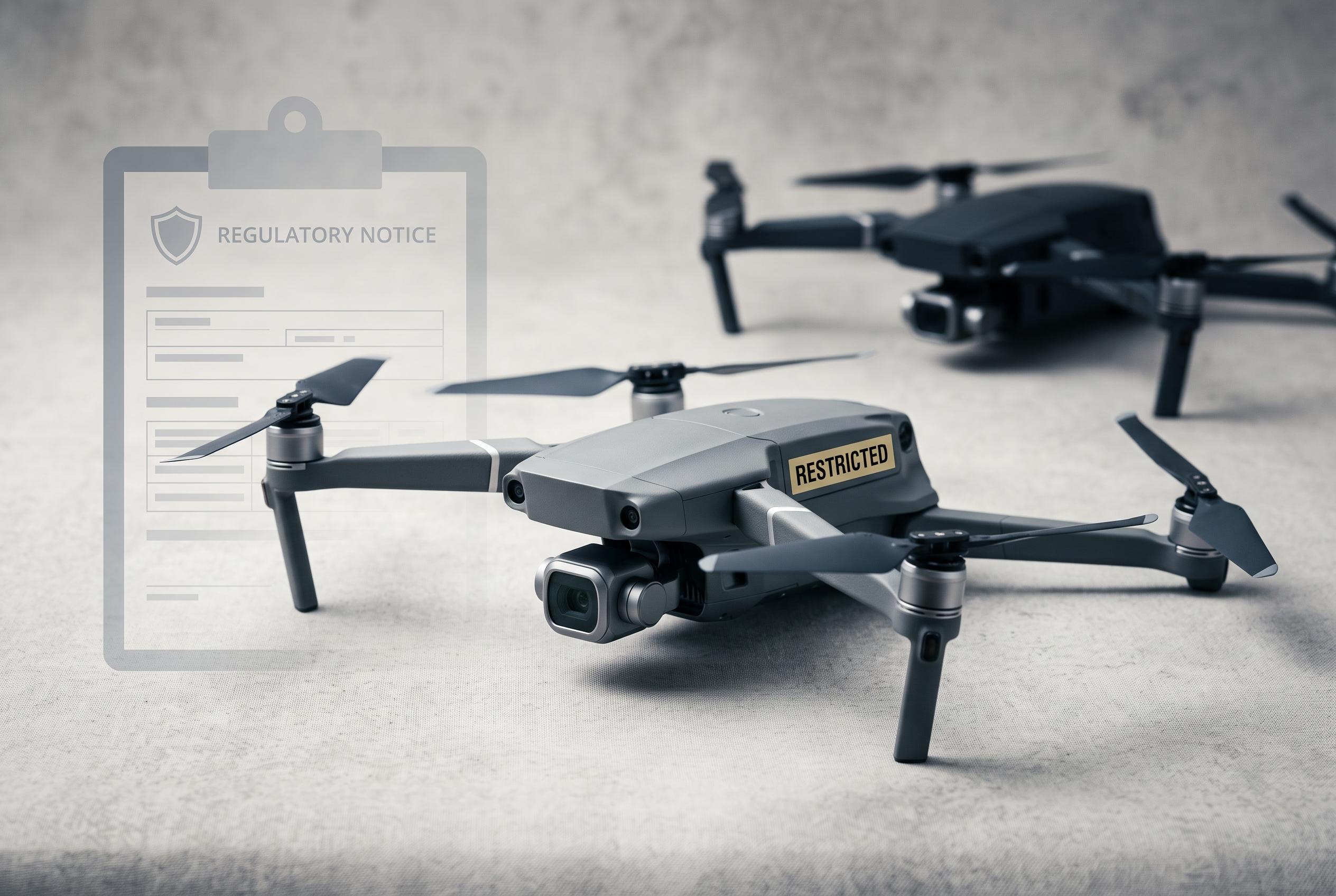

The US Federal Communications Commission is expanding its restrictions on foreign-made drones, raising concerns about market access, safety features, and the future of domestic drone manufacturing amid a broader crackdown on foreign technology.
The Federal Communications Commission’s latest move against foreign-made drones is broadening concern well beyond the hobbyist market. According to PCMag, the agency has already placed foreign drones and DJI camera products on its Covered List, and is now considering whether to go further by revoking approval for models that had already been authorised for sale in the United States. That shift matters because drones are no longer niche gadgets: they are used in search and rescue, infrastructure inspection, agriculture and media production.
What makes the proposal contentious is the FCC’s definition of “military-grade”. Reporting by Tom’s Hardware and TechRadar says the commission is weighing restrictions on drones with LiDAR obstacle sensors, thermal cameras, spray systems and docking hardware, as well as heavier aircraft and some coordinated swarm applications. Those features are common in professional and consumer devices alike. Models such as DJI’s Mini 5 Pro and Air 3S could be caught up in the rule, even though LiDAR is primarily a safety tool that helps prevent crashes.
The practical effect would be to narrow the US market at a time when domestic alternatives remain limited. PCMag’s reporting cites Hylio chief executive Arthur Erickson as saying the US is still years away from producing a consumer camera drone that can match DJI’s latest models on capability and price. That gap is especially significant for real estate photographers, filmmakers, small businesses and local public safety teams, which often depend on affordable equipment. Industry commentary also warns that higher-cost domestic replacements could increase costs for farmers and municipalities.
The FCC’s broader campaign against foreign technology is adding to that uncertainty. In recent months, the agency has also moved against foreign-made routers, robot vacuums, robot lawn mowers and portable power stations, according to PCMag and Tom’s Hardware. It has also targeted DJI-related clone brands such as Anzu Robotics, Specta and Skyrover, while Xtra, a maker of DJI-style handheld cameras, has been singled out for possible inclusion. That pattern suggests the drone rules may not remain confined to aircraft for long.
For existing owners, the immediate impact may be more indirect than sudden. Tom’s Hardware says the commission’s proposal would not stop people flying drones they already own, but it could make repairs, replacement parts and future software support harder to obtain. The FCC is taking public comment until September 2, 2026, and DJI has criticised the move as an attack on safety features rather than genuine military capability. For pilots, first responders and businesses that rely on these systems, the question is no longer whether regulation will tighten, but how much of the consumer drone market will survive the process intact.
Disclaimer: This content is intended for informational purposes only. Readers are advised to exercise their own judgement, conduct due diligence, or consult a qualified expert before acting on any information provided.