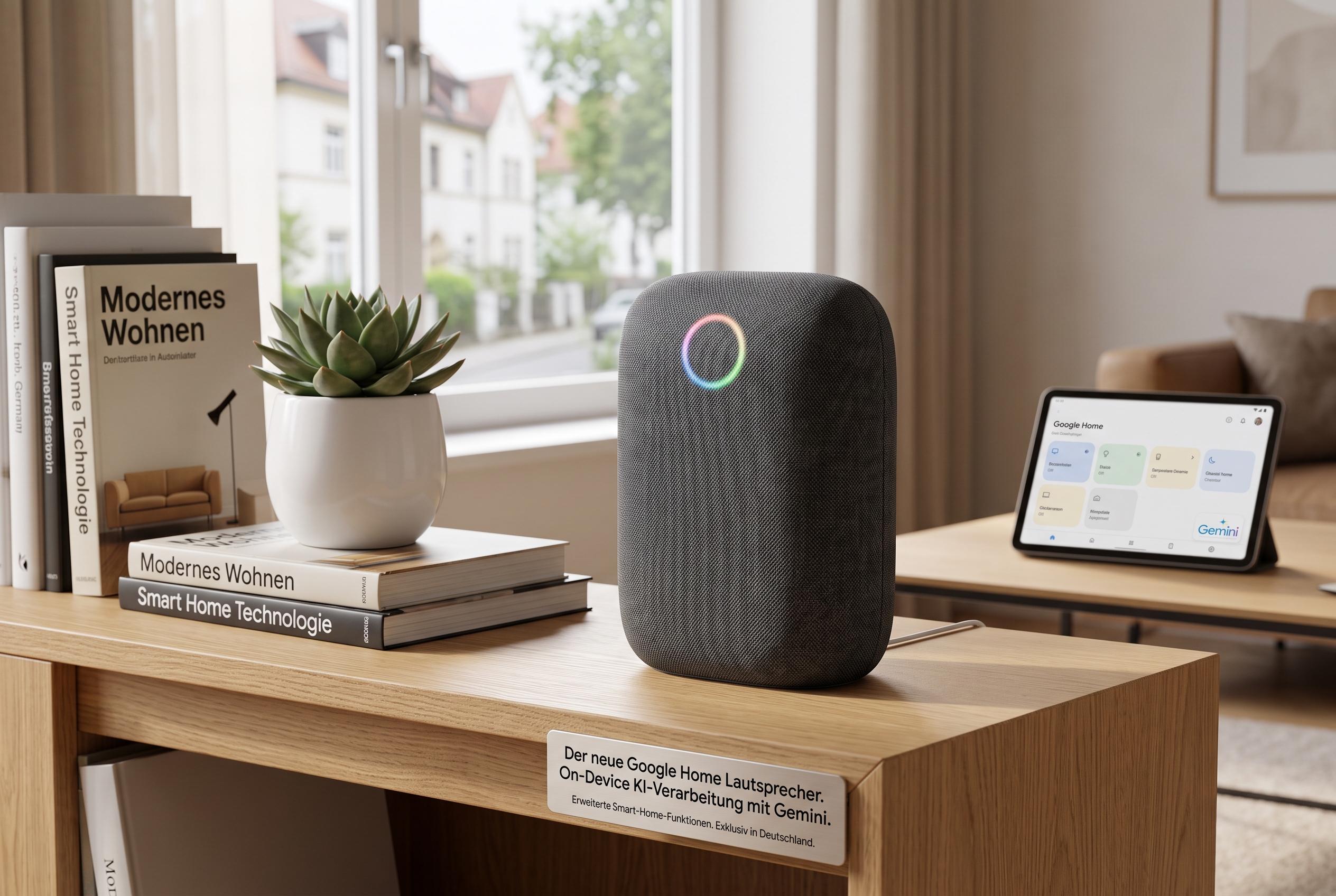

Google launches its latest Home Speaker in Germany, featuring on-device AI processing with Gemini and enhanced smart home capabilities, marking a strategic shift in its smart device ecosystem.
Google has finally brought its new Home Speaker to Germany, 41 days after the device first reached 18 other countries, including Austria and Switzerland. The speaker went on sale there on August 4 at €119.99, with Google offering it in Porcelain and Hazel through its own store and through MediaMarkt and Saturn. In the UK and other European markets, the launch matters less as a product event than as a sign that Google is trying to rebuild its smart speaker business around Gemini rather than the old Assistant model, as reported by Numerama and Google’s own support material.
The hardware is familiar, but the software shift is significant. Google’s support page says Gemini for Home is now the company’s main voice assistant for compatible devices, with setup handled through the Google Home app. The Home Speaker is built around a 58 mm full-range driver with 360-degree sound, three far-field microphones, Wi-Fi 6, Bluetooth 5.4 and a physical mute switch. It also includes a dedicated neural processing unit so Gemini Nano can run on the device itself for basic queries and household controls. According to Google and coverage from TechCrunch and Notebookcheck, that local processing is one of the headline differences from earlier Nest speakers.
That distinction is also central to how Google is positioning the product in privacy-conscious markets such as Germany. Google says routine commands, timers, music playback and smart home control can be handled on-device, while more advanced functions still rely on the cloud. Those cloud-based features include Gemini Live, camera history search and AI-generated household summaries. German users who want that wider feature set need a Google One AI Pro subscription, priced at €21.99 a month, although buyers receive a six-month trial. Google’s support documentation also makes clear that core Gemini for Home functions remain available without a paid plan.
The speaker is also being sold as a smart home hub, not just an audio device. It acts as a Matter controller and a Thread border router, which lets it connect low-power devices such as locks, sensors and thermostats to the wider network. That gives it a practical role in mixed-brand smart homes, where Matter compatibility has become a buying requirement. But there is a technical catch: the device ships with Thread 1.3 support, even though new Thread border router certification now runs to Thread 1.4. Existing networks should still work, but the hardware arrives on a specification that is already behind the current standard.
The German launch also ended an awkward gap in Google’s rollout. When the device was announced last year, Germany was listed as a target market, yet it was missing from the June launch wave that covered most of Europe. Heise Online reported that Google gave only a vague assurance that Germany would get the speaker “soon”, without offering a reason for the delay. For German buyers, the wait meant a period in which Google had stopped selling the old Nest Audio and Nest Mini without yet offering a replacement.
At the same time, Google is trying to make the speaker part of a broader ecosystem rather than a single product. The company has said Gemini for Home is expanding to more devices and that third-party makers will be able to build compatible speakers using a reference design. That suggests the Home Speaker may be only the first step in a wider shift. For now, though, German buyers get a device that combines local AI processing, smart home control and multi-room audio, while also carrying a reminder that Google’s smart home strategy is still moving faster in software than in hardware standards.
Disclaimer: This content is intended for informational purposes only. Readers are advised to exercise their own judgement, conduct due diligence, or consult a qualified expert before acting on any information provided.