
JBL launches Cove, a trio of Wi-Fi speakers designed to challenge Sonos by transforming portable audio expertise into a comprehensive in-home ecosystem through ease of use, multi-functionality, and open connectivity.
JBL has made its clearest move yet into the multi-room home-audio market with Cove, a three-speaker Wi-Fi range that specialist and consumer-tech titles immediately cast as a bid to challenge Sonos more directly. T3 described the launch as JBL taking aim at Sonos, while What Hi-Fi? said the company was moving into a category long contested by Sonos, Denon and Bose. The significance is less the existence of another wireless speaker line than JBL’s attempt to turn its name in portable audio into a broader in-home ecosystem.
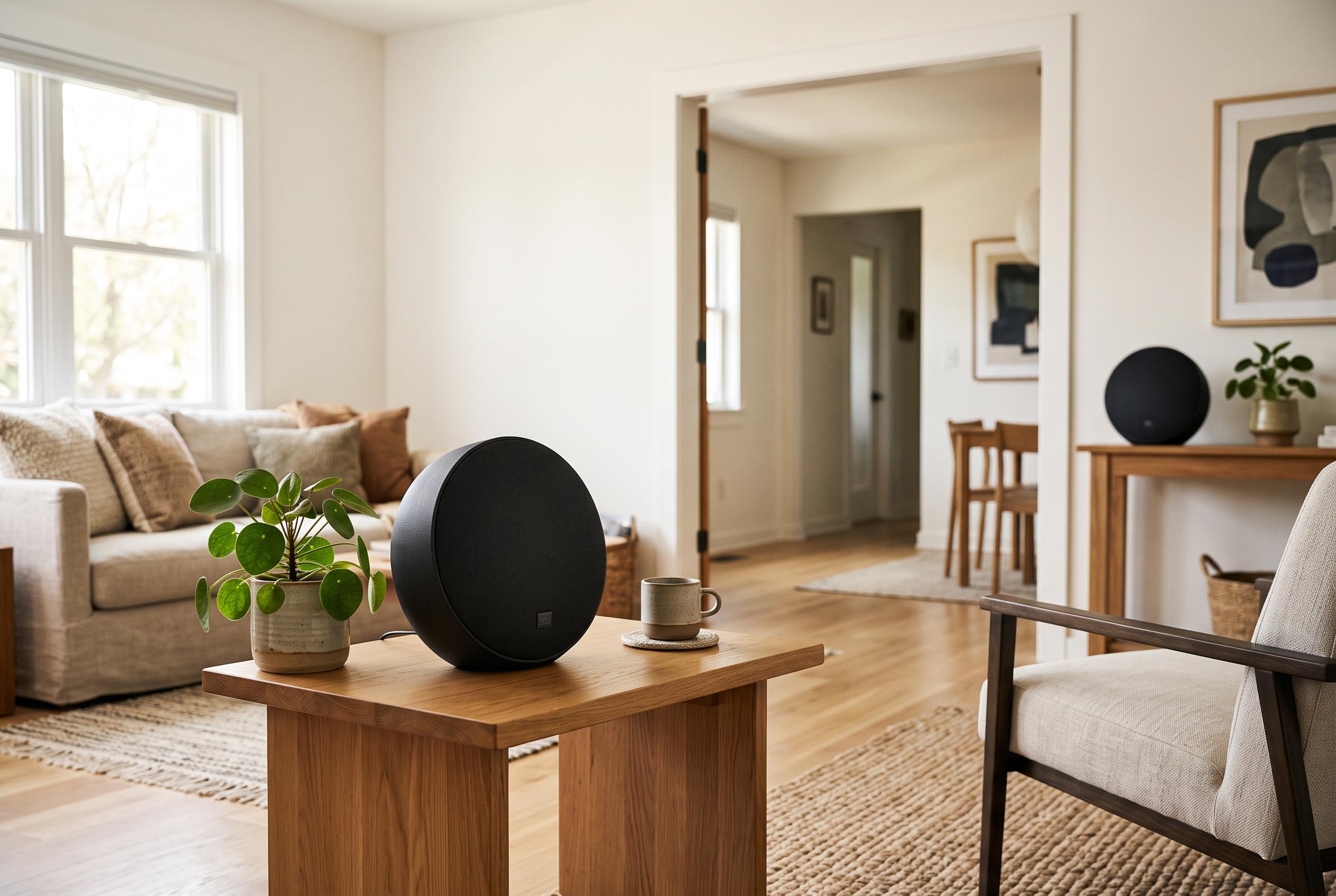
The line-up is split into three distinct jobs. The Cove M1 is the fixed, mains-powered entry model for smaller spaces. The Cove P1 is the portable variant, supplied with a charging dock and designed to move around the house or on to a patio without dropping out of the system. The Cove X1 is the largest model and the one aimed at bigger rooms, with four tweeters and two woofers. What Hi-Fi? and Residential Systems both highlighted that only the P1 and X1 support Dolby Atmos, while T3 and TechRadar focused on the P1’s up-firing driver, its claimed 14 hours of battery life and its IP56 dust and water resistance.
That matters because JBL is not entering this segment from nowhere, but from a different part of the audio market. What Hi-Fi? argued that the brand has already dominated portable Bluetooth speakers through families such as Go, Flip, Charge and Xtreme, and is now trying to extend that reach indoors. TechRadar saw an obvious resemblance to Denon’s Home 200, 400 and 600 range, and suggested JBL was stepping into a mature field rather than creating a new one. In other words, Cove is not just another speaker launch. It is a test of whether JBL can persuade buyers to see it as a whole-home platform rather than a maker of standalone wireless boxes.
JBL’s main pitch is ease of use, especially around grouping and moving playback between rooms. T3 stressed that the system is meant to avoid the usual friction of rebuilding or breaking apart speaker groups when a listener wants sound in a different space. Residential Systems drew attention to the “Music Follows Me” feature, which lets a user press and hold the Moment button on a speaker so that music or TV audio jumps to that room without reopening an app. That is a practical claim rather than a glamorous one, but it speaks directly to one of the irritations that has shadowed multi-room systems for years.
The Cove range is also being positioned as more than a music-only product. Forbes and Residential Systems both reported that the speakers work with JBL Bar Series MK2 soundbars, allowing the same platform to stretch from casual listening into television and film use. Residential Systems went further, noting that Cove speakers can serve as rear channels in a Dolby Atmos home-cinema arrangement. That gives JBL a potentially useful bridge product: a buyer who starts with a soundbar can add Wi-Fi speakers room by room, while a music customer can expand later into surround sound without changing brand or app.
On connectivity, JBL is trying to remove as much lock-in as possible. Forbes said the range supports Wi-Fi and Bluetooth alongside AirPlay 2, Google Cast, Roon Ready, Spotify Connect, Tidal Connect and Qobuz Connect. That is an important technical point. A whole-home Wi-Fi system is more attractive when music can be sent directly from services over the network rather than relayed from a phone over Bluetooth, because the phone then stops being the weak link for range, interruptions and, in some cases, sound quality. JBL is effectively arguing that convenience should not require a closed ecosystem.
There was, however, some confusion in early coverage over pricing and timing. T3 listed the M1 at $219.95 in the US, £199.99 in the UK and €229.99 in Europe. What Hi-Fi? and Forbes both wrote that the range would arrive in October 2026, while Residential Systems published US prices that included $219.95 for the M1 and $379.95 for the X1. JBL’s own US product pages now show the M1 at $229.95, the P1 at $399.95 and the X1 at $449.95, with pre-orders expected to ship on 13 September 2026. For buyers comparing launch reports, that official store listing appears to be the clearest current position.
The commercial question is whether simplicity is enough to unsettle established rivals. Carsten Olesen, HARMAN’s president of consumer audio, said JBL was setting “a new benchmark” and wanted to become “a leading force in home audio”. The product strategy is coherent: an entry speaker, a portable step-up model, and a larger flagship for bigger rooms, all tied together by the same control layer. T3 singled out the P1 as the most intriguing part of the range because portability is still rare in serious multi-room systems, while TechRadar warned that the X1 is entering a part of the market with strong incumbents and little room for error. That may prove to be the real story of Cove: not whether JBL can build a capable Wi-Fi speaker, but whether it can make the whole-home category feel less fussy than the companies that got there first.
Disclaimer: This content is intended for informational purposes only. Readers are advised to exercise their own judgement, conduct due diligence, or consult a qualified expert before acting on any information provided.