
From soil and water levels to energy use and asset tracking, ready-made LoRaWAN sensors are broadening remote monitoring , but radio compatibility, payload decoding and realistic battery expectations remain crucial to successful deployment.
For organisations that need remote monitoring across buildings, farms or utility sites, ready-made LoRaWAN sensors are often a more practical choice than building a node from scratch. The appeal is straightforward: these devices are designed to take small, periodic measurements, transmit them over long range to a gateway and keep working for years on battery power. That model suits cold rooms, greenhouses, warehouses, meeting rooms, tanks and other hard-to-wire locations where regular cabling is expensive or impractical. According to the guide, the strongest commercial offerings on Amazon are concentrated among Dragino, Milesight and Seeed’s SenseCAP line, which together cover climate, soil, level, current, sound and tracking use cases.
The practical buying decision begins with radio compatibility. A sensor must match the gateway’s frequency plan, whether that is US915 for North America or EU868 for Europe, and it must also work with the network stack in use, such as The Things Network, ChirpStack, Helium or a vendor cloud. The guide also stresses the less visible parts of deployment: the DevEUI, JoinEUI and AppKey needed for registration, plus a payload decoder to turn raw packets into readable measurements. That advice aligns with broader buying guidance from other LoRaWAN specialists, who emphasise that the device is only one part of the system and that integration support matters as much as the hardware itself.
Among the climate sensors, Dragino’s LHT65N stands out as the most established general-purpose option. It combines temperature and humidity sensing in a compact Class A device and is widely used in community LoRaWAN deployments, which helps explain why it is repeatedly recommended for server rooms, warehouses, homes and greenhouses. The same family also includes variants aimed at colder storage and outdoor installations, while Milesight’s AM307 is better suited to indoor environments where facilities teams want a more polished display and multiple ambience readings in one unit. For offices, classrooms and meeting rooms, the e-ink screen is especially useful because occupants can see conditions locally as well as remotely.
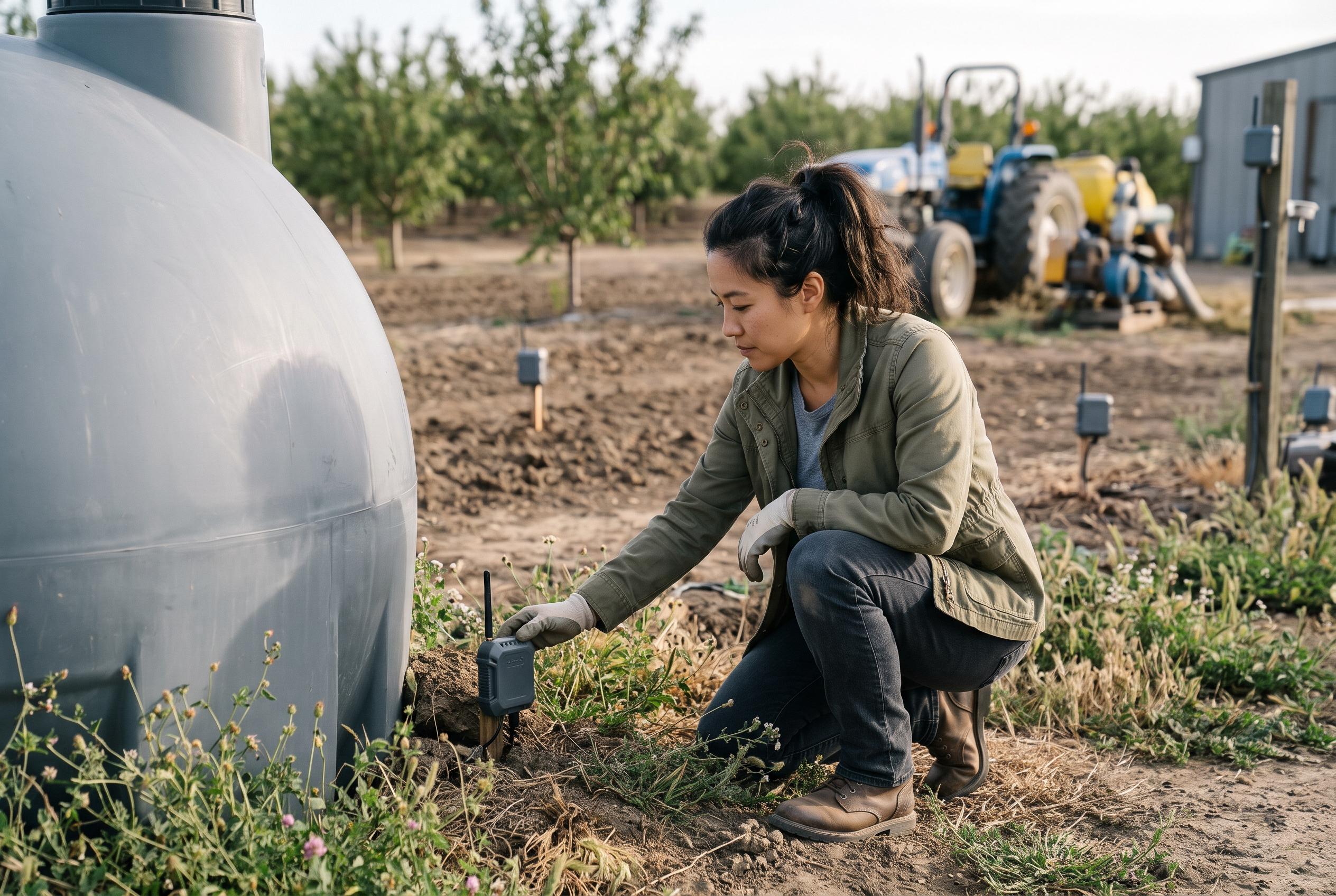
The guide’s agricultural section reflects how varied field deployments can be. For basic soil monitoring, the Dragino SE01-LB measures moisture and electrical conductivity, while the SPH01-LB adds remote pH measurement for orchards, vineyards and research plots. Seeed’s SenseCAP S2105 goes further by combining soil moisture, temperature and EC in one industrial-grade unit. Related buying guides point out that this kind of sensor choice should be driven by the site itself: fields, greenhouses and irrigation projects often need durable enclosures, careful calibration and an understanding of how soil type affects readings. In practice, the right sensor is the one that matches the agronomic question being asked, not simply the one with the longest feature list.
Other categories in the guide show how LoRaWAN has moved well beyond temperature monitoring. The DDS75-LB is aimed at water tanks, bins and silos because it measures distance non-contact, making it useful where a float switch or wired probe would be awkward. The CT10X current sensor is designed for energy monitoring and equipment load analysis, though the guide correctly notes that clamp-on installation around live conductors should be handled by an electrician. For noise monitoring, the Milesight WS302 is positioned at offices, libraries, hospitals and rental properties, with NFC setup simplifying commissioning. And for asset or people tracking, the SenseCAP T1000-A, Elecrow tracker card and Capsule Sensor V3 show how GPS, motion and modular sensing are increasingly being packaged into compact LoRaWAN devices for mixed indoor and outdoor use.
A recurring theme across the guide and the wider LoRaWAN buying literature is that battery claims should be treated as conditional, not absolute. Multi-year life is possible, but it depends heavily on how often a device sends data, how far it is from the gateway and how the radio behaves in the real installation. A minute-by-minute reporting interval can shorten life dramatically compared with one message every 15 or 20 minutes. That is why reporting interval, enclosure rating, seller reliability and documentation quality all matter. For buyers, the most useful rule is simple: choose the sensor by use case, verify the radio and network details before ordering, and confirm that the vendor provides the payload decoder and setup guidance needed to bring the device into service quickly.
Disclaimer: This content is intended for informational purposes only. Readers are advised to exercise their own judgement, conduct due diligence, or consult a qualified expert before acting on any information provided.