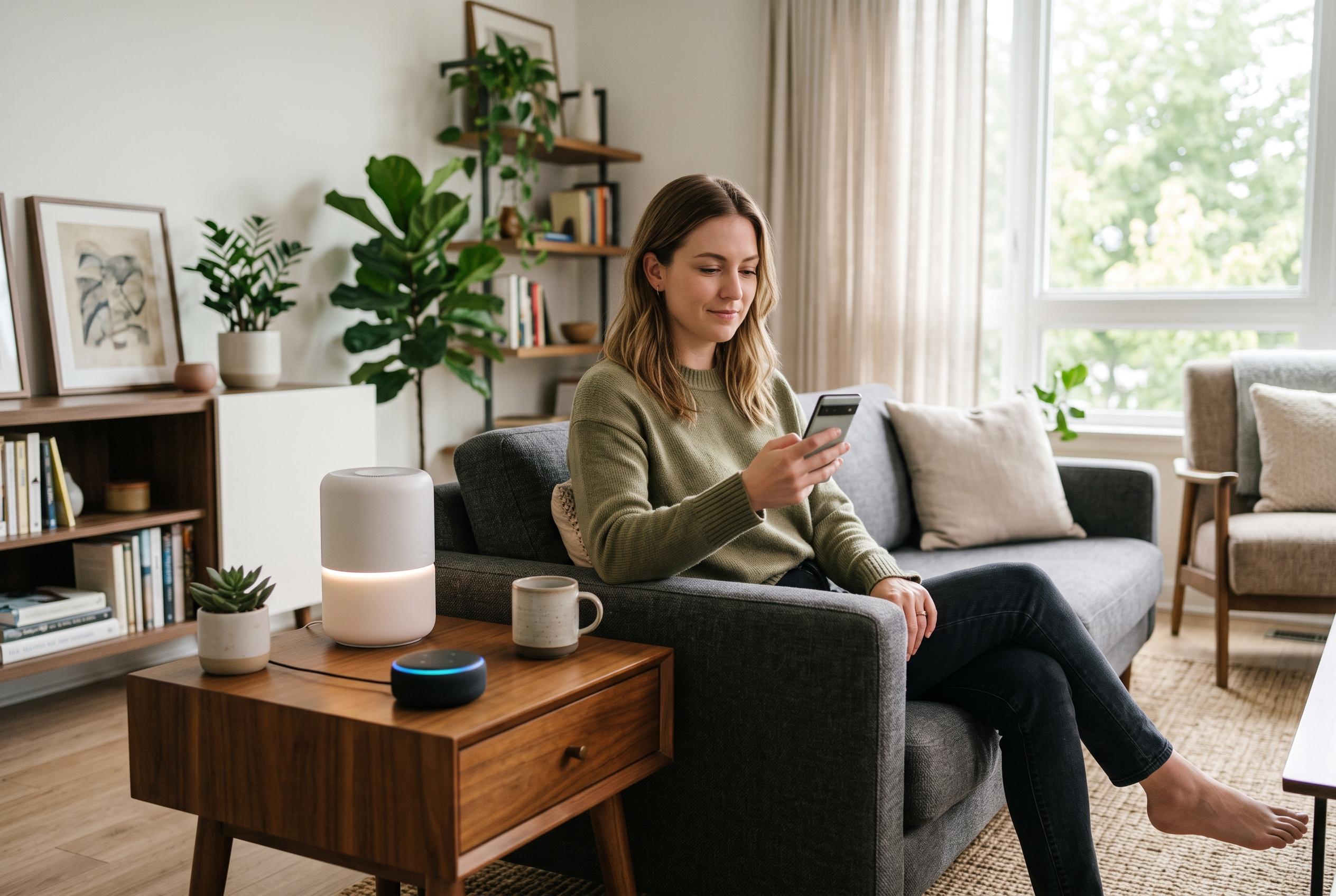

A small but growing group of air purifiers now connects directly with Apple Home, Google Home and Alexa, led by models from SwitchBot, Dyson, WELOV, xCREAS and GoveeLife.
Matter air purifiers remain a narrow category, but the market is beginning to take shape around a small group of devices that connect directly into Apple Home, Google Home, Alexa and other smart home platforms without relying on a manufacturer hub. According to Microcontrollers Lab, the current field is led by SwitchBot, Dyson, WELOV, xCREAS and GoveeLife, with the strongest options judged on room coverage, sensor quality, noise levels and how cleanly they behave through Matter rather than through proprietary cloud links.
The practical appeal is straightforward. A purifier can respond to cooking smoke, pollen or wildfire haze as part of a wider home automation routine, switching between high output, quiet overnight operation and scheduled use without extra integrations. Microcontrollers Lab notes that Matter support in air purifiers is still young, because the device type only arrived with Matter 1.2 and Apple Home only began supporting it in iOS 18. That leaves a limited but useful group of models for buyers who want a genuinely native smart-home appliance.
SwitchBot emerges as the most versatile choice in the guide. The company’s Air Purifier Table combines HEPA filtration with a side-table form factor, a Qi charger, ambient lighting and a reported 20dB sleep mode, while also appearing as a native Matter device over Wi-Fi. Microcontrollers Lab says the standard SwitchBot purifier uses the same purification hardware without the furniture-style extras, making it the better value for large rooms and homes with pets. SwitchBot’s own support documentation also confirms that its Air Purifier can work as a standalone Matter device on firmware V2.2-2.2, rather than needing a hub-based bridge.
Dyson’s Purifier Hot+Cool HP2 De-NOx occupies the premium end of the market. It is presented as a three-in-one machine that purifies, heats and cools, while also targeting nitrogen dioxide and formaldehyde in addition to particles. That broader pollutant handling makes it relevant for gas-stove kitchens and winter bedrooms, although it is also the most expensive option in the comparison. Because the Matter support requires a firmware update, it is a more complex buy than the simpler SwitchBot models, but it offers the widest feature set.
WELOV’s Matter P200 Pro stands out for sleep-focused automation. According to Microcontrollers Lab, it is the first Matter-certified air purifier and supports Apple Health sleep integration, allowing it to align quiet operation with the user’s overnight routine. Its PM2.5 sensor enables faster automatic responses when air quality worsens, which makes it well suited to bedrooms and Apple-centric homes. WELOV’s own material says the purifier now integrates fully with Apple Home, reinforcing its position as one of the more mature Matter implementations in the category.
For buyers watching price, xCREAS and GoveeLife fill two different roles. xCREAS’s Brivo300s offers a full-size tower format, a washable pre-filter, PM2.5 sensing and an aroma tray at a comparatively low entry cost, though the brand is less established than SwitchBot or Dyson. GoveeLife’s Smart Mini Air Purifier, by contrast, is designed for desks, nurseries and small rooms. Matter Catalog lists a Govee smart purifier line with Wi-Fi-based Matter support, washable pre-filter, Eco Mode, PM2.5 monitoring and Sleep Mode, and that aligns with Microcontrollers Lab’s note that the mini model is best treated as a compact, low-cost option rather than a whole-home cleaner.
The main buying lesson is that Matter alone does not make a purifier equally useful in every home. Buyers still need to think about room size, sensor quality, noise and filter costs. Models with built-in PM2.5 sensing can react more intelligently in Auto mode, while decorative features such as table surfaces or wooden finishes may matter more in living spaces than in utility rooms. The result is a market that is small but increasingly practical: one that now offers a few credible ways to bring air cleaning into the same automation layer as lights, thermostats and occupancy sensors.
Disclaimer: This content is intended for informational purposes only. Readers are advised to exercise their own judgement, conduct due diligence, or consult a qualified expert before acting on any information provided.