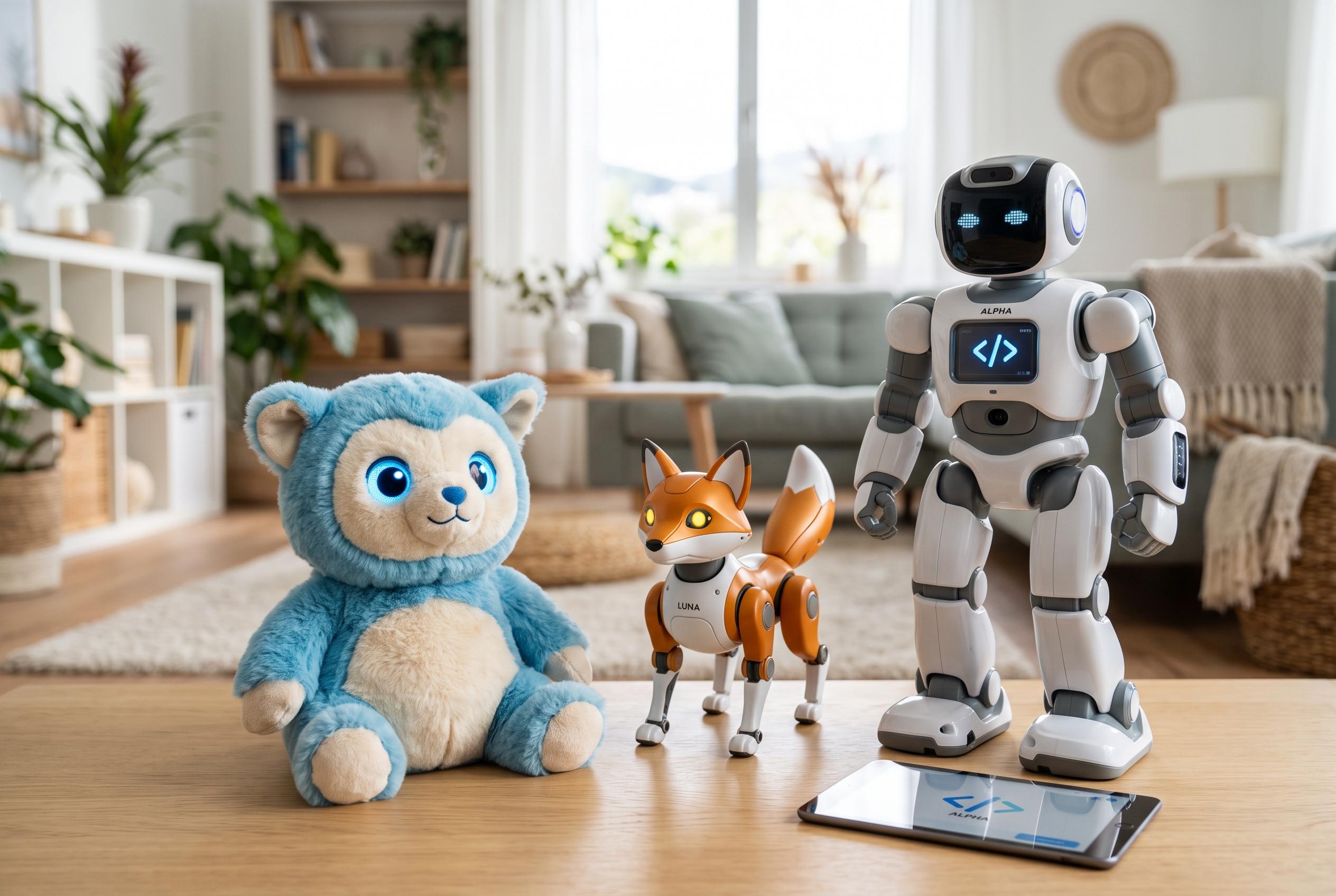

A range of innovative robotic pets now offer tailored experiences, from cuddly companions to programming platforms, reflecting evolving consumer preferences and technological advances in the market.
Robot pets now span several distinct categories, from soft companions and desktop characters to roaming home devices and programmable kits. That makes the market less about simple cuteness than about what kind of interaction a buyer actually wants. Some products are built to comfort, others to explore a room, and others to teach coding and robotics through hands-on use.
KEYi Tech’s Loona stands out as the most complete robot puppy in the group. The company describes it as an AI-powered pet with face and gesture recognition, voice commands, games, autonomous charging and a camera-and-speaker system for home monitoring. With a 720p RGB camera, 3D ToF sensing, a four-microphone array, a display and ear and wheel actuators, it is designed to move and react in ways that make it feel more animated than a simple toy.
For buyers who want something softer and more intimate, CASIO’s Moflin is the clearest cuddle-focused option. The company presents it as a smart companion robot that responds to touch and speech, develops a simulated personality over time and comes with a charging bed. CASIO says it offers roughly five hours of use per charge. It is best understood as a comforting companion device, not a live animal replacement.
LivingAI’s EMO is aimed at people who want a pet-like presence on a desk rather than on the floor. The company says it can explore independently, play music and games, recognise people and objects and produce more than 1,000 facial expressions and movements. Its appeal is compactness and character rather than scale. In practice, it is the smallest and most office-friendly option here.
Sony’s aibo sits at the premium end of the market. It is built around rounded puppy-like proportions, OLED eyes, blinking, ear movement, tail wagging and 22-axis drive actuators. Sony positions it as an autonomous companion that develops its own personality through use. That experience comes at a cost, however, because service plans, accessories and software features can all affect the total price of ownership.
Enabot’s EBO X is less about emotional simulation and more about utility. The robot can map a home, follow people, send voice messages, keep pets company and take low-angle photos. It is effectively a moving camera with companion features, which makes it useful for pet owners who want to check in remotely. The trade-off is that privacy, Wi-Fi reliance and indoor layout all matter more than they do with a stationary device.
Petoi’s Nybble Q and Bittle X V2 occupy a different category altogether. Both are presented as open-source, maker-oriented platforms rather than finished companions. Nybble Q is a programmable robot cat that supports app control, block coding, Python and C++, while Bittle X V2 adds robot dog styling, voice control and broad support for coding and robotics tools. These are the best choices for readers who want to build and modify behaviour rather than simply interact with a polished pet.
The most sensible way to choose is to match the robot to the role. Moflin is strongest for holding and stroking, Loona for a puppy-like roaming companion, EMO for a desk pet, aibo for the premium experience, EBO X for home monitoring and Petoi’s robots for programming and hands-on learning. None of them should be mistaken for a living pet, and features such as cloud access, app dependency, battery life and regional availability should be checked before buying.
Disclaimer: This content is intended for informational purposes only. Readers are advised to exercise their own judgement, conduct due diligence, or consult a qualified expert before acting on any information provided.