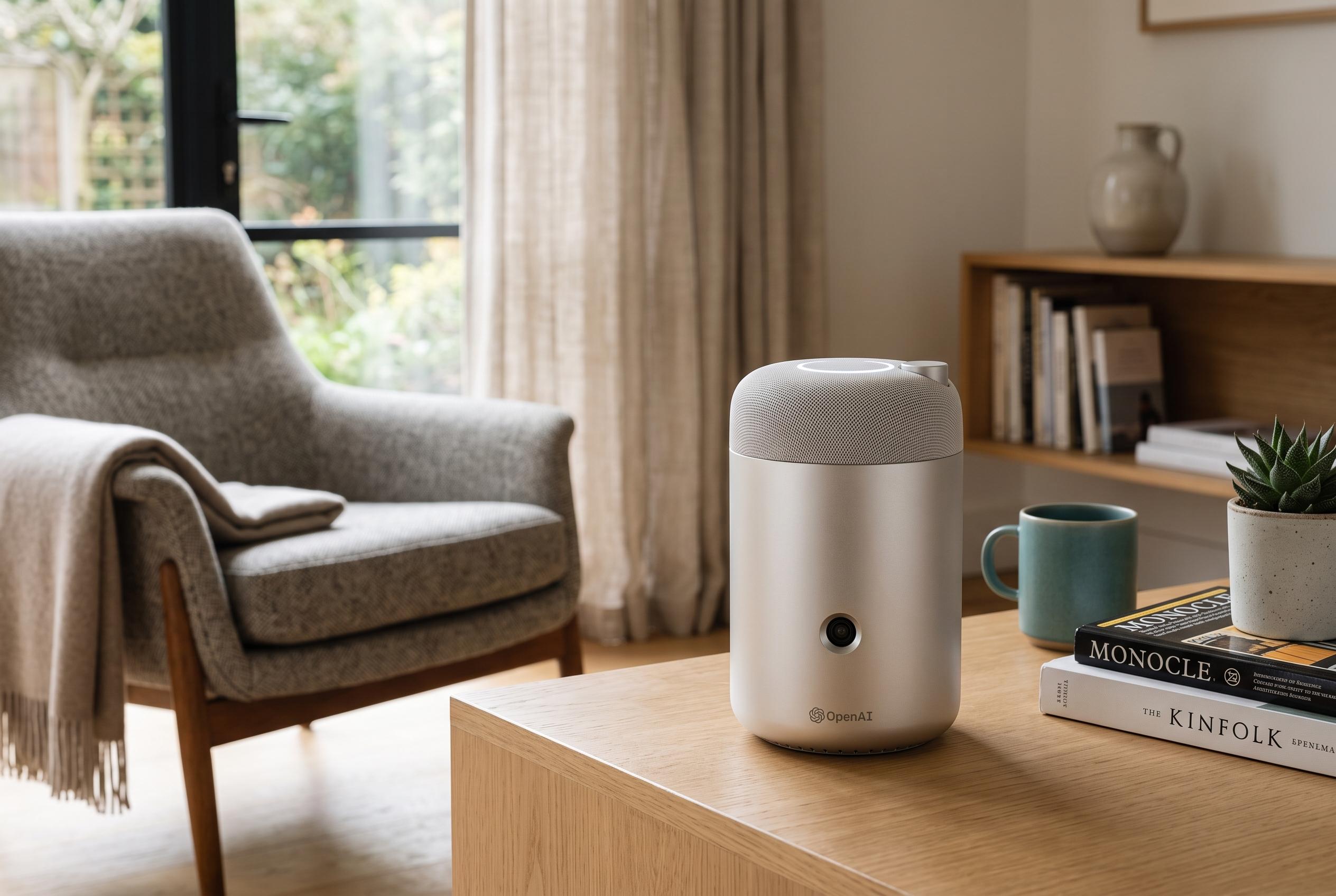

OpenAI collaborates with Jony Ive on a disruptive, screenless smart speaker featuring advanced sensors and facial recognition, signalling a shift towards more integrated and context-aware AI devices for domestic use.
OpenAI appears to be moving beyond software into a dedicated home device that could give ChatGPT a physical presence in the room. According to reporting by New Atlas and MacRumors, the company is working with former Apple designer Jony Ive on a small, screenless smart speaker that is expected to arrive in early 2027 and may cost about $300 to $400. The device is described as roughly hockey-puck sized, with a central opening, battery power and a charging base.
What distinguishes it from familiar smart speakers is the suggested hardware around the conversation engine. Reports say the product could include cameras, environmental sensors, status lighting and moving elements that give users a clearer sense of what it is doing. MacRumors says the system may even use facial recognition in a Face ID-like manner, while also watching for context and suggesting actions, such as recommending an earlier bedtime before a morning meeting.
That would put OpenAI on a different path from Amazon, Google and Apple, whose voice assistants largely reduced the problem to microphones, speakers and cloud queries. The company’s first confirmed hardware product, however, is far more modest: the Codex Micro, a $230 programmable macropad built with Work Louder for users of OpenAI’s coding tools. Tom’s Hardware, TechCrunch and Gizmochina all describe it as a compact accessory with 13 low-profile mechanical keys, a joystick, a rotary encoder and RGB indicators that show agent status.
Taken together, the two products suggest a broader hardware strategy. The Codex Micro gives developers a physical control surface for AI agents, while the rumoured home device would extend ChatGPT into domestic life with always-available voice interaction and richer sensing. The unanswered questions are the ones that will matter most to buyers: how much processing happens locally, how the sensors are used, and how deeply the speaker will connect with existing smart-home systems. For now, the reports point to a more ambitious idea than another cheap assistant box. They point to an attempt to make AI aware of the space and people around it.
Disclaimer: This content is intended for informational purposes only. Readers are advised to exercise their own judgement, conduct due diligence, or consult a qualified expert before acting on any information provided.