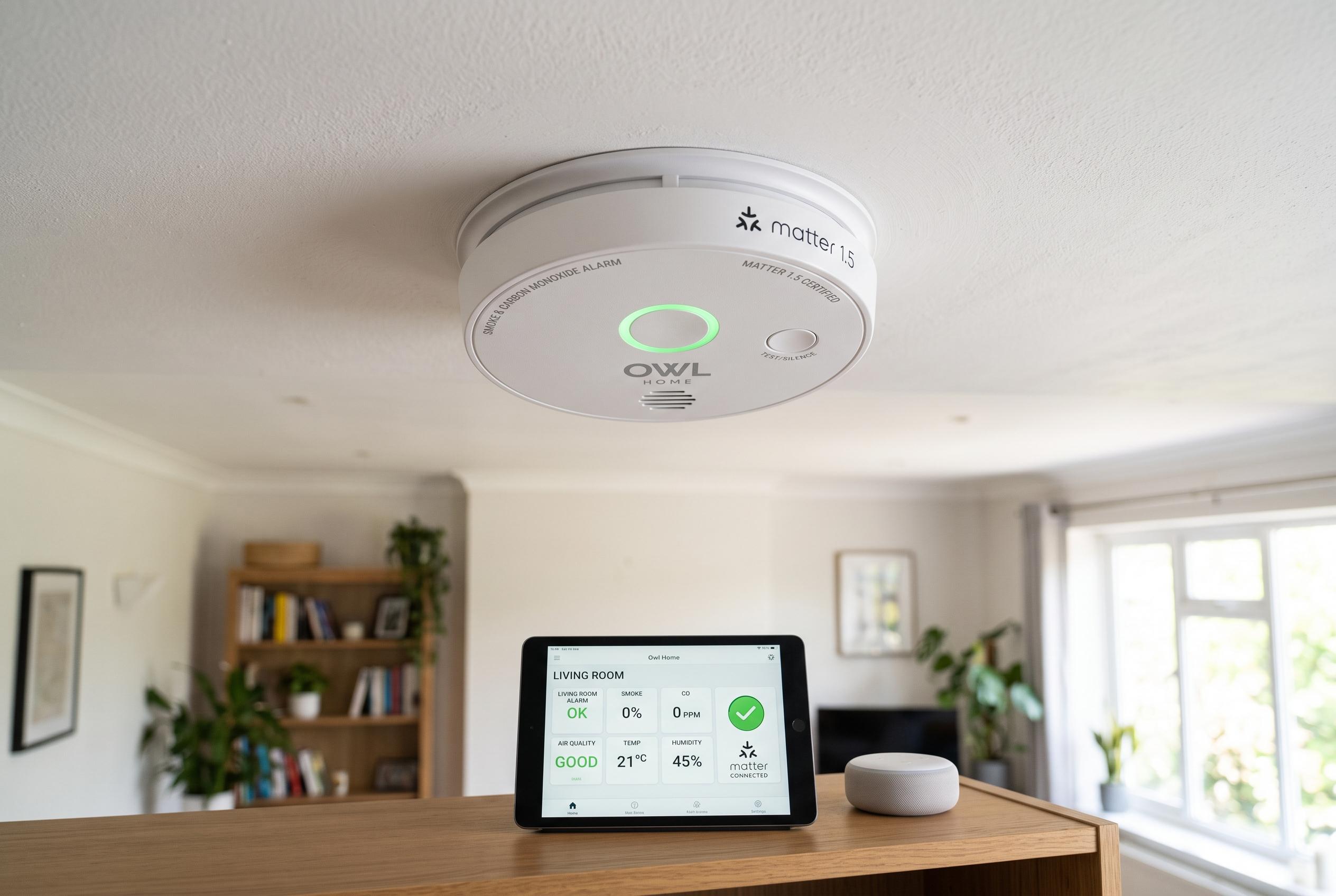

Owl Home’s wired smoke and carbon monoxide alarm gains Matter 1.5 certification, transforming it into a versatile multi-sensor device capable of enhancing fire safety and automation in smart homes across leading platforms.
Owl Home’s Wired smoke and carbon monoxide alarm has gained Matter 1.5 certification, giving the ceiling-mounted device a broader role inside the smart home than a conventional detector. The certification, logged by the Connectivity Standards Alliance on August 11, means existing compatible units should be able to gain the same status through a free over-the-air firmware update rather than a hardware swap, although Owl has not said when that update will be ready.
The practical significance is larger than the certification label suggests. Working smoke alarms are still one of the most effective protections in the home, and fire-safety data from the National Fire Protection Association shows the risk of death in residential fires is much lower when detectors are functioning. That makes interoperability more than a convenience feature: if a smoke alarm can trigger local automations across brands without relying on a proprietary bridge or a cloud server, it can improve response times in the moments that matter most.
Owl’s Wired model is already an unusually dense sensor package. According to Owl Home’s own product information and Consumer Reports’ review, it combines photoelectric smoke sensing, electrochemical carbon monoxide detection, motion sensing, temperature, humidity and air-quality monitoring in one mains-powered unit, with battery backup for outages. The company also positions the device as a broader home-monitoring hub, using a speaker, LED alerts and app-based notifications to surface events beyond smoke and CO.
What distinguishes the Matter update is not only compatibility but structure. The certification documents show six separate Matter endpoints, which means the device can present its sensors individually to a home platform. That matters because most Matter smoke alarms expose only the alarm function itself. In Owl’s case, the detector can also share occupancy, temperature, humidity, air-quality and battery data as separate inputs for automations. In effect, the product is behaving less like a single-purpose alarm and more like a multi-sensor node that happens to include life-safety hardware.
That broader approach may be especially relevant for households using Apple Home, Amazon Alexa or Samsung SmartThings, which have advanced further in supporting later Matter device categories than Google Home has in some areas. Owl has said it will keep its existing HomeKit integration available during the transition, which should reduce pressure on current users to move immediately. For buyers, the appeal is straightforward: a $189 safety device that can gain a more open standard by software alone is likely to have a longer useful life than one tied to a closed ecosystem.
The update also sits within a wider shift in the smart home market. Matter first added smoke and carbon monoxide alarms in 2023, and later versions have continued to expand the standard’s device support and local control features. Owl’s certification suggests the safety-device category is starting to catch up with lighting, locks and thermostats, where interoperability has already become a more common expectation.
Disclaimer: This content is intended for informational purposes only. Readers are advised to exercise their own judgement, conduct due diligence, or consult a qualified expert before acting on any information provided.