
Signify unveils major updates to Philips Hue at IFA 2026, including a camera-based TV sync system, AI-driven automation, and expanded ecosystem collaborations that aim to reduce costs and enhance user experience across the smart home landscape.
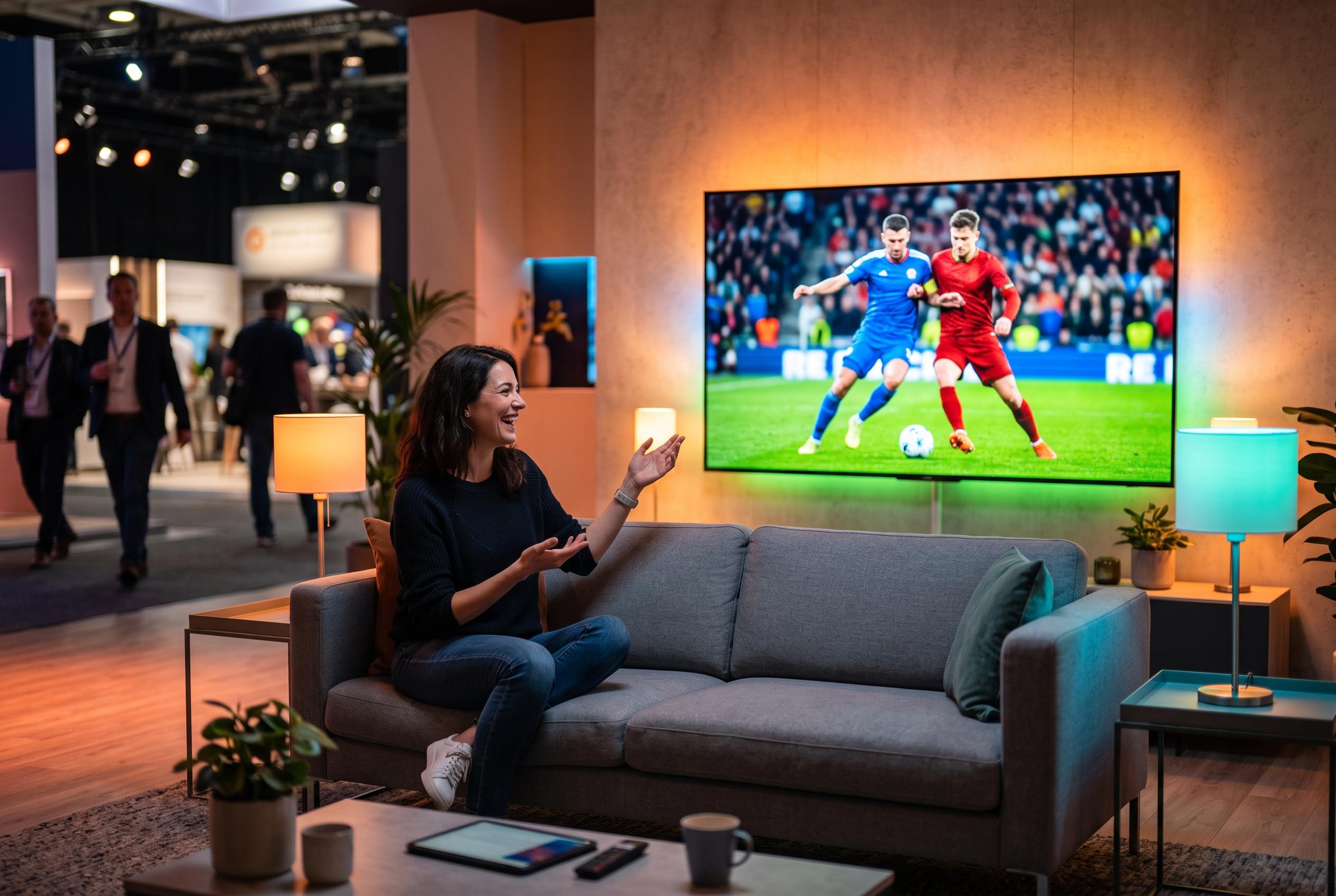
Signify’s most consequential Philips Hue announcement at IFA 2026 was not a new lamp but a broader attempt to remove two of the system’s longest-standing barriers: HDMI dependence for television syncing and the cost of entering the Hue entertainment stack. The company has begun selling two new routes into reactive TV lighting from 3 September: the camera-based Philips Hue Play Screen Sync from £109.99 and the slimmer Philips Hue Play HDMI sync box 4K from £134.99, both pitched as simpler ways to bring synced lighting to more living rooms. According to Signify’s UK release, the rollout started this month, while Forbes noted that the 4K box arrives at less than half the price of the flagship 8K model. (signify.com)
That matters because Hue’s earlier TV setup largely depended on passing video through a sync box, which excluded viewers using a television’s own streaming apps or broadcast sources. The new Screen Sync instead sits above the set and uses a fisheye camera with automatic calibration to read what is actually on the screen, allowing it to work with native smart-TV apps, broadcast channels and HDMI devices alike. TechRadar said that approach puts Hue into the same category as camera-based systems already sold by rivals such as Govee and Nanoleaf, while Apfelpage reported that Screen Sync is intended for screens up to 85 inches. The same German report said the new 4K box is aimed at simpler installations, with one HDMI input, HDMI 2.0 support, 4K at 60Hz and HDR, leaving the existing 8K unit as the option for buyers who need multiple sources, 4K at 120Hz or 8K passthrough. (signify.com)
Signify is also trying to make Hue syncing less hub-dependent. The company says one Play gradient TV strip can now connect directly over Bluetooth to either the Screen Sync camera or the 4K box without a Hue Bridge, with a Bridge or Bridge Pro only needed if users want to expand to a full entertainment area of up to 10 lights. Forbes argued that this is one of the clearest signs that Signify is trying to lower Hue’s historical cost barrier, especially when combined with cut-to-fit gradient strips and a new version sized for televisions up to 100 inches. (signify.com)
On the software side, the company’s most ambitious update is Custom AI Behaviors, which is scheduled for an early October software release on the Hue Bridge Pro. Rather than assembling automations manually from triggers, conditions and actions, users will be able to describe the outcome they want in ordinary language. Signify’s examples include different switch logic at weekends, scenes that start at dusk instead of a fixed time, and lighting changes triggered when entertainment syncing begins. TechRadar’s assessment was that the feature is less about generating decorative scenes than about making advanced automation usable by people who would not normally build it by hand. Apfelpage added that the launch build is expected to support German, English, Dutch, Spanish and Japanese. (signify.com)
The companion software announcement, Back-up & Restore, may prove just as important for existing owners with larger installations. Signify says both the standard Hue Bridge and Bridge Pro will be able to save lights, accessories, rooms, zones, scenes and automations to the Hue cloud, although restoring that saved configuration will initially be limited to Bridge Pro users. Apfelpage reported that the first version is expected to allow one backup per home, retained for a year and overwritten when needed, but it also noted that Signify has not yet put a release date on the feature and still describes it as in development. (signify.com)
The most unexpected ecosystem change is a formal tie-up with Nanoleaf, a company long treated as a direct rival in decorative smart lighting. Through a new Hue Wall Light Module, compatible Nanoleaf Shapes panels, including Hexagons, Triangles and Mini Triangles, can be brought into Hue rooms, scenes, automations and entertainment areas. Signify says the module starts at £34.99, and Philips Hue’s product page says it can control up to 100 panels. But Apfelpage reported that the integration has clear limits: existing Nanoleaf connectors remain in place, yet Nanoleaf-specific features such as music visualisations, touch gestures and special effects are not carried across, meaning the panels behave as standard Hue lights inside the Hue app. T3 described the partnership as a surprising move for a launch that otherwise stayed close to Hue’s usual playbook. (signify.com)
The Sonos link follows a similar pattern of deeper integration with an important caveat. Signify has said that selected Hue switches, including the Tap Dial Switch, will be able to trigger Sonos favourites, play or pause audio, skip tracks and adjust volume when the update arrives in November. Stuff presented that as one of the most practical additions in the package, especially for rooms where a physical volume control is more useful than opening an app. Apfelpage, however, reported two restrictions: each button can be assigned either a lighting command or a Sonos command, not both, and the feature would require Bridge Pro. That last point no longer appears settled. Philips Hue’s own Sonos compatibility page, published after the announcement, says the forthcoming control works with a Bridge or Bridge Pro rather than Bridge Pro alone. (stuff.tv)
Around those software and entertainment updates sits a sizeable hardware refresh. The new Liane 360° rope light, available in the UK from 3 September at £379.99, uses omni-directional optics and Hue’s OmniGlow diffusion to cast light around its full circumference rather than along one visible face. The Signe line is being extended with pendant, pendulum and pole models, with the pendant and pendulum available in Europe now from £309.99 and North American availability due in November; the timing for the Signe pole is still to be announced. Festavia is expanding beyond seasonal strings into curtain, net and icicle formats from £189.99, while the outdoor range adds Semeru, Scenova, Muscari and Struana fixtures from £69.99, plus an OmniGlow outdoor strip light sold in several lengths. Marco Merolla, Signify’s business leader for consumer connected lighting, said customers wanted homes to feel “personal” and to reflect “the way they live”. (signify.com)
Taken together, the launch looks less like a routine annual product drop than a deliberate widening of what Hue is for. Signify is opening the platform slightly to outside hardware, reducing the entry cost of its TV-sync system and finally addressing long-running complaints about migration and backup. Yet the company is also preserving a hierarchy inside the range: the most sophisticated automation tools, and at least initially some recovery features, remain tied to Bridge Pro. For buyers comparing Hue with cheaper entertainment-lighting brands, that split may define the package as much as the new hardware itself. (forbes.com)
Disclaimer: This content is intended for informational purposes only. Readers are advised to exercise their own judgement, conduct due diligence, or consult a qualified expert before acting on any information provided.