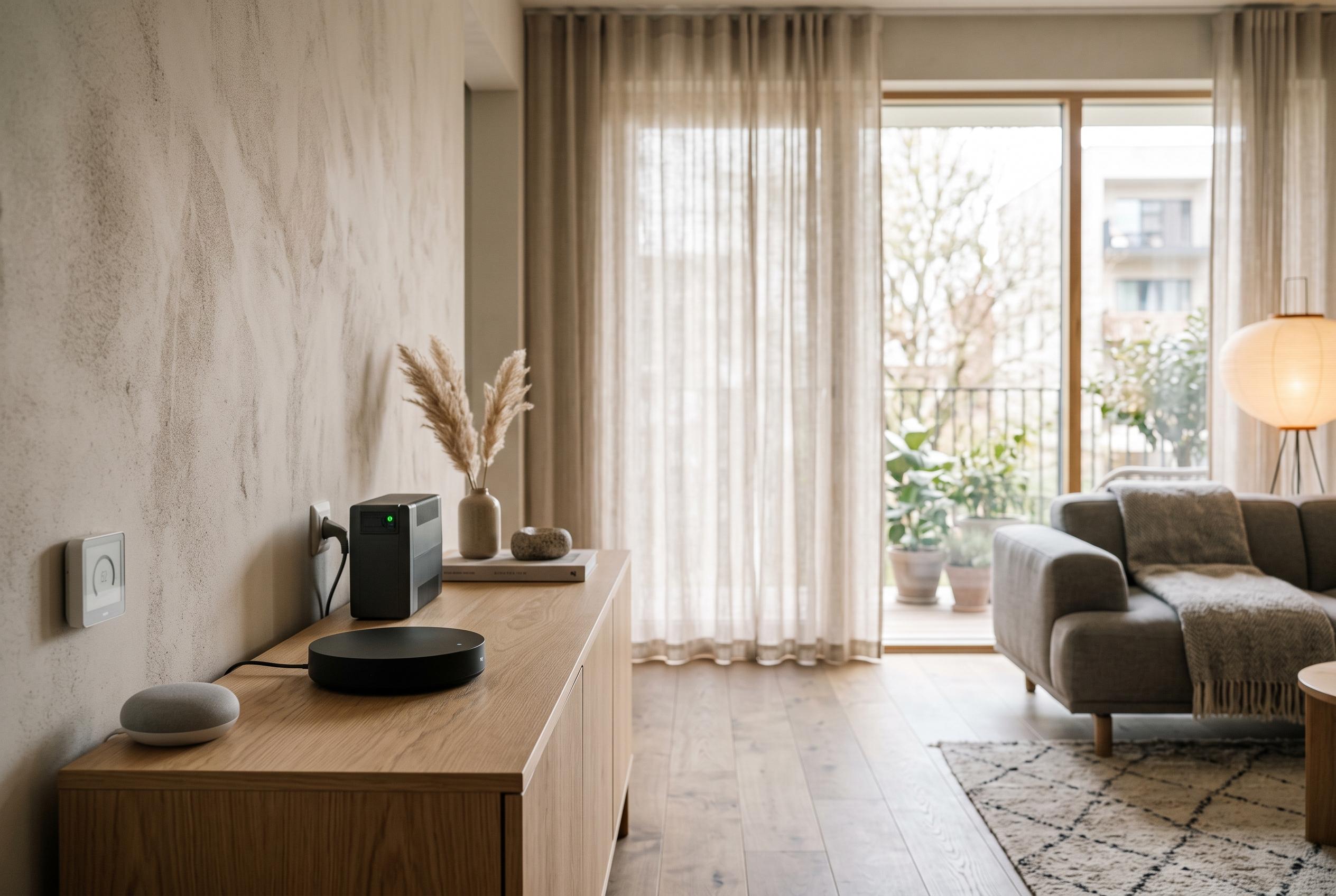

While UPS units protect essential hardware from power outages, achieving a truly resilient smart home demands automations that can recover gracefully from interruptions and re-establish intended states after outages.
An APC Back-UPS Pro Gaming unit can protect a home lab from a brief mains interruption, but it cannot by itself make a smart home resilient. In a setup where Home Assistant runs as a virtual machine on a Proxmox server, the appeal of a battery-backed UPS is obvious: the controller stays alive, the network stack stays powered, and a short brownout does not bring the whole system down. That still leaves a basic weakness. The lights, plugs and hubs being managed usually sit on ordinary wall power, so they can disappear even while the automation engine remains online.
That distinction matters because most Home Assistant routines are written as one-shot instructions. A schedule fires, a command is sent, and the system assumes the device received it. If the target is unavailable, the action can fail and never be retried. Home Assistant’s own documentation warns that triggers using a “for:” delay do not survive a restart or an automation reload, and that delay-based sequences can be interrupted in the same way. The platform’s trace tools are useful for diagnosis, but they do not change the underlying problem: an automation that depends on a single moment in time can miss its chance permanently.
A practical test makes the point. In the example described, a lamp on an Eve Energy smart plug was used with two automations: one that simply turned it on at 9 p.m., and another that could also act when Home Assistant restarted or when the plug returned from an unavailable state. When the plug was pulled, Home Assistant continued to believe it was present for several minutes. The scheduled automation fired on time, sent its command, then failed once the device did not answer. By the time the plug came back, the original trigger had passed and nothing else happened. The lamp stayed off.
The second automation behaved differently because it checked for recovery as well as time. Once the plug reappeared in an off state, the rule that watched for the device returning from unavailability fired, the time condition still matched, and the lamp switched on almost immediately. That suggests a better pattern for resilient automations: describe the state the house should have now, not just what should happen at a single moment. In practice, that means combining schedule triggers with Home Assistant startup and device-return triggers, then adding a condition that confirms the action is still relevant before it runs.
Other details help as well. Long delays are better replaced with timer helpers that restore state after a restart. Devices should have their power-on behaviour set deliberately, rather than left on the default. The modem, router and switch should be on the UPS too, because a powered controller is not much use if the network is down. Local protocols such as Matter, Zigbee and ESPHome also reduce dependence on external services, while the Network UPS Tools integration can help Home Assistant recognise when mains power returns and run a catch-up pass. The broader lesson is simple: a UPS is valuable, but the more important fix is writing automations that recover cleanly after outages.
Disclaimer: This content is intended for informational purposes only. Readers are advised to exercise their own judgement, conduct due diligence, or consult a qualified expert before acting on any information provided.