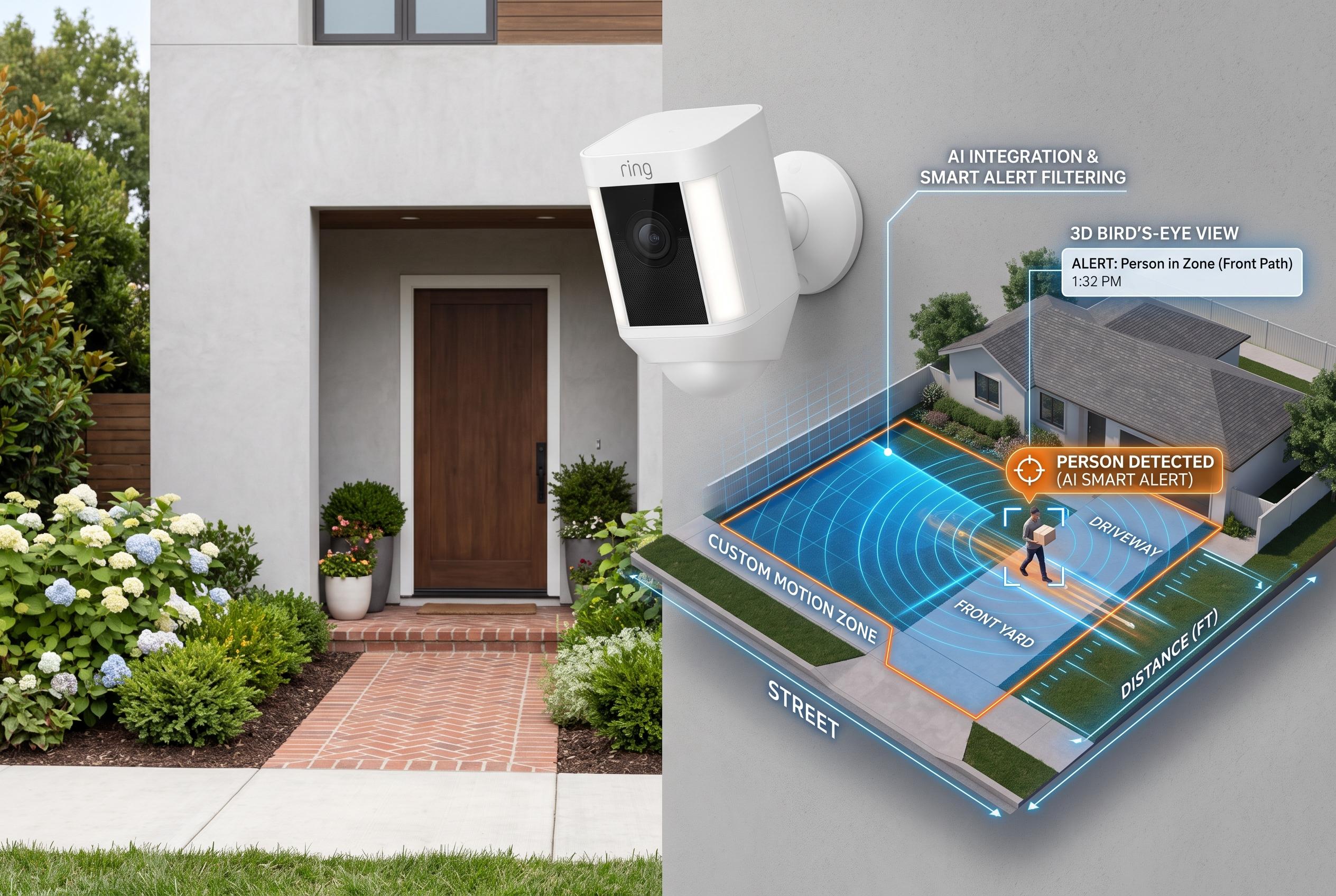

Ring’s new Bird’s Eye Zones feature utilises radar, computer vision, and AI to reduce alert noise by allowing customised motion detection zones, reflecting a broader shift towards context-aware home security systems.
Bird’s Eye Zones is Ring’s answer to a familiar problem in home security: too many alerts, and too little distinction between harmless movement and meaningful activity. The feature uses radar, computer vision and AI to narrow what a device treats as relevant motion, so users are not flooded with notifications about passing cars, trees in the wind or routine street activity. Ring’s support material says the system is available on selected doorbells and cameras, and can be tuned through the app by drawing custom zones and setting privacy exclusions.
The underlying method is not simply motion sensing, but layered interpretation. A patent for “Techniques for Implementing Customized Intrusion Zones” describes how a system can combine radar and camera data to locate objects, map their position and decide whether to raise an alert based on user-defined areas. That approach is designed to separate raw detection from contextual judgement, which is what gives Bird’s Eye Zones its practical value.
According to the account published by WhatGadget, Illia Bondariev, a technical product manager at Amazon Ring, framed the feature as more than another detection tool. The emphasis, he said, is on building a system that lets homeowners define what matters in their own environment, while the platform handles the technical complexity in the background. That design choice matters because consumer security products fail quickly when users are forced to interpret sensor data themselves.
Ring’s own guidance underlines the user-facing side of the feature. It recommends placing devices at the right mounting height, adjusting Bird’s Eye Zones to match the property layout and using privacy zones to block out areas that should not be monitored. That makes the system easier to manage, but it also shows how heavily it depends on proper configuration rather than on detection alone.
The broader market is moving in the same direction. AI-driven camera systems from companies such as InstaVision and EyeX are also built around filtering noise and focusing attention on events that matter, while ViSense describes a wider class of physical AI platforms that fuse wave-based sensors with real-time inference. In automotive systems, too, researchers have explored bird’s-eye radar annotation to improve object detection and scene understanding. Taken together, these developments point to a clear shift: the value is no longer in sensing motion alone, but in turning multiple data streams into a decision that is both fast and understandable.
Disclaimer: This content is intended for informational purposes only. Readers are advised to exercise their own judgement, conduct due diligence, or consult a qualified expert before acting on any information provided.