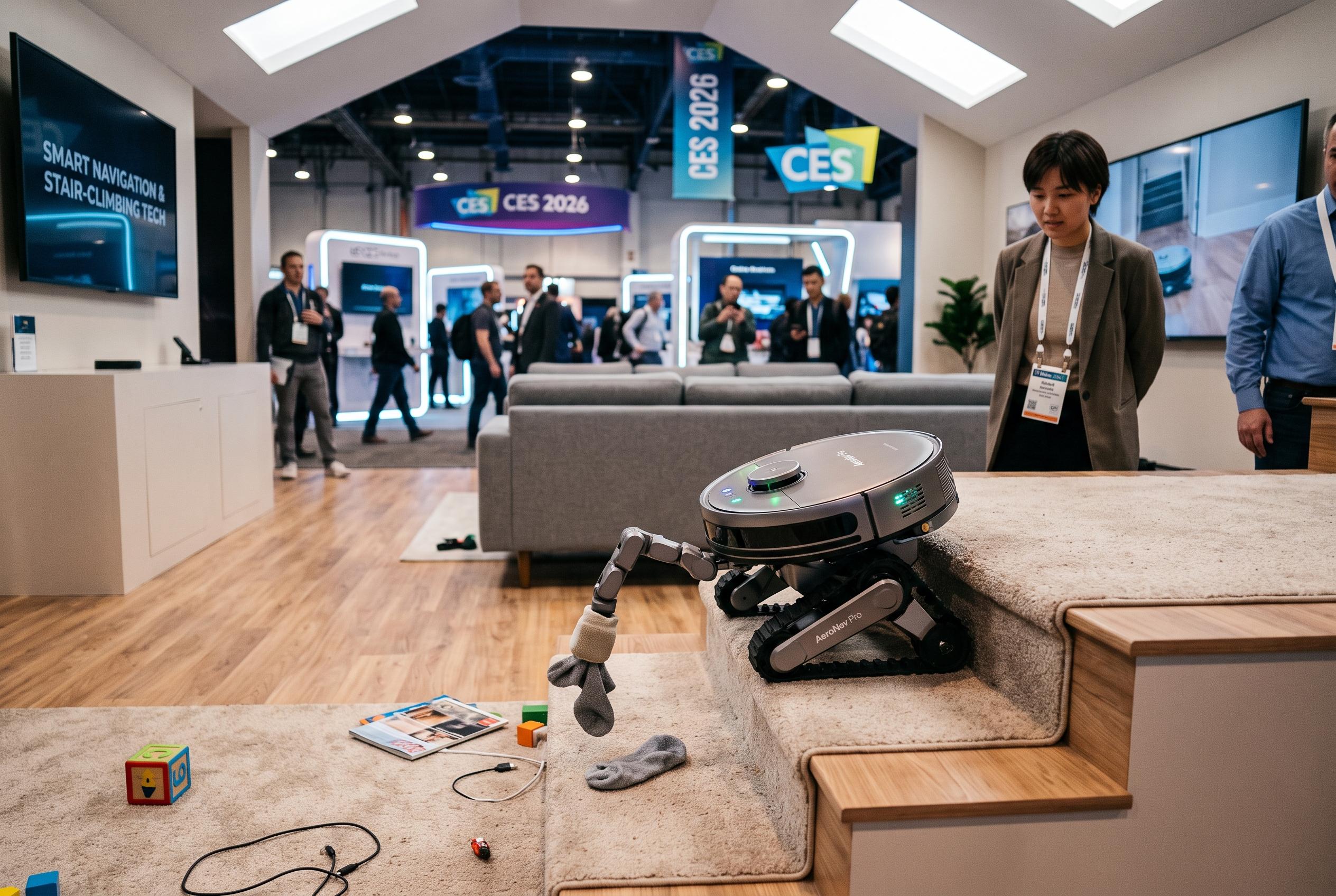

Innovations showcased at CES 2026 reveal robotic vacuums that can climb stairs, handle clutter, monitor pets, and navigate low furniture, marking a significant leap in domestic automation.
Robot vacuums are moving well beyond basic floor cleaning. Manufacturers are now building machines that can climb stairs, pick up clutter, monitor pets, talk to users in natural language and slip under low furniture, reflecting a push to make them more autonomous in real homes rather than simply smarter on paper.
The most ambitious development is stair climbing. At CES 2026, Roborock unveiled the Saros Rover, a concept that uses articulated, wheel-mounted legs to rise over steps and continue cleaning on different levels. According to TechSpot and other CES reports, the design is intended to tackle one of the biggest limits in domestic robotics: multi-storey homes and uneven transitions between rooms. Roborock has also been working on robots that can clear high thresholds, while other brands, including MOVA, have pushed that figure to around 8 cm in some models.
Another major step is object handling. Roborock introduced the Saros Z70 at CES 2025, described by TechAdvisor as the first robot vacuum with a robotic arm for lifting small items such as socks, tissues, pet toys and light shoes. The arm, called OmniGrip 1.0, uses five-axis movement to extend, rotate and reposition clutter so the robot can continue cleaning. That kind of system reduces one of the most common reasons a vacuum gets stuck: everyday objects left on the floor.
Camera systems are also becoming more useful. Samsung, Roborock and Ecovacs are among the companies adding infrared sensing and HD RGB cameras so the device can act as a pet monitor when the owner is away. Users can view a live feed, receive alerts and, in some cases, speak to animals through the app. At the same time, voice controls are becoming more flexible as LLM-based processing reaches consumer robots, allowing commands in more natural language rather than fixed phrases.
A quieter but practical improvement is the retractable LiDAR tower. Xiaomi and MOVA have both used low-profile navigation modules or folding sensor systems so the robot can pass beneath beds, sofas and other low furniture. Xiaomi’s Robot Vacuum 5, for example, is reported to be under 9.5 cm tall thanks to its dToF navigation module. For many households, that may matter more than headline-grabbing features: it lets the machine clean spaces that earlier models simply could not reach.
Disclaimer: This content is intended for informational purposes only. Readers are advised to exercise their own judgement, conduct due diligence, or consult a qualified expert before acting on any information provided.