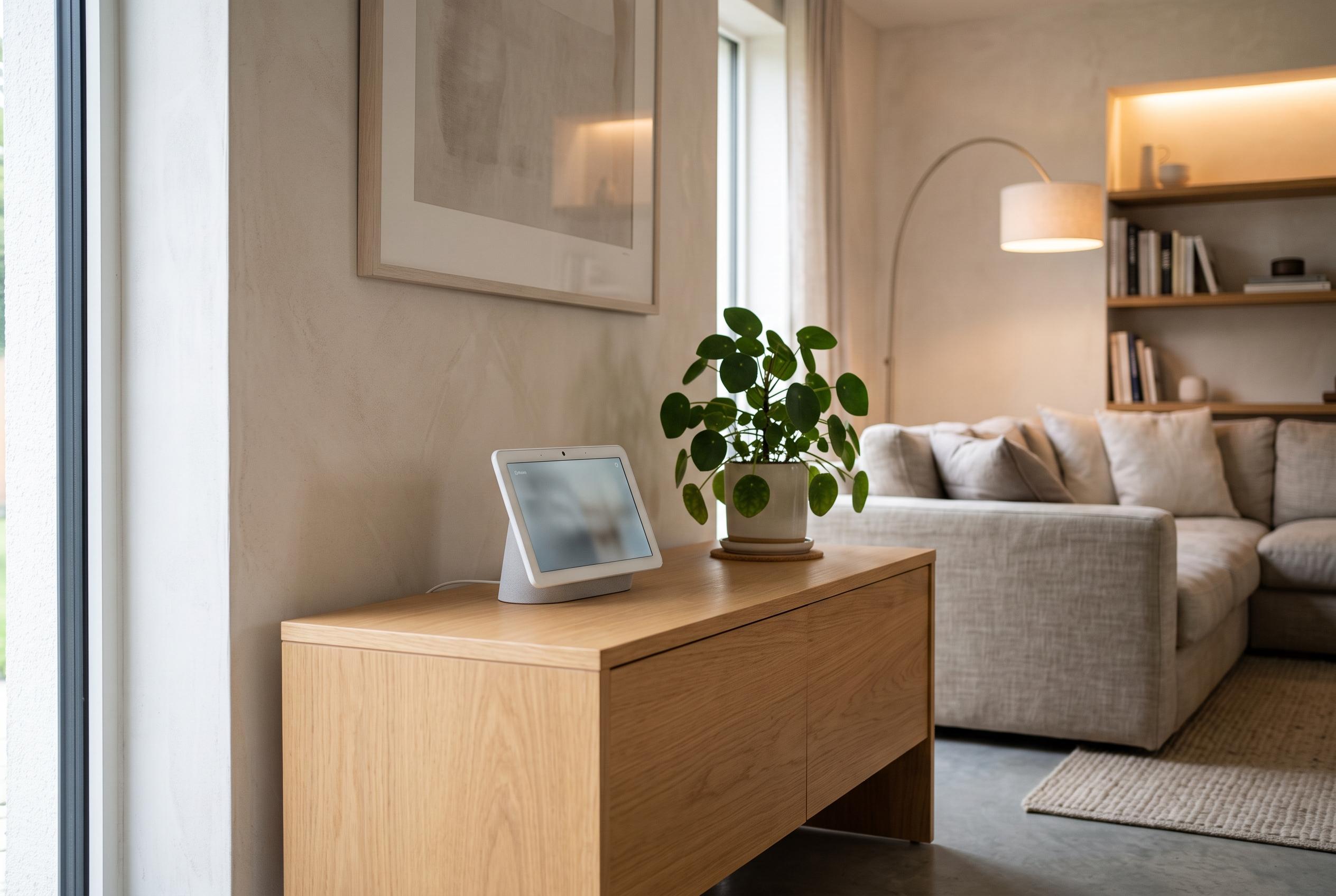

Beginners in home automation are advised to prioritise systems that address genuine nuisances, remain dependable despite failures, and remain transparent to users, rather than chasing endless device connections and complex setups.
The smartest lesson for beginners in home automation is not how to connect more devices, but how to leave many of them alone. Across consumer guides, policy research and academic studies, the same pattern appears: the useful smart home is the one that addresses a clear point of friction, survives failure gracefully and remains legible to the people living in it. Systems built mainly because they are possible, rather than because they solve a problem, tend to accumulate complexity faster than value.
That matters because the market has spent years selling the opposite idea. An OECD report on the smart home said connected devices are marketed on promises of convenience, control, comfort, customisation, security and entertainment, as well as energy savings. The same report described smart products as working alone, as part of a wider system such as heating and cooling, or across system boundaries so that, for example, security devices and lighting interact. Citing Cisco forecasts, it noted that smart-home machine-to-machine connections were expected to rise from 2.4 billion in 2015 to 5.8 billion by 2020, driven by cheaper components, broader connectivity and more advanced data analysis. In other words, the industry made it increasingly easy to add intelligence to almost anything in the house.
What is harder is building a system that remains dependable. Ars Technica argued on 31 March 2021 that Home Assistant had become a credible answer for people who wanted local control rather than a stack of incompatible brand silos. At the time, the open-source platform had more than 1,700 integrations, and its commercial backer, Nabu Casa, offered an optional $5-a-month subscription to simplify remote access and voice assistant support. That article made a distinction beginners often miss: cloud tools can be helpful, but they should be “an extension of your smart home, not the core of it”. The trade-off, Ars Technica noted, is that self-hosting swaps convenience for maintenance, asking users to spend more of their own time and effort in exchange for greater control over data and uptime.
That logic changes what counts as a good automation. Ars Technica’s practical example was not a theatrical morning routine or a house that talks back, but a simple synchronisation of two hallway lighting circuits so that one light follows the other. That is a useful rule of thumb: automate awkwardness, distance or repetition, not ordinary actions that already take one second and rarely go wrong. If a switch is easy to reach and everybody understands it, replacing it with a network dependency, a battery-powered sensor and another layer of software may be a downgrade disguised as innovation.
The costs also grow in ways product pages often minimise. Tom’s Guide wrote on 17 June 2025 that camera storage subscriptions can start at about $3 a month for a single device and increase quickly once more cameras are added. Professional monitoring for DIY security systems typically costs around $19 a month if users want authorities contacted automatically. Some router makers now sell security subscriptions for connected devices, with plans reaching roughly $100 a year. Tom’s Guide pointed to locally storing systems such as Eufy as an alternative with higher upfront prices but lower long-run fees. The headline purchase, in other words, is often only the opening payment.
Even technically confident users run into another problem: configuration burden. A 2024 arXiv preprint examining Home Assistant community discussions found that researchers had to inspect 190 threads about automation configuration, and 129 of those cases, or 68 per cent, were about debugging. The authors said many users struggle to create YAML files correctly because of device diversity and configuration complexity, with the result that smart homes may not work as expected. Existing tools, they added, could detect at most 14 of the issues they examined and fix none. That is strong evidence that unreliable automation is not just a beginner’s complaint; it is a recognised engineering problem.
Failures can also be remarkably opaque. In a 2019 paper, University of Washington researchers found that none of the seven smart-home platforms they tested alerted users when a device became unavailable, even though that missing device might be essential to an automation. They also reported that Vera marked an automation as failed when an actuator did not respond, while SmartThings and Philips Hue incorrectly showed the automation as successful. Apple Home, the researchers wrote, showed no status or log of previously run automations, leaving users unaware that anything had gone wrong. The same paper warned that poorly designed access control can give one occupant more power over the home than others, turning a technical hobby into a household governance problem.
That social point has been in the literature for much longer than the current crop of hubs and assistants. A Carnegie Mellon paper from 2006 argued that home routines are often improvisational and represent “constantly shifting targets”. It added that “exceptions to routines are actually not exceptional”, meaning a rigid system will keep misreading real family life and interrupting it at the wrong moments. People swap chores, arrive late, host guests, change school schedules, forget things and recover on the fly. Any home automation that assumes perfect repetition is being designed for a fiction.
For beginners, the practical conclusion is simple. Choose the automation that removes a real nuisance, still works when one component fails and can be understood without a guided tour. Prefer local control where possible. Count the subscription and replacement costs before buying the hardware. Keep manual fall-backs obvious. And if an idea is clever but brittle, the better decision is usually not to build it at all.
Disclaimer: This content is intended for informational purposes only. Readers are advised to exercise their own judgement, conduct due diligence, or consult a qualified expert before acting on any information provided.